
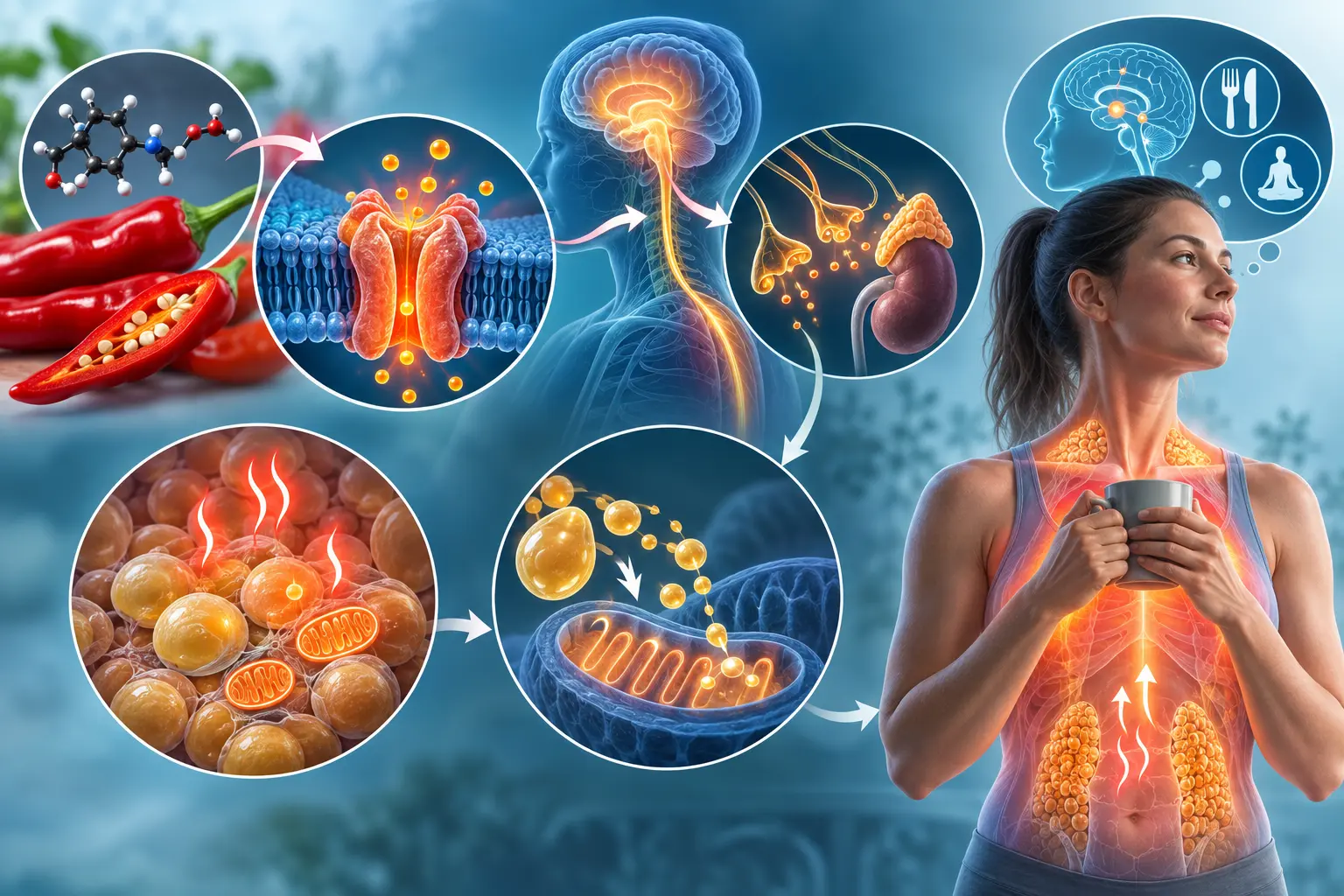
TRPV1 begins the hypothesis
Capsaicin activates transient receptor potential vanilloid 1, a channel involved in heat and irritation sensing. Researchers then examine sympathetic signaling, catecholamines, brown adipose tissue, substrate oxidation, appetite, and expenditure. This sequence creates a plausible mechanism for testing.
It does not allow a shortcut from receptor activation to kilograms lost. Each step can be small, temporary, variable, or offset elsewhere in daily energy balance.
Know what the instrument measured
Indirect calorimetry estimates energy expenditure and substrate use from respiratory gases. Resting metabolic rate, post-meal thermogenesis, respiratory quotient, and fat oxidation are related but distinct endpoints. A lower respiratory quotient does not prove net body-fat loss if total intake offsets oxidation.
A meta-analysis has reported a modest pooled increase in resting metabolic rate. Put that average beside daily food variation and possible behavioral compensation before calling it meaningful.
The body and behavior do not stay frozen
People may become accustomed to pungency, change portions, move less, sleep differently, or stop a product because of gastrointestinal symptoms. Extrapolating one laboratory session across months assumes those responses do not occur.
Longer trials with body-composition outcomes deserve more weight than a single calorimetry curve. Record both the acute signal and the downstream behavior it is supposed to improve.
Example: converting a daily estimate into a promise
A review reports a small average rise in resting expenditure. Marketing multiplies that number by 365 and converts it into predicted fat loss. The calculation assumes a constant response, perfect adherence, no intake change, no metabolic adaptation, and no measurement error.
A responsible interpretation reports the observed endpoint and uncertainty. It does not convert a brief group average into a guaranteed annual result.
Use an evidence ladder, not an ingredient-name shortcut
- Identity. Confirm the species or chemical, extract, standardization, active amount, serving, and maximum day.
- Mechanism. Cell, receptor, or animal findings explain what researchers might test; they do not establish weight loss in people.
- Acute human response. A short change in heat production, respiratory quotient, appetite rating, or energy expenditure is still not a multi-week body-composition result.
- Clinical outcome. Prefer randomized trials reporting body weight, waist, or fat mass for a relevant duration and population.
- Finished product. Require evidence on the sold combination before assigning an ingredient result to the bottle.
Record funding, sample size, dropouts, comparator, co-interventions, adverse events, and whether the result was prespecified. Statistical significance does not answer whether the average difference is large enough to matter.
Run a label-to-study match
Copy the complete Supplement Facts panel and calculate daily exposure. “Pepper extract,” “thermogenic matrix,” or a proprietary-blend total cannot be matched to a trial using a defined compound. Check whether the paper tested food, a purified ingredient, a whole botanical extract, or a multi-ingredient formula. These are separate evidence objects.
Then compare dose, duration, population, fed or fasted conditions, caffeine and exercise. Mark every mismatch rather than averaging them away. A transparent label makes review possible; it does not prove effectiveness, purity, or safety. Third-party quality testing can support identity and contamination control but cannot validate a weight-loss claim.
Use a four-week decision system
Week 0: define one job and establish baseline weight averages, waist, diet adherence, activity, sleep, appetite, and digestion. Weeks 1–2: if professional review permits use, change only the supplement and follow the labeled dose. Weeks 3–4: compare the predefined outcome with baseline, including side effects and cost. Decision: stop when benefit is unclear, too small, or offset by discomfort, sleep loss, anxiety, palpitations, or worse adherence.
A personal trial cannot establish causation or detect uncommon harm. Do not escalate the dose to chase warmth, sweating, or the first-day sensation. Stop and seek appropriate help for chest pain, fainting, severe palpitations, breathing difficulty, a serious allergic reaction, persistent vomiting, or severe abdominal pain.
Make the result auditable
Before day one, write a one-sentence prediction: what should change, by how much, and by what date? Use a seven-day morning-weight average rather than a single reading, and measure waist at the same landmark, time, posture, and breathing phase. Record calories or the same structured meal plan, steps, planned training, sleep duration, caffeine, alcohol, menstrual-cycle context when relevant, bowel changes, and every missed serving. A simple daily note is more useful than a complicated dashboard that is abandoned.
Choose one primary outcome and two guardrails. For example, the primary outcome could be waist change after four weeks; the guardrails could be sleep quality and digestive comfort. Predetermine a minimum useful difference that justifies the price and inconvenience. Compare averages only after enough consistent observations, and do not interpret a hot meal, one energetic workout, or an overnight scale drop as confirmation.
If food intake, activity, or another supplement changes midway, mark the trial as confounded instead of crediting the thermogenic. Repeat only if doing so is safe and genuinely useful. Keep the package, lot number, label photograph, dates, dose, and any adverse-event notes. This system cannot turn a self-test into clinical evidence, but it can prevent memory, expectation, and normal water fluctuation from becoming a false success story.
Where Fat Burn Active fits
A pepper-related component in Fat Burn Active would require a defined active dose before thermogenesis research could be matched. An acute pathway still would not prove the finished product causes meaningful fat loss.
Fat Burn Active is optional and not required for fat loss. Ingredient plausibility cannot substitute for finished-product evidence, a complete dose match, or a sustainable calorie deficit. Sensation, sweating, appetite suppression, and short-term water change do not prove meaningful fat loss.
Fat Burn Active is relevant to Capsaicinoids and Thermogenesis because its official listing identifies standardized plant extracts, caffeine sources, vitamins, and zinc in one formula. First read our independent review. If the formula, stimulant profile, evidence limits, and warnings fit your situation, check the current formula and purchase options on the official Fat Burn Active website. We may receive a commission at no additional cost.
Safety boundaries
Ask a clinician or pharmacist before using concentrated thermogenic ingredients if you are pregnant or breastfeeding, under 18, have an eating-disorder history, reflux or gastrointestinal disease, high blood pressure, heart-rhythm disease, anxiety, glaucoma, liver or kidney disease, diabetes, or take medicines. Do not stack fat burners, exceed directions, or combine a formula casually with pre-workout and energy drinks.
Food-level use and concentrated extracts are not interchangeable. Novel compounds and proprietary standardized extracts may have conditions of use that do not apply to every market or formulation. Regulatory authorization under specified conditions is not proof of weight-management efficacy and is not a personal medical clearance.
Frequently asked questions
What is thermogenesis?
It is heat production; studies may infer it through measured energy expenditure.
Does more fat oxidation mean fat loss?
Not necessarily. Net fat change also depends on storage and total energy balance over time.
Are capsinoids capsaicin?
They are related compounds, not interchangeable doses.
Sources
- NIH ODS: Dietary Supplements for Weight Loss
- Capsaicinoids and thermogenesis meta-analysis
- Capsaicin and capsiate energy-balance review
- Capsinoids, expenditure and lipid oxidation trial
Sources reviewed September 14, 2026. This article is general educational information, not medical advice, diagnosis, or treatment.