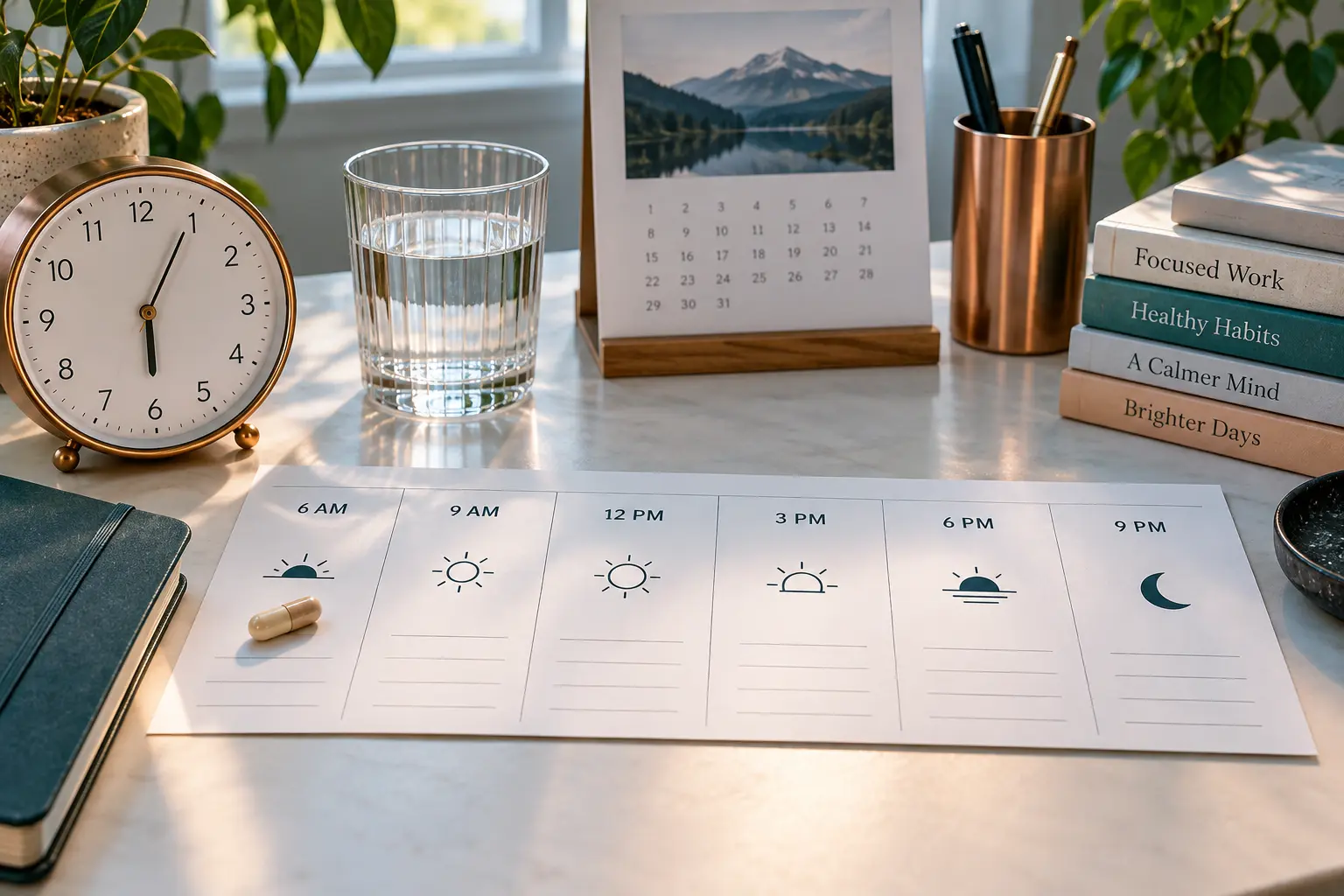
The decision order matters more than the clock
Search results commonly recommend “first thing in the morning” or “30 minutes before training,” but those rules often come from supplement sellers and ignore the formula, dose, bedtime, meals, and individual sensitivity. Timing cannot rescue a weak formula or create a calorie deficit on its own.
Morning is common, but not automatically optimal
Morning use can reduce the chance that caffeine remains active near bedtime and makes exposure easier to track. It may suit someone who trains early or wants to avoid an afternoon serving. It is not automatically suitable for a person who skips breakfast when the product says not to use it on an empty stomach.
“Morning” is also relative. A night-shift worker who sleeps at noon should plan from intended sleep, not from sunrise. The safest useful reference points are wake time, first tolerated meal, exercise, and bedtime—not a generic 8 a.m. recommendation.

Training time is a secondary decision
Caffeine research often tests ingestion before exercise, and a sports-nutrition position stand notes that 60 minutes before exercise is the most common research timing. That evidence concerns exercise performance and caffeine, not proof that any multi-ingredient fat burner produces greater long-term fat loss when taken before training.
If training occurs late, protecting sleep may be more valuable than seeking an acute stimulant effect. A morning serving can still be used on a training day if the label permits; the supplement does not need to coincide with every workout to “activate” fat loss.
What about rest days?
First ask why the product is being used. If the intended benefit is workout alertness, a rest-day dose may add exposure without serving that purpose. If the label describes daily use, consistency may be part of the manufacturer’s directions, but it does not prove a cumulative finished-product effect.
Do not double the next day after a missed serving. Do not move a forgotten serving into the evening when it threatens sleep. Follow the bottle and contact the manufacturer or a pharmacist when instructions are unclear.
Timing mistakes that create more risk than benefit
- Taking the capsules fasted despite an instruction to use food.
- Using coffee or pre-workout because the supplement “did not kick in.”
- Moving the dose later to suppress dinner appetite.
- Interpreting jitters, sweating, or a faster pulse as effectiveness.
- Increasing the serving when tolerance develops.
- Ignoring a changing bedtime, shift schedule, medication, or health condition.
The best schedule is deliberately boring: label-compliant, early enough for sleep, compatible with food, and stable enough to judge.
Three schedules—and three different answers
Consider an early exerciser who eats breakfast at 7 a.m., trains at 8:30, and sleeps at 10:30 p.m. A label-compliant serving with breakfast leaves a long sleep buffer and avoids fasting. Now consider an office worker who trains at 7 p.m. Taking the same stimulant before training may enter the sleep-risk window; an earlier serving or no stimulant is more defensible. Finally, a night-shift worker who sleeps from noon to 7 p.m. should not copy a daytime clock. A 9 a.m. serving is late relative to that person's sleep even though it looks like “morning.”
These examples show why product type alone cannot determine timing. The decision changes with the actual bedtime, food instructions, daily caffeine, and reason for use. It also changes when the person becomes ill, starts a new medicine, develops insomnia, or moves training. Recheck the schedule instead of treating the first choice as permanent.
Use a simple rule when competing goals appear: protect safety and sleep first, follow the label second, support the established meal or exercise routine third. Any claimed thermogenic advantage belongs after those gates, because its practical effect is uncertain and cannot compensate for a schedule that undermines recovery.
Build a timing routine you can actually evaluate
Write down the product, serving, every caffeine source, meal time, training time, bedtime, medicines, and the reason for taking the supplement. Then choose one consistent schedule for at least several comparable days. Record sleep onset, awakenings, morning alertness, appetite, stomach symptoms, training quality, resting heart rate or blood pressure when clinically appropriate, and any adverse effects. A warmer feeling, more sweat, or a stronger buzz is not proof of more fat loss.
Change only one timing variable at a time. If you move the serving earlier while also cutting coffee, changing meals, and adding exercise, you cannot tell which change improved sleep or comfort. Use a predefined stopping rule: stop and seek appropriate advice for chest pain, fainting, severe palpitations, marked shortness of breath, or other concerning symptoms. Persistent insomnia, anxiety, nausea, tremor, or headache also deserves action rather than dose escalation.
The outcome that matters is whether the complete plan remains sustainable. A supplement that makes one workout feel easier but damages sleep, increases next-day hunger, or encourages higher stimulant intake may work against the larger goal.
How this applies to Fat Burn Active
The current official page directs adults to take two capsules with 300 ml of water, preferably before a meal or training, and specifically says not to consume the product on an empty stomach. It lists 76 mg caffeine anhydrous and guarana standardized to an estimated 44 mg caffeine, so the known minimum is 120 mg per serving. Green-tea caffeine is not quantified, and the formula also supplies bitter-orange extract standardized to 6 mg synephrine.
The manufacturer cautions against use with other caffeine sources or ingredients with a similar effect. That makes a coffee, energy drink, caffeinated medicine, or pre-workout part of the same timing decision—not an unrelated beverage. Follow the delivered label if it differs from the website and ask the manufacturer to clarify the all-source caffeine total.
Fat Burn Active is most defensible as an optional stimulant-containing formula used according to its directions—not as a clock-based shortcut. Its exact all-source caffeine remains an important question.
Fat Burn Active is relevant to When Should You Take a Fat Burner? because its official listing identifies standardized plant extracts, caffeine sources, vitamins, and zinc in one formula. First read our independent review. If the formula, stimulant profile, evidence limits, and warnings fit your situation, check the current formula and purchase options on the official Fat Burn Active website. We may receive a commission at no additional cost.
Frequently asked questions
Is morning always the best time?
No. It is common because it can protect sleep, but meals, work shifts, training and the label matter.
Can timing make a fat burner work better?
Timing may change tolerance or acute alertness. It does not prove greater long-term fat loss.
What if I miss a dose?
Do not double it or move it close to bedtime. Follow the product instructions.
Sources
- Fat Burn Active official formula and directions
- FDA: How Much Caffeine Is Too Much?
- NIH ODS: Weight-Loss Supplements
- ISSN position stand on caffeine and exercise
- Dose and timing effects of caffeine on sleep
Sources reviewed September 13, 2026. This article is general educational information, not medical advice, diagnosis, or treatment.