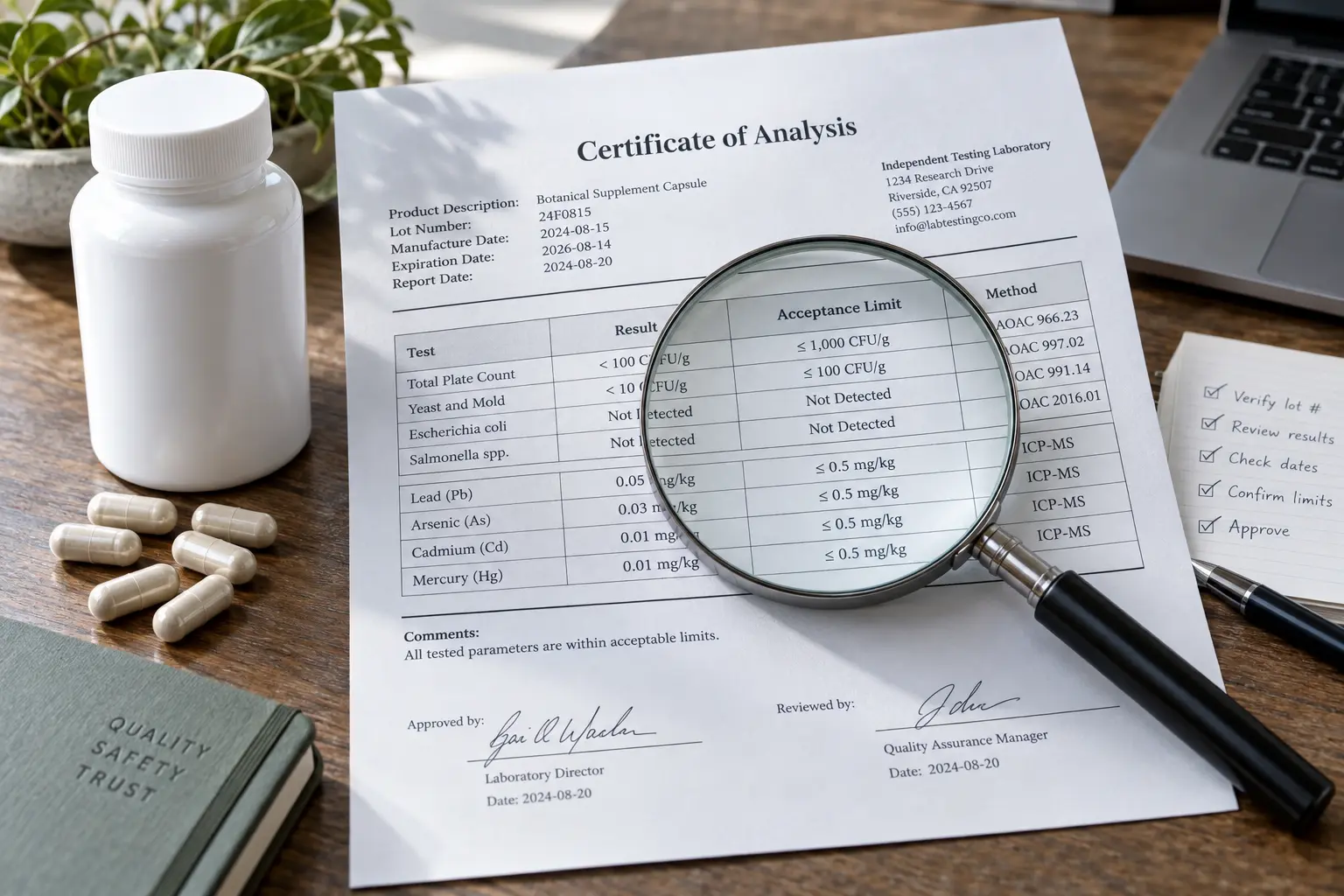
Start by matching the document to the bottle
Compare the exact product name, dosage form, flavor or variant, strength, package description, manufacturer, lot or batch code, and relevant dates. The report number should be unique, and the laboratory or issuing quality unit should be identifiable. If the COA describes only “botanical blend” while the bottle contains a finished multi-ingredient capsule, the connection is weak.
A raw-material COA may be authentic yet still fail to establish finished-product potency or contamination after blending and packaging. Write the sample type at the top of your review before reading the results.
Look for results, limits, and methods in the same row
Each test should identify what was measured, the method or method reference, the acceptance criterion, and the actual result. “Conforms” can be appropriate for some identity tests, but numerical assays and contaminants are more informative when the numeric result and units are reported.
Check units carefully: percent, milligrams per serving, milligrams per gram, parts per million, and colony-forming units are not interchangeable. A result has meaning only beside a specification that fits the product, serving, population, and applicable standard.
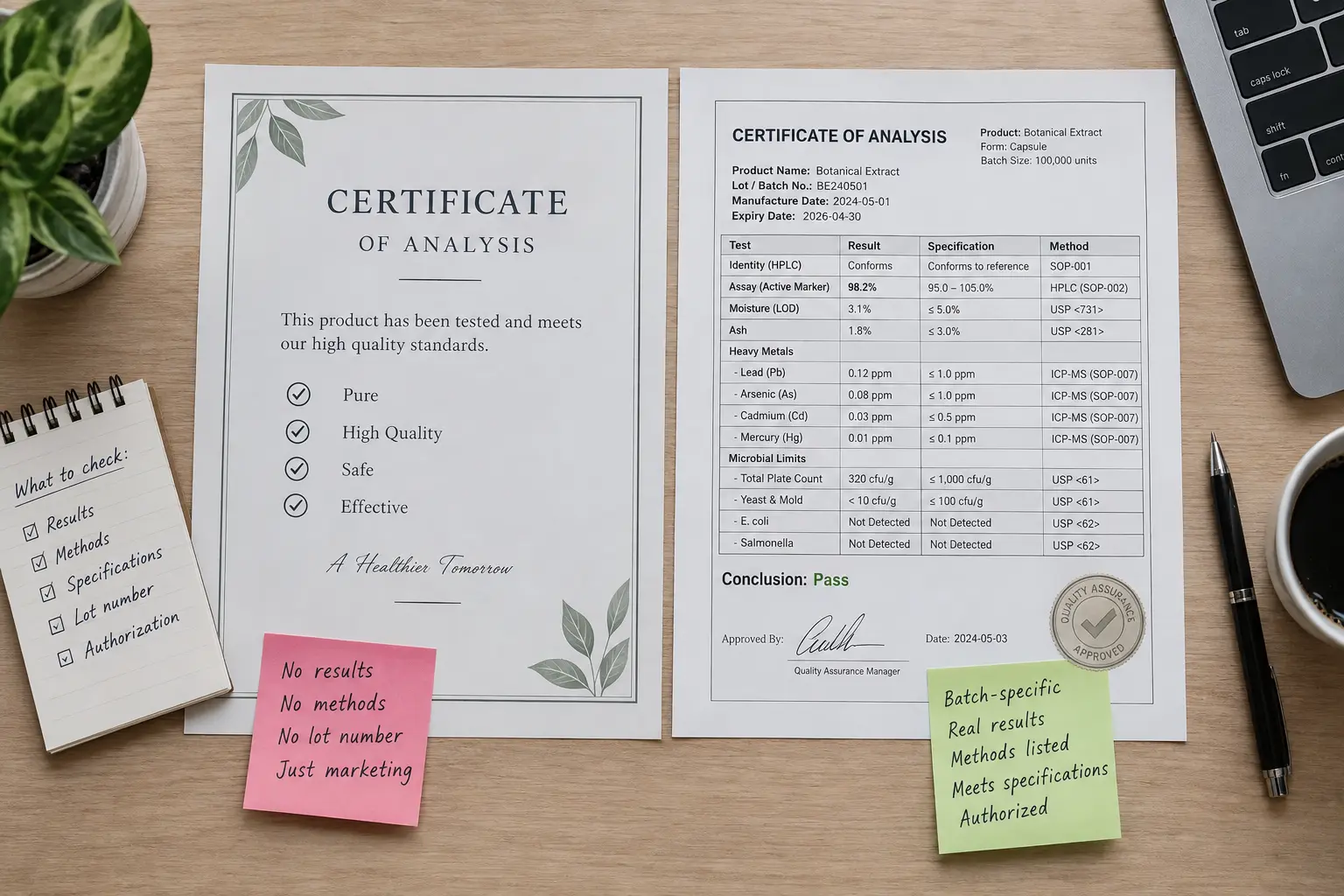
A COA is only as broad as its test panel
Do not interpret a short panel as a complete safety screen. The document cannot rule out hazards it did not test.
Check dates, signatures, and document control
Look for manufacture or receipt date, sampling date when available, test dates, report or release date, expiry or retest date when relevant, document version, and approval by authorized quality personnel. Electronic approval can be legitimate, but the issuer should be traceable and the document difficult to alter without detection.
Contact the laboratory using details found on its official website, not only those printed on a PDF. Ask whether it issued the report number and whether the result may be shared publicly. Laboratories may limit disclosure, but a forged or altered report should not survive this check.
COA red flags
- No lot or batch number, or one that differs from the bottle.
- No actual results, acceptance limits, units, or methods.
- A “certificate” created by the seller with no laboratory or quality unit.
- Identical results and dates reused across unrelated products.
- A raw-ingredient report presented as finished-product testing.
- Cropped pages, missing signatures, inconsistent fonts, altered fields, or impossible dates.
- Claims of purity or effectiveness that exceed the listed panel.
One red flag does not diagnose fraud, but it justifies direct verification and withholding trust.
Use a document-first buying system
- Capture the exact product. Save the product name, serving size, complete label, bottle count, seller, purchase date, lot code, expiry, and photographs of every panel.
- Define the claim. Write whether you are checking identity, potency, microbes, heavy metals, prohibited substances, facility controls, or finished-product performance. “Tested” is not a complete claim.
- Find the primary record. Use the certifier’s directory, laboratory accreditation scope, lot-linked report, FDA notice, or manufacturer response—not a marketplace badge.
- Match identifiers. Product name, form, strength, lot or batch, report number, and date must describe the bottle in hand.
- Read the scope. Record the sample tested, analytes, methods, specifications, numerical results, and who authorized release.
- Mark limits. State what the document does not test or prove, including clinical effectiveness and personal safety.
Keep the evidence as screenshots or PDFs because listings and formulas change. A transparent document can support one quality question; it cannot convert an untested outcome into proof.
Worked example: the badge that does not identify a product
A marketplace listing displays “GMP, third-party tested” beside an unbranded seal. The seller provides a polished certificate, but it names only a facility, contains no product or lot number, lists no methods or numerical results, and cannot be found in the named organization’s directory.
The correct conclusion is not that the supplement failed testing. It is that the claim cannot be connected to this bottle or to a defined testing scope. The buyer requests a lot-specific report and a verifiable directory entry. If the seller supplies only another marketing image, the uncertainty remains and the product should not receive an evidence credit.
Grade the evidence instead of calling it verified
Use four grades. Unverified means only a seller statement or badge is available. Facility-level means a current manufacturing or laboratory credential is authentic but not linked to the bottle. Product-level means an official directory or report identifies the exact product, though not necessarily the delivered lot. Lot-level means the bottle code matches a dated, authorized record with a defined sample, panel, methods, specifications, and results.
Higher traceability narrows uncertainty; it does not enlarge the claim. A lot-level heavy-metal panel still says nothing about appetite control, weight loss, or an untested adulterant. Write the evidence grade and the exact supported conclusion in one sentence. This prevents a genuine but narrow document from becoming a blanket “safe and effective” endorsement.
Where Fat Burn Active fits
A useful Fat Burn Active COA would need to match the delivered finished-product lot and disclose the relevant panel, methods, limits, and actual results.
Quality documentation and clinical effectiveness are separate. Even a genuine GMP record, certification, or certificate of analysis would not prove that Fat Burn Active causes meaningful weight loss. Our independent Fat Burn Active review separates label facts, ingredient evidence, dose relevance, safety, and finished-product evidence.
Use the Certificate of Analysis: What Buyers Should Look For criteria to assess Fat Burn Active rather than relying on a headline claim. Our formula evidence analysis explains the remaining uncertainty. If the product fits your needs, view current availability and ordering terms on the official website. We may earn a commission at no extra cost.
Quality checks do not replace safety review
A conforming batch can still be unsuitable for an individual. Review medicines, health conditions, allergies, pregnancy or breastfeeding, age, total stimulant exposure, and prior reactions with a clinician or pharmacist when relevant. Independent testing usually addresses specified product characteristics, not every interaction or uncommon adverse event.
Stop use and seek appropriate care for chest pain, fainting, breathing difficulty, a serious allergic reaction, severe confusion, jaundice, repeated vomiting, or a sustained racing or irregular heartbeat. Preserve the container, lot code, receipt, and remaining product for a report or investigation. Do not take another serving to reproduce a suspected reaction.
Frequently asked questions
Does a certificate prove that a supplement works?
No. Manufacturing and analytical documents address defined quality characteristics, not a clinical weight-loss outcome.
Is “third-party tested” meaningful without details?
Only weakly. Identify the organization, product, lot, testing scope, date, methods, and results before assigning value.
Can a company test its own product?
Yes, when it follows appropriate procedures and controls. Independence is a separate question from whether the method and sample were suitable.
What should I save after buying?
Keep label photographs, lot and expiry codes, receipt, seller identity, relevant reports, and the company’s written answers.
Sources
- 21 CFR Part 111
- FDA: Dietary Supplement cGMP Final Rule Backgrounder
- FDA: Q7A GMP Guidance—Certificates of Analysis
- ISO: ISO/IEC 17025 Laboratories
- USP: Dietary Supplement Verification Program
- FDA: Questions and Answers on Dietary Supplements
Sources reviewed September 16, 2026. This article is general educational information, not medical advice, diagnosis, or treatment.