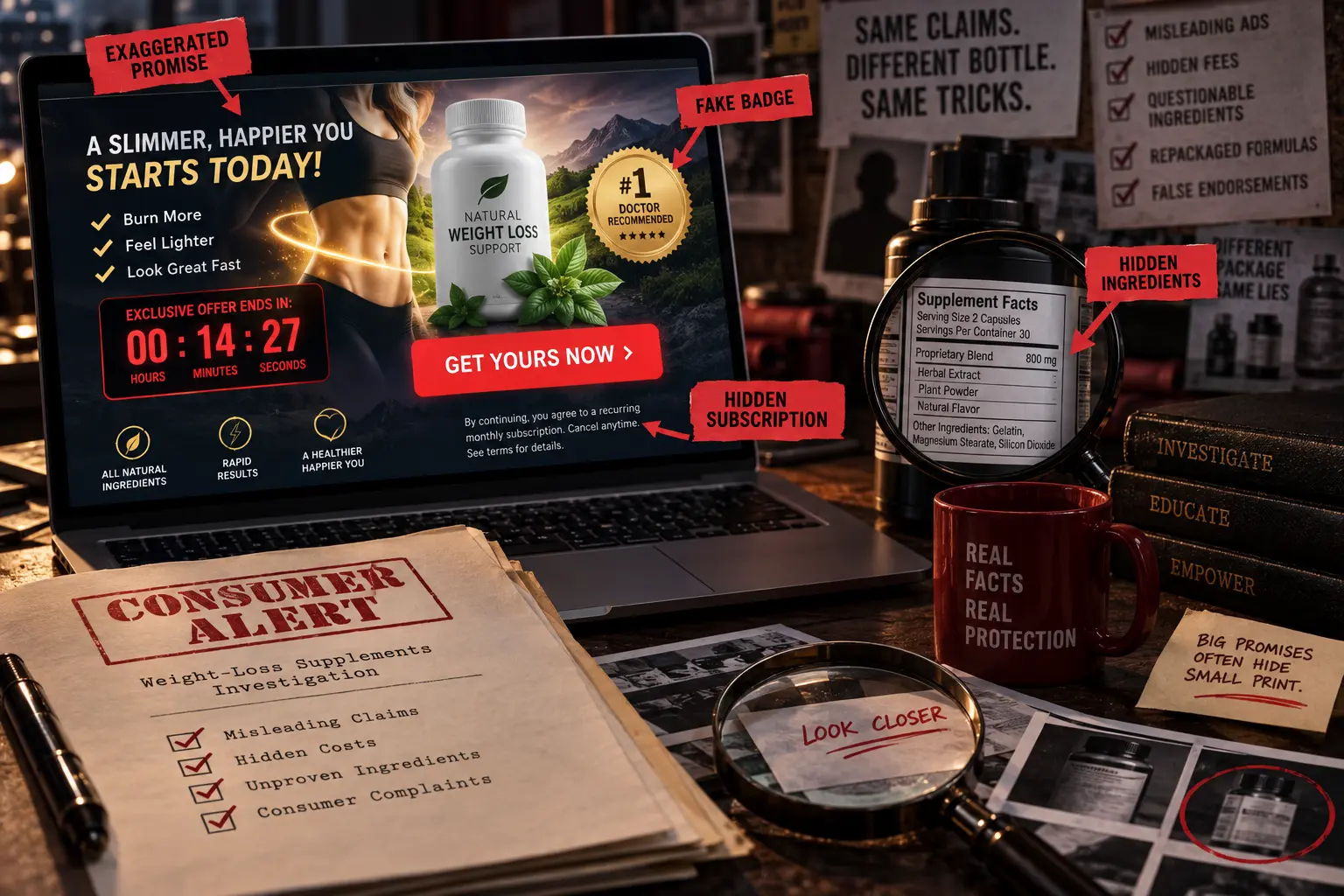
Red flag 1: guaranteed, rapid, or effortless results
Claims such as “melt fat,” “lose weight without diet or exercise,” “permanent results,” or a guaranteed number of pounds in a few days conflict with how body weight changes. Short-term scale movement can include water, glycogen, gastrointestinal contents, and lean tissue; it is not automatically body-fat loss. FTC guidance has long treated dramatic, easy weight-loss promises as an area requiring particular skepticism.
Also watch for precise outcomes presented without population, timeframe, diet, activity, adherence, or range. A single large number makes a strong advertisement but a poor forecast for an individual.
Red flag 2: a mechanism is sold as an outcome
“Supports thermogenesis,” “increases fat oxidation,” and “boosts metabolism” describe possible mechanisms or short-term measurements. They do not by themselves establish meaningful, sustained fat loss. Ask whether the cited human study measured body fat or weight over a relevant period, or only temperature, heart rate, appetite ratings, energy expenditure, or a laboratory marker.
Then ask whether the evidence tested the exact ingredient preparation and dose, the combination, or the finished product. A study on 300 mg of a standardized extract cannot validate a formula that hides the extract amount. Scientific vocabulary can make a gap less visible without closing it.
Red flag 3: borrowed badges and authority
Phrases such as “FDA approved,” “doctor recommended,” “clinically proven,” “pharmaceutical grade,” and “made in an FDA-registered facility” need precise support. FDA does not approve dietary supplements before they are marketed. Facility registration or compliance language should not be transformed into government endorsement.
Inspect seals. Legitimate third-party certification relates to defined testing or manufacturing criteria; it does not prove weight-loss effectiveness. Click the certifier’s own database rather than trusting a logo. A stock image of a person in a white coat is not a clinical endorsement.

Red flag 4: hidden label or incomplete stimulant disclosure
A sales page that displays lifestyle photos but no readable Supplement Facts panel asks you to buy before you can calculate exposure. Other warning signs include a proprietary blend that hides dose-sensitive ingredients, different serving sizes across sections, missing “other ingredients,” and caffeine described only as “natural energy.”
Request an all-source caffeine total and the maximum daily use. Check tea, coffee, guarana, mate, kola, and pre-workout overlap. Transparency does not prove effectiveness, but missing information blocks evidence matching, interaction review, and fair comparison.
Red flag 5: testimonials replace representative evidence
Before-and-after images, celebrity stories, and five-star reviews are emotionally vivid but vulnerable to selection bias, lighting, posture, editing, undisclosed diet and training, and formula changes. A disclosure such as “results may vary” does not automatically cure an otherwise misleading impression. FTC guidance expects endorsements to reflect honest experience and material connections to be clearly disclosed.
Look for typical-results data, timeframe, denominator, and what else participants changed. If only exceptional outcomes are shown, do not treat them as the expected result.
Red flag 6: fake scarcity and subscription friction
Countdown timers that reset, “only three left” notices that never change, surprise continuity plans, and preselected subscription boxes create pressure unrelated to product quality. Check the final price, billing interval, cancellation method, refund exclusions, shipping cost, and whether a “free trial” converts automatically.
Search the page for terms, returns, company identity, physical contact information, and customer-service route. A sound buying decision should survive a ten-minute pause. Urgency that prevents label or evidence review is itself useful information.
A five-minute claim audit
Copy the exact claim, including qualifiers and footnotes. Classify it as a label fact, mechanism, structure/function claim, health claim, testimonial, or outcome promise. Identify the evidence level and whether the tested product, dose, duration, population, and outcome match. Note funding, adverse events, dropout, and absolute effect size.
Then check FDA warnings, recalls, and tainted-product notices; confirm the seller and current label; and ask a clinician or pharmacist when medicines, pregnancy, surgery, or health conditions are involved. One red flag calls for verification. Several unresolved red flags justify walking away.
Safety and evidence still come first
Dietary supplements are not approved by FDA before marketing in the way drugs are. Read the complete current label and discuss it with a physician or pharmacist if you use prescription or over-the-counter medicines, have cardiovascular, liver, kidney, endocrine, psychiatric, sleep, or gastrointestinal conditions, are pregnant or breastfeeding, are under 18, or have surgery planned. Do not stop or change prescribed treatment to use a supplement.
Stop use and seek urgent care for chest pain, fainting, severe shortness of breath, seizure, confusion, a sustained fast or irregular heartbeat, a serious allergic reaction, or signs of liver injury such as yellow skin or eyes and dark urine. Insomnia, anxiety, tremor, palpitations, severe nausea, or unusual mood changes are adverse effects—not evidence that a fat burner is working.
Apply the same standard to Fat Burn Active
Fat Burn Active should be evaluated with the same rules as any other multi-ingredient weight-management supplement: use the current complete label, calculate the maximum daily exposure, identify stimulant sources, distinguish ingredient research from finished-product evidence, and review personal contraindications. The product name and marketing do not replace those checks.
If you want a practical example, read our independent Fat Burn Active review and the label checklist before buying. If the formula, evidence limits, safety profile, and seller terms remain acceptable, you can verify the current official label and purchase options. We may receive a commission at no extra cost to you.
Frequently asked questions
Does a disclaimer make a weight-loss claim trustworthy?
No. A disclaimer has a regulatory role but does not supply evidence or cancel a misleading overall impression.
Is “natural” a safety guarantee?
No. Natural substances can have pharmacologic effects, contamination risks, side effects, and medicine interactions.
Does third-party testing prove fat loss?
No. It may support identity, purity, or manufacturing claims within the program’s scope, not clinical effectiveness.
Keep a decision record
Save a small evidence file with dated screenshots, the full label, seller identity, support replies, the studies actually relied on, and your unresolved questions. Record why a claim was accepted, rejected, or left uncertain. This prevents a new advertisement, package redesign, or enthusiastic review from quietly replacing facts you already checked.
Revisit the record when the formula, dose, health status, medicines, caffeine intake, price, or seller changes. A buying decision is valid only for the version and circumstances reviewed. When a material fact cannot be verified, choosing a clearer product is a rational outcome—not a failure to finish the comparison.
Separate deal breakers from preferences before shopping. An undisclosed stimulant amount, a medicine interaction, a mismatched label, or an unverified seller can stop the decision. Flavor, capsule count, and delivery speed can be compared only after those gates are passed. This order prevents a discount or dramatic story from outweighing a safety-relevant unknown.
Practical decision checkpoint
Save a copy of a product claim and its linked citation before the page changes. Match population, formula, dose, and outcome line by line. “Clinically studied” can describe an ingredient or an unrelated blend; ask whether the finished product sold today was actually tested under comparable conditions.
Sources
- FDA: Questions and Answers on Dietary Supplements
- FDA Dietary Supplement Labeling Guide
- FTC Health Products Compliance Guidance
- FTC: Disclosures 101
- NIH Dietary Supplement Label Database
Sources reviewed September 19, 2026. Educational information only; not medical advice.