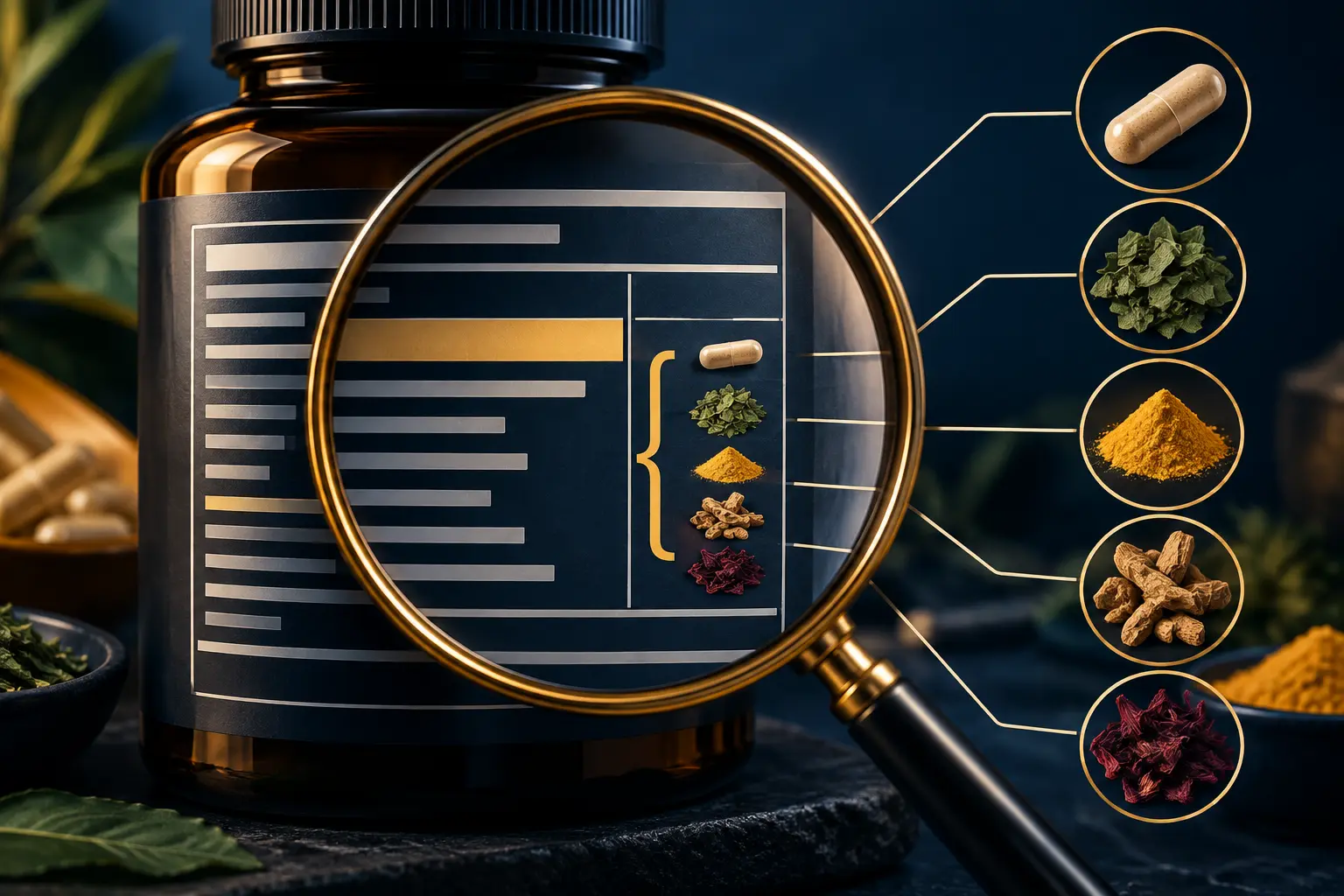
The three visual signs of a proprietary blend
First, the Supplement Facts panel shows a branded or generic group name such as “thermogenic matrix.” Second, one milligram or gram value sits beside that group rather than beside every ingredient. Third, several ingredients appear below or after the group name, often separated by commas or indented.
Do not rely only on the word “proprietary.” “Complex,” “matrix,” “support blend,” “delivery system,” and a trademarked formula can use the same disclosure pattern. Conversely, a branded ingredient with its own exact milligrams is not automatically a proprietary blend.
What the blend total tells you
Under U.S. dietary-supplement labeling rules, the blend's total weight per serving is declared, and the ingredients within it are listed in descending order by weight. Individual blend-component weights generally do not have to appear. The first ingredient therefore weighs at least as much as the second, but the gap could be tiny or very large.
If a 900 mg blend contains five ingredients, it does not provide 900 mg of each. Nor can you divide by five. Capsule capacity, order, and total may create mathematical boundaries, but those boundaries rarely establish a research-matched dose.

Worked example: why order is not a dose
A 600 mg “Metabolic Blend” lists green tea extract, guarana, bitter orange, ginger, and black pepper. Green tea is the heaviest component and black pepper the lightest, yet many distributions fit that order. Green tea could occupy most of the blend or only slightly more than guarana.
Without extract amounts and standardizations, you cannot calculate EGCG, guarana-derived caffeine, or p-synephrine. A separate caffeine line may still omit botanical caffeine unless the label explicitly states an all-source total.
Opacity matters most when the ingredient is dose-sensitive
Hidden amounts are especially consequential for caffeine and other stimulants, minerals with upper limits, ingredients that affect glucose or blood pressure, concentrated green tea extracts, serotonergic ingredients, and botanicals that interact with medicines. A tiny flavor component and a hidden stimulant do not create the same risk.
Request the complete current label and written all-source totals. If the manufacturer answers only with “clinically dosed” or “trade secret,” choose a transparent alternative. Intellectual-property protection does not require the shopper to accept unmeasurable exposure.
A label audit you can repeat in five minutes
- Photograph every panel. Capture the front, Supplement Facts, other ingredients, directions, warnings, lot, expiry, and company contact.
- Normalize to one serving. Write the number of capsules, scoops, drops, or gummies and the actual amount of each named ingredient.
- Calculate the maximum day. Multiply every per-serving amount by the largest number of servings permitted.
- Separate facts from claims. Ingredient identity and milligrams are label facts; “metabolism,” “detox,” and “clinically studied” require separate evidence.
- Match the research. Compare species, plant part, extract, active compound, dose, duration, population, and measured outcome.
- Mark every unknown. Do not silently replace a hidden or ambiguous value with zero.
Then add caffeine from coffee, tea, energy drinks, pre-workout, medicines, guarana, mate, kola, and tea or coffee extracts. Review allergens, sweeteners, excipients, and third-party certification separately. Certification may support identity or contamination testing; it does not prove weight loss.
Turn the audit into a buying decision
Save the dated label because formulas change. Recheck it before repurchasing and whenever the bottle, serving directions, or retailer image changes. A familiar product name does not guarantee an unchanged composition.
Compare like-for-like daily use, not front-label impressions. Build a small table with form, daily amount, active yield, caffeine, servings, days per container, daily cost, relevant human evidence, warnings, and unanswered questions. A lower headline price can cost more per usable day, while a larger milligram number may describe raw-herb equivalent rather than material physically present. If two products cannot be normalized to the same fields, record that comparison as unresolved instead of declaring a winner.
How this applies to Fat Burn Active
If the current Fat Burn Active information lists ingredients and percentages but withholds each extract amount, the active doses and total stimulant exposure cannot be fully calculated.
The official Fat Burn Active page lists a multi-ingredient thermogenic formula, but the buying decision for How to Identify a Proprietary Blend should follow the evidence check above. Compare our independent review, then, if the product remains a reasonable fit, verify the current label, directions, and purchase options. We may receive a commission at no additional cost.
Safety is not solved by a compliant-looking panel
A label is the start of a safety review, not a guarantee. Stop use and seek urgent care for chest pain, fainting, severe shortness of breath, confusion, seizure, a sustained racing or irregular heartbeat, a serious allergic reaction, or signs of liver injury such as yellow skin or eyes and dark urine. Insomnia, anxiety, tremor, nausea, vomiting, diarrhea, headache, palpitations, or unusual mood changes are adverse effects—not signs that a dose is working.
Ask a clinician or pharmacist to review the actual label when pregnancy or breastfeeding, surgery, cardiovascular, liver, kidney, endocrine, psychiatric, or sleep conditions, or prescription medicines are involved. Do not combine stimulants or concentrated botanicals until the full exposure is known. Never stop prescribed treatment to make room for a supplement.
How Proprietary Blends Weaken Evidence Assessment: the evidence boundary
A label may comply with FDA rules while hiding the individual dose needed to compare it with a study. FDA says proprietary-blend components are listed by weight order and only the blend total must be declared. Order does not reveal exact amounts. For example, a three-ingredient 600 mg blend cannot show whether the first ingredient supplies 400 mg or 201 mg, and neither number may match a trial. FDA researchers have observed that undisclosed component amounts prevent calculation of exposure and dose comparisons in clinical evidence. If a company supplies a current, verifiable breakdown for the exact formula, use that information cautiously; otherwise describe efficacy and stimulant exposure as uncertain. A branded name for one component does not solve the formula-wide dose gap. See how ingredient branding can be overextended.
Source: FDA-affiliated research: Proprietary blend dose limits.
Frequently asked questions
Are proprietary blends illegal?
No. The format may comply with U.S. labeling rules, but it can still block an informed evidence and safety review.
Does ingredient order show the dose?
No. It gives a descending-by-weight order inside the blend, not individual milligrams.
Can I divide the blend total equally?
No. There is no basis for assuming equal amounts.
Sources
- FDA Dietary Supplement Labeling Guide
- 21 CFR 101.36: Supplement Facts
- NIH Dietary Supplement Label Database
- NIH ODS: What You Need to Know
Sources reviewed September 8, 2026. This article is general educational information, not medical advice, diagnosis, or treatment.