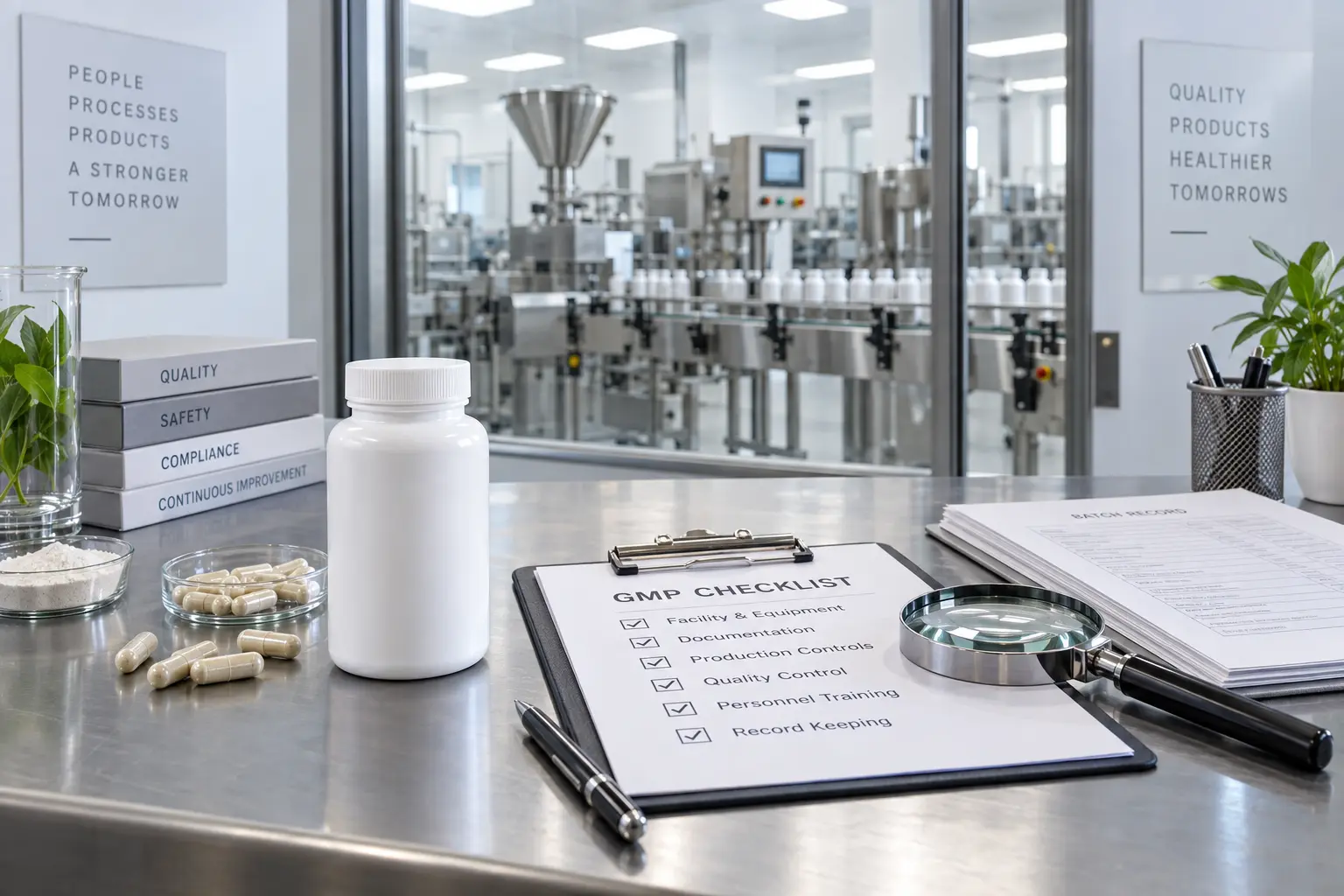
GMP describes a controlled manufacturing system
In the United States, 21 CFR Part 111 establishes current good manufacturing practice requirements for dietary supplements. Firms must create specifications, control components and processes, use appropriate laboratory operations, maintain records, handle complaints, and have quality-control responsibilities. The word current matters because procedures and controls should remain appropriate rather than freeze at an old standard.
GMP is therefore broader than one laboratory test. It asks whether the facility can repeatedly produce and release a product under documented controls. A certificate or audit may examine that system, but its value depends on the facility named, activities covered, issuing body, date, status, and audit scope.
What a credible claim can support
This support is not absolute. An audit samples records and conditions; it is not continuous surveillance of every action. A facility-level certificate also may not identify the exact product or batch a buyer receives.
What GMP does not prove
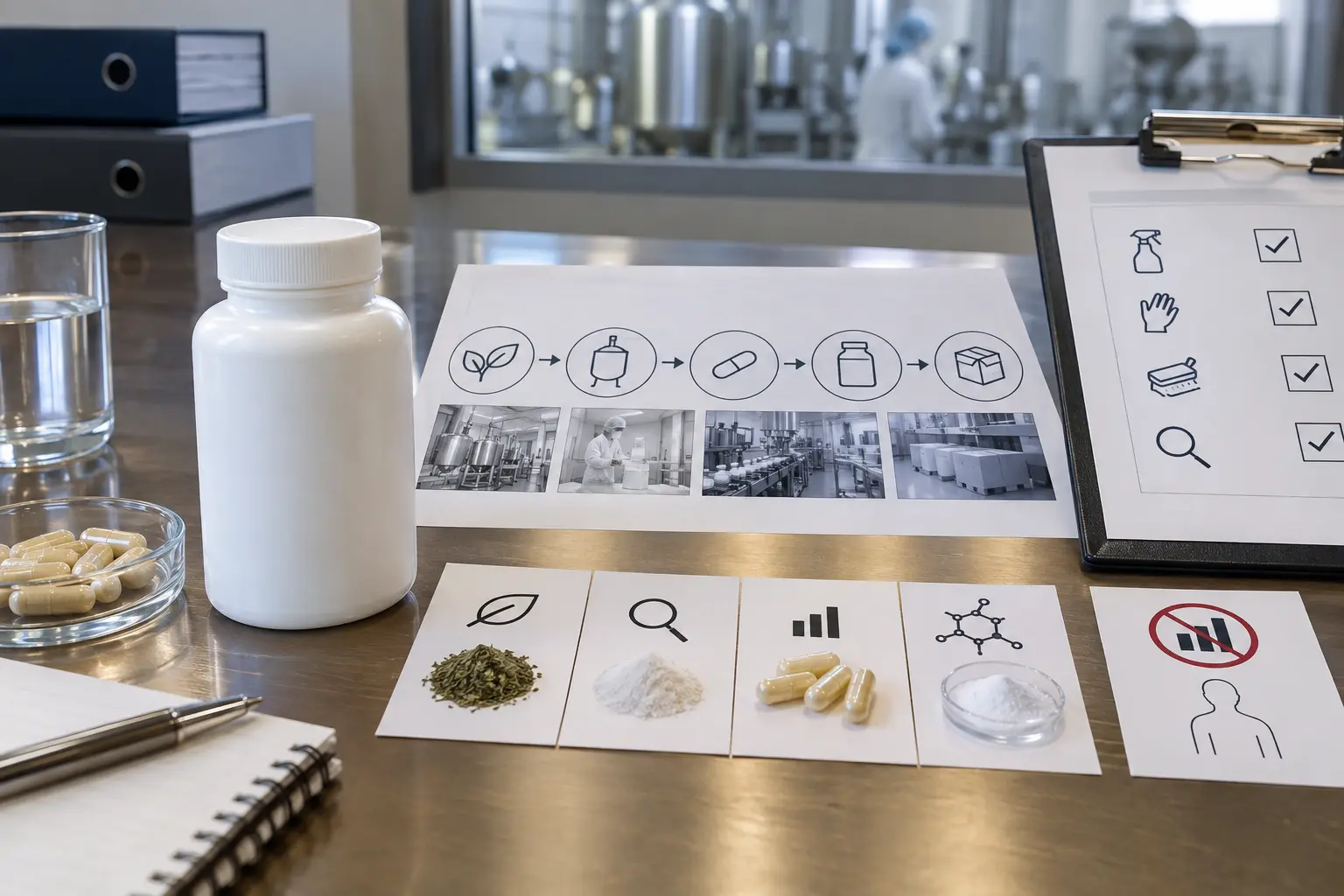
GMP does not establish that an ingredient causes weight loss, that the formula uses a clinically relevant dose, or that the finished product outperforms placebo. It does not mean FDA approved the product before sale. It also does not guarantee zero defects, zero adulteration, or zero enforcement risk.
A claim may refer to the contract manufacturer while the brand controls formula selection and marketing. Conversely, a badge on a sales page may be self-created or expired. Do not upgrade facility compliance into product efficacy, medical suitability, or a universal safety guarantee.
How to verify a GMP claim
Ask for the facility name and address, the organization that audited or certified it, certificate number, standard, scope, issue and expiry dates, and current status. Search the issuer’s own directory or contact it directly. Confirm whether the record covers manufacturing, packaging, labeling, holding, or only a narrower activity.
Compare the certificate with the responsible firm on the bottle. If contract manufacturing is used, ask which facility produced the specific lot. FDA inspection or registration language should not be presented as FDA product approval. Warning letters and recalls provide additional context but must be matched to the exact firm and dates.
Red flags that weaken the claim
- A logo with no issuer, certificate number, directory, dates, or scope.
- “FDA certified GMP” wording that implies product approval.
- A certificate naming a consultant or brand but no manufacturing facility.
- An expired document or one covering a different address.
- A facility certificate used as proof of potency, purity, or effectiveness for every batch.
- Refusal to identify the actual manufacturer while making strong quality claims.
A missing document does not prove noncompliance, but it prevents the buyer from verifying the advertised assurance.
Use a document-first buying system
- Capture the exact product. Save the product name, serving size, complete label, bottle count, seller, purchase date, lot code, expiry, and photographs of every panel.
- Define the claim. Write whether you are checking identity, potency, microbes, heavy metals, prohibited substances, facility controls, or finished-product performance. “Tested” is not a complete claim.
- Find the primary record. Use the certifier’s directory, laboratory accreditation scope, lot-linked report, FDA notice, or manufacturer response—not a marketplace badge.
- Match identifiers. Product name, form, strength, lot or batch, report number, and date must describe the bottle in hand.
- Read the scope. Record the sample tested, analytes, methods, specifications, numerical results, and who authorized release.
- Mark limits. State what the document does not test or prove, including clinical effectiveness and personal safety.
Keep the evidence as screenshots or PDFs because listings and formulas change. A transparent document can support one quality question; it cannot convert an untested outcome into proof.
Worked example: the badge that does not identify a product
A marketplace listing displays “GMP, third-party tested” beside an unbranded seal. The seller provides a polished certificate, but it names only a facility, contains no product or lot number, lists no methods or numerical results, and cannot be found in the named organization’s directory.
The correct conclusion is not that the supplement failed testing. It is that the claim cannot be connected to this bottle or to a defined testing scope. The buyer requests a lot-specific report and a verifiable directory entry. If the seller supplies only another marketing image, the uncertainty remains and the product should not receive an evidence credit.
Grade the evidence instead of calling it verified
Use four grades. Unverified means only a seller statement or badge is available. Facility-level means a current manufacturing or laboratory credential is authentic but not linked to the bottle. Product-level means an official directory or report identifies the exact product, though not necessarily the delivered lot. Lot-level means the bottle code matches a dated, authorized record with a defined sample, panel, methods, specifications, and results.
Higher traceability narrows uncertainty; it does not enlarge the claim. A lot-level heavy-metal panel still says nothing about appetite control, weight loss, or an untested adulterant. Write the evidence grade and the exact supported conclusion in one sentence. This prevents a genuine but narrow document from becoming a blanket “safe and effective” endorsement.
Where Fat Burn Active fits
For Fat Burn Active, a GMP statement should be tied to the actual manufacturing facility and current scope; it would not validate weight-loss claims.
Quality documentation and clinical effectiveness are separate. Even a genuine GMP record, certification, or certificate of analysis would not prove that Fat Burn Active causes meaningful weight loss. Our independent Fat Burn Active review separates label facts, ingredient evidence, dose relevance, safety, and finished-product evidence.
Fat Burn Active is relevant to What GMP Claims Do and Do Not Prove because its official listing identifies standardized plant extracts, caffeine sources, vitamins, and zinc in one formula. First read our independent review. If the formula, stimulant profile, evidence limits, and warnings fit your situation, check the current formula and purchase options on the official Fat Burn Active website. We may receive a commission at no additional cost.
Quality checks do not replace safety review
A conforming batch can still be unsuitable for an individual. Review medicines, health conditions, allergies, pregnancy or breastfeeding, age, total stimulant exposure, and prior reactions with a clinician or pharmacist when relevant. Independent testing usually addresses specified product characteristics, not every interaction or uncommon adverse event.
Stop use and seek appropriate care for chest pain, fainting, breathing difficulty, a serious allergic reaction, severe confusion, jaundice, repeated vomiting, or a sustained racing or irregular heartbeat. Preserve the container, lot code, receipt, and remaining product for a report or investigation. Do not take another serving to reproduce a suspected reaction.
Frequently asked questions
Does a certificate prove that a supplement works?
No. Manufacturing and analytical documents address defined quality characteristics, not a clinical weight-loss outcome.
Is “third-party tested” meaningful without details?
Only weakly. Identify the organization, product, lot, testing scope, date, methods, and results before assigning value.
Can a company test its own product?
Yes, when it follows appropriate procedures and controls. Independence is a separate question from whether the method and sample were suitable.
What should I save after buying?
Keep label photographs, lot and expiry codes, receipt, seller identity, relevant reports, and the company’s written answers.
Sources
- 21 CFR Part 111: Dietary Supplement cGMP
- FDA: Dietary Supplement cGMP Final Rule Backgrounder
- FDA: Current Good Manufacturing Practices for Dietary Supplements
- FDA: Questions and Answers on Dietary Supplements
- FDA: Warning Letters
Sources reviewed September 16, 2026. This article is general educational information, not medical advice, diagnosis, or treatment.