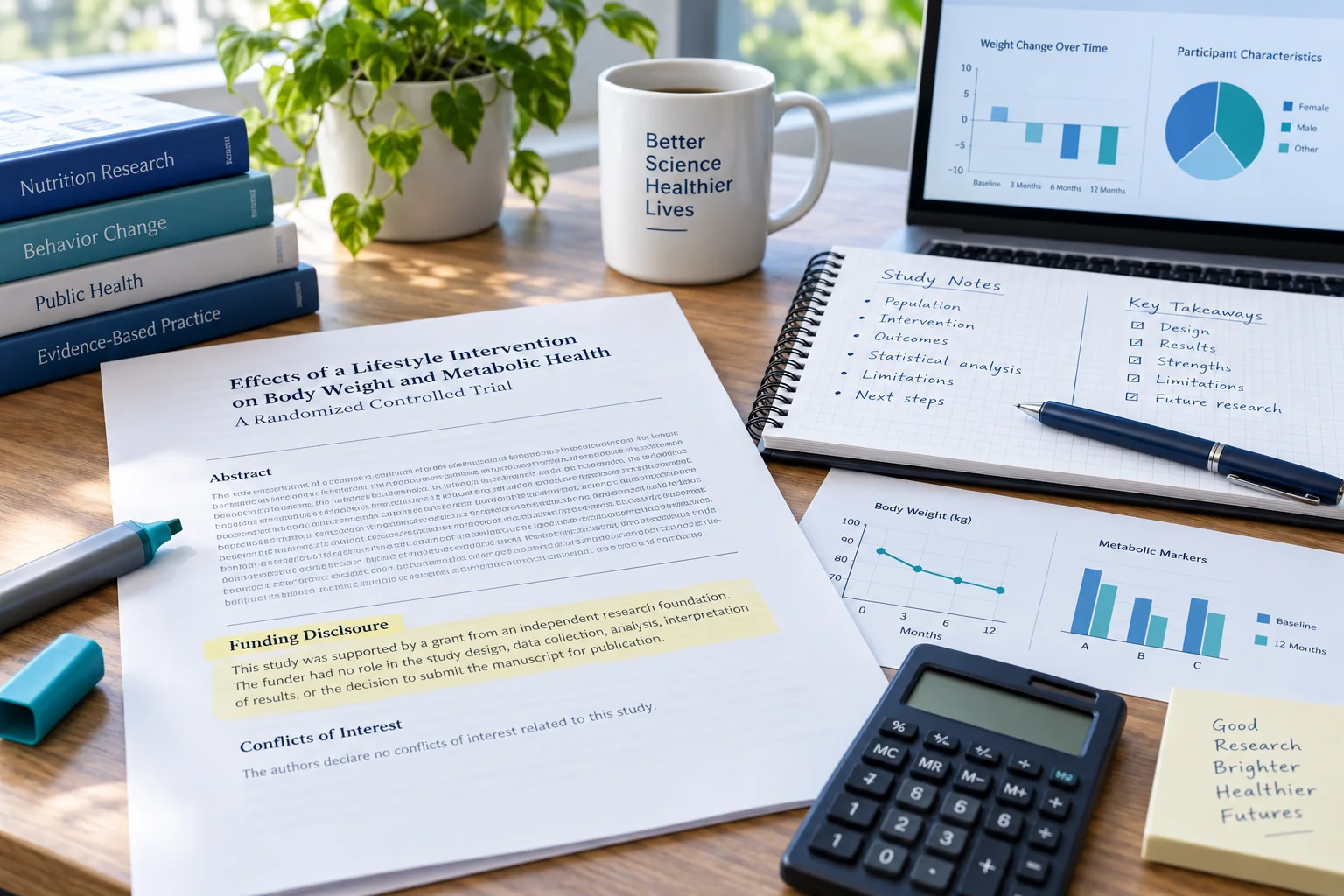
Funding is context, not a verdict
A commercial sponsor may fund competent research, and an independent grant does not guarantee flawless methods. The important question is whether financial relationships created opportunities to influence the study. Look beyond the sponsor name to the protocol, comparator, outcomes, analysis plan, access to data, publication rights, and author disclosures.
Systematic research on sponsorship has found that industry-sponsored drug and device studies are more likely to report sponsor-favorable efficacy results and conclusions. That pattern does not prove bias in any single paper. It does justify checking whether design choices, selective reporting, or interpretation could explain a favorable message.
Where funding can influence a study
- Question selection. A sponsor may study a marketable mechanism while leaving harder long-term questions unanswered.
- Comparator choice. Placebo, no treatment, a weak dose, or an unrealistic control can make an intervention look more favorable.
- Outcome choice. An acute change in energy expenditure is easier to obtain than sustained body-fat loss.
- Timing. Stopping follow-up when an effect peaks can hide later adaptation or attrition.
- Analysis. Multiple outcomes and subgroups create more chances to highlight a positive result.
- Publication and wording. Neutral data can be framed enthusiastically while limitations move to the end.
None of these possibilities should be assumed without evidence. They are inspection points. A preregistered protocol, prespecified primary outcome, transparent flow diagram, complete adverse-event reporting, and public data-analysis plan reduce room for post hoc storytelling.
Read the disclosure in three layers
First, identify direct study funding: who paid for materials, staff, laboratory testing, statistics, or publication support? Second, review author relationships such as consulting, employment, stock ownership, speaking fees, patents, or advisory work. Third, read the funder-role statement. The phrase “funded by” tells less than whether the sponsor helped design the protocol, analyzed the data, wrote the manuscript, or decided to publish.
A missing conflict statement is not proof that no conflict exists. Older papers and some journals report disclosures inconsistently. Search the full paper, supplementary files, trial registration, and corrections. If access is limited to an abstract, mark sponsor control as unknown rather than filling the gap with an assumption.
Separate results from the authors’ interpretation
Write down the primary outcome, between-group difference, confidence interval, study duration, attrition, and adverse events before reading the discussion. Then compare your plain-language summary with the abstract conclusion. If the paper reports a small or uncertain difference but uses words such as “effective,” “promising,” or “clinically meaningful,” ask what threshold supports that wording.
Watch for spin: emphasizing within-group improvement when the between-group comparison is weak, spotlighting a secondary outcome after the primary outcome failed, describing statistical significance without effect magnitude, or treating absence of a significant safety signal as proof of safety. Funding can increase concern about spin, but the same checks apply to every study.
Use a funding-aware evidence worksheet

Record sponsor, author conflicts, funder role, registration, primary outcome, comparator, sample, duration, missing data, effect size, confidence interval, adverse events, and whether the conclusion matches the result. Use “not reported” when necessary. This makes uncertainty visible and prevents a polished conclusion from replacing the evidence.
Look for safeguards and independent confirmation
Several features reduce—but never eliminate—the opportunity for sponsor influence. A public protocol limits silent changes to outcomes. Independent ethics review protects participants but does not certify that the commercial question is useful. Statistical analysis by a team with full data access can strengthen credibility when roles are explained. A contract that preserves investigator publication rights matters because unfavorable findings should not disappear.
Replication is especially valuable when a positive study is small, uses a branded ingredient, or is written by people with financial relationships. Compare independent studies by intervention identity, dose, participant characteristics, duration, and outcome rather than counting papers. Five studies of different extracts are not five confirmations of the same claim. Consistency across genuinely comparable work is more informative than the logo on a funding statement.
Also inspect the evidence that did not become a headline. Trial registries may show completed studies without posted results, changed outcomes, or delays between completion and publication. These observations do not prove suppression, but they keep the evidence map from being limited to favorable papers that are easiest to find. A balanced review states what was searched, what was located, and what remains unavailable.
Apply the check to fat-burner evidence
Supplement research often sits several steps away from the buying decision. A sponsor may test one branded ingredient, a dose different from the marketed serving, or a short metabolic endpoint. Even a well-run ingredient trial does not establish the effect of a multi-ingredient finished product. Confirm ingredient identity, dose relevance, population, outcome, and duration before connecting the study to a formula.
On Active Body Hub, our Fat Burn Active evidence-level review keeps ingredient findings separate from evidence for the complete formula. That separation matters more than whether a single paper has a favorable headline.
A fair decision rule for sponsored research
Do not discard a paper solely because a company funded it. Lower confidence when sponsor involvement combines with weak controls, unregistered outcomes, incomplete reporting, selective emphasis, implausibly broad claims, or lack of independent replication. Raise confidence when methods are prespecified, reporting is complete, effect estimates are precise enough, data access is credible, and independent teams reproduce a relevant outcome.
Use the How Study Funding Can Influence Interpretation criteria to assess Fat Burn Active rather than relying on a headline claim. Our formula evidence analysis explains the remaining uncertainty. If the product fits your needs, view current availability and ordering terms on the official website. We may earn a commission at no extra cost.
Frequently asked questions
Does industry funding mean a study is false?
No. It is a potential source of influence, not proof of fabrication or error.
Is independent funding bias-free?
No. Academic incentives, researcher beliefs, publication pressure, and weak methods can affect any study.
What is the most useful disclosure?
A specific statement explaining funding, conflicts, protocol control, data access, analysis, writing, and publication authority.
Can replication overcome funding concerns?
Independent replication with relevant outcomes can increase confidence, especially when methods and results are consistent.
Practical decision checkpoint
A useful reading exercise is to compare the registered primary outcome with the result emphasized in the press release. Then check who designed the analysis, who had access to the data, and whether the paper reports every planned outcome. Funding alone does not invalidate a result; the question is whether the methods let readers test a competing explanation. If the supplement seller cites only an abstract, locate the complete paper before treating the finding as support for the product. Keep ingredient evidence and finished-formula evidence in separate columns.
Sources
- Cochrane review: Industry Sponsorship and Research Outcome
- ICMJE: Disclosure of Financial and Non-Financial Relationships
- CONSORT reporting guideline
- Catalog of Bias: Industry Sponsorship Bias
- NIH ODS: Dietary Supplements for Weight Loss
Sources reviewed September 18, 2026. This article provides general educational information and does not replace medical advice.