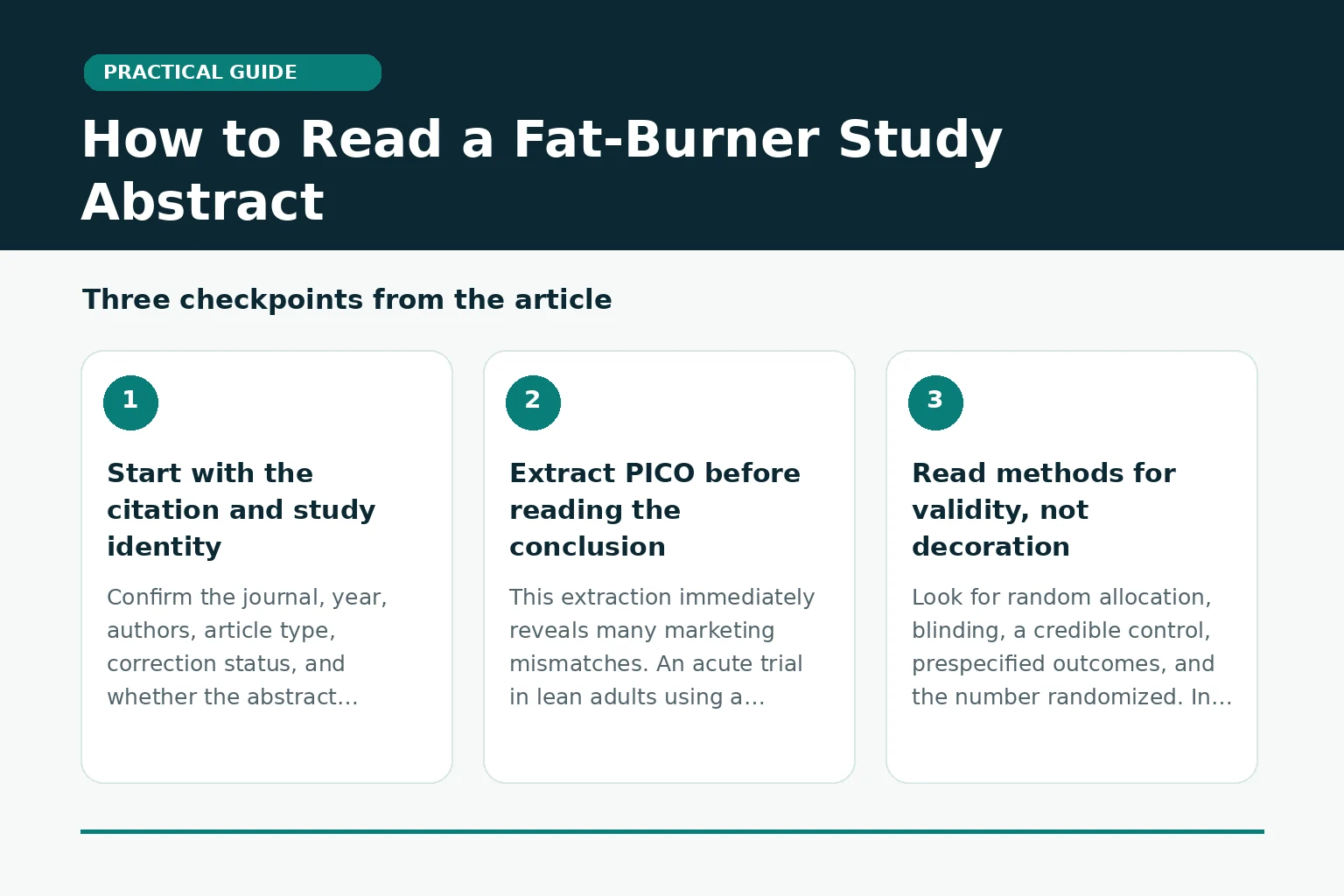
Start with the citation and study identity
Confirm the journal, year, authors, article type, correction status, and whether the abstract belongs to a randomized trial, crossover experiment, observational study, animal experiment, systematic review, or conference presentation. These designs answer different questions. “Clinical study” is too vague to establish quality.
Search for a trial registration number, protocol, or full text. Check whether the paper has a correction, expression of concern, or retraction. An abstract indexed in PubMed is easier to locate; indexing itself is not an endorsement of the conclusions.
Extract PICO before reading the conclusion
- Population: Who was studied—age, sex, health, weight status, medications, and sample size?
- Intervention: What exact ingredient, extract, dose, route, schedule, and duration were used?
- Comparator: Placebo, no treatment, another product, or a different dose?
- Outcomes: Body weight, fat mass, waist, appetite, energy expenditure, fat oxidation, or a laboratory marker?
- Time: Hours after one serving or months of repeated use?
This extraction immediately reveals many marketing mismatches. An acute trial in lean adults using a purified ingredient cannot directly prove long-term fat loss from a multi-ingredient product used by people with obesity.
Read methods for validity, not decoration
Look for random allocation, blinding, a credible control, prespecified outcomes, and the number randomized. In crossover studies, check sequence, washout, and whether each participant received both conditions. In parallel trials, check whether groups received the same diet, exercise, and support apart from the intervention.
The abstract may omit essential details. Do not interpret “double blind” as proof that allocation, adherence, missing data, and analysis were handled well. Mark unknowns, then use the full text and trial registry to resolve them.
Translate the results into one plain sentence
Find the primary between-group result. Record the effect in its original unit, confidence interval, and time point. Distinguish change within the supplement group from difference versus control. A group can improve from baseline while performing no better than placebo.
Do not let p-values replace magnitude. Note the number analyzed, missing participants, adverse events, and whether the result was primary or secondary. Relative percentages need an absolute baseline. If the abstract reports only “significant improvement” without numbers, it is insufficient for a practical decision.
Audit the conclusion for overreach
Compare the conclusion with your plain-language result. Does it turn association into causation, an acute mechanism into fat loss, a secondary endpoint into the main story, or an ingredient finding into a finished-product claim? Does “safe” mean no serious event occurred in a small short trial? Does “promising” hide a wide interval?
Authors are allowed to interpret. Readers should separate interpretation from observation. A cautious conclusion states the design, population, measured outcome, magnitude, duration, uncertainty, and need for confirmation.
Use a repeatable five-step abstract check

Copy the abstract into notes and label five lines: who, what, compared with what, measured what, and for how long. Add effect, uncertainty, attrition, harms, funding, and product match. Finish with one verdict: relevant and credible enough to read in full; relevant but incomplete; or not relevant to the claim.
Abstract red flags that require the full paper
Pause when the abstract omits group sizes, reports only within-group changes, lists many outcomes without a primary one, uses only relative change, emphasizes a subgroup, provides no uncertainty, or calls a result safe without adequate exposure. Also check whether funding and conflicts appear only in the full text.
Conference abstracts deserve special caution because methods and results may be preliminary and may never become a peer-reviewed full report. Systematic-review abstracts can also oversimplify heterogeneous trials. Always inspect inclusion criteria, risk of bias, and whether the pooled studies test comparable interventions.
What to verify in the full paper
Open the participant flow diagram and compare the numbers screened, randomized, treated, analyzed, and lost to follow-up. Read the table of baseline characteristics, but do not treat a non-significant baseline test as proof that randomization worked perfectly. Check the intervention description, control contents, adherence measurement, prohibited co-interventions, and whether diet or exercise support differed between groups.
Find the prespecified primary outcome and analysis population. Compare the registry dates and outcome names with the publication. Review numerical results, confidence intervals, missing-data assumptions, sensitivity analyses, adverse events, and reasons for withdrawal. Supplementary files often contain information that the abstract cannot fit, including subgroup definitions and protocol deviations.
Finish with funding, conflicts, data availability, limitations, and corrections. Then rewrite the result in one sentence without promotional adjectives. If your sentence is materially narrower than the title or conclusion, preserve the narrower version. The goal is not to accuse authors of misconduct; it is to keep the consumer claim aligned with what the study actually tested.
A one-minute screening routine
If time is limited, ask six questions in order: Was this study done in humans? Was the exact ingredient or finished formula tested? Was there a credible comparison group? Was the outcome actual weight or fat mass rather than a short-term proxy? How large and uncertain was the between-group result? Were harms, funding, and conflicts disclosed?
Any “no” does not automatically invalidate the paper, but it changes what the paper can support. Save promising abstracts for full-text review and reject marketing claims that are broader than the tested population, intervention, outcome, or timeline.
Connect the paper to the actual product carefully
After reading the study, compare its ingredient identity, standardization, dose, formula, serving, population, duration, and outcome with the product. Our ingredient-versus-product evidence guide explains why a recognizable ingredient name is not enough.
The official Fat Burn Active page lists a multi-ingredient thermogenic formula, but the buying decision for How to Read a Fat-Burner Study Abstract should follow the evidence check above. Compare our independent review, then, if the product remains a reasonable fit, verify the current label, directions, and purchase options. We may receive a commission at no additional cost.
Frequently asked questions
Can I trust the abstract conclusion?
Use it as the authors’ interpretation, then verify that the methods and numerical results support it.
Is PubMed indexing proof of quality?
No. PubMed helps locate biomedical literature but does not certify every study’s validity.
What if the full paper is inaccessible?
Keep important design, numerical, safety, and conflict details marked as unknown.
What is the fastest useful check?
Identify design, PICO, time scale, primary between-group effect, confidence interval, and whether the tested intervention matches the product.
Practical decision checkpoint
Try making a one-line evidence card before reading the authors’ final sentence: “In [population], [specific dose] for [duration] changed [measured outcome] by [absolute amount] compared with [control].” Leave a blank where the abstract omits information. A blank for dose, sample size, or adverse events is a reason to open the full text, not an invitation to assume the best case. If the cited trial tested only one ingredient, do not copy its result into a claim about a multi-ingredient fat burner.
Sources
- CONSORT for Abstracts
- EQUATOR Network: Reporting Guidelines
- ClinicalTrials.gov: Learn About Studies
- PubMed User Guide
- NIH ODS: Dietary Supplements for Weight Loss
Sources reviewed September 18, 2026. This article provides general educational information and does not replace medical advice.