Educational guidance only; persistent symptoms deserve individualized healthcare advice.
Why a short diary can help
After a poor night, you might feel hungrier in the afternoon and blame a lack of control. Laboratory research shows sleep restriction can affect appetite and food choices; an NIH-reported trial found that extending sleep among adults with overweight who habitually slept too little reduced average calorie intake during the study. That does not mean every snack is caused by sleep. A seven-day diary can identify timing and context worth testing without promising weight loss.
This article is an observation tool. The sleep and appetite guide reviews the broader evidence; the satiety audit focuses on meals. Keep the questions separate.
Write only four useful daily lines
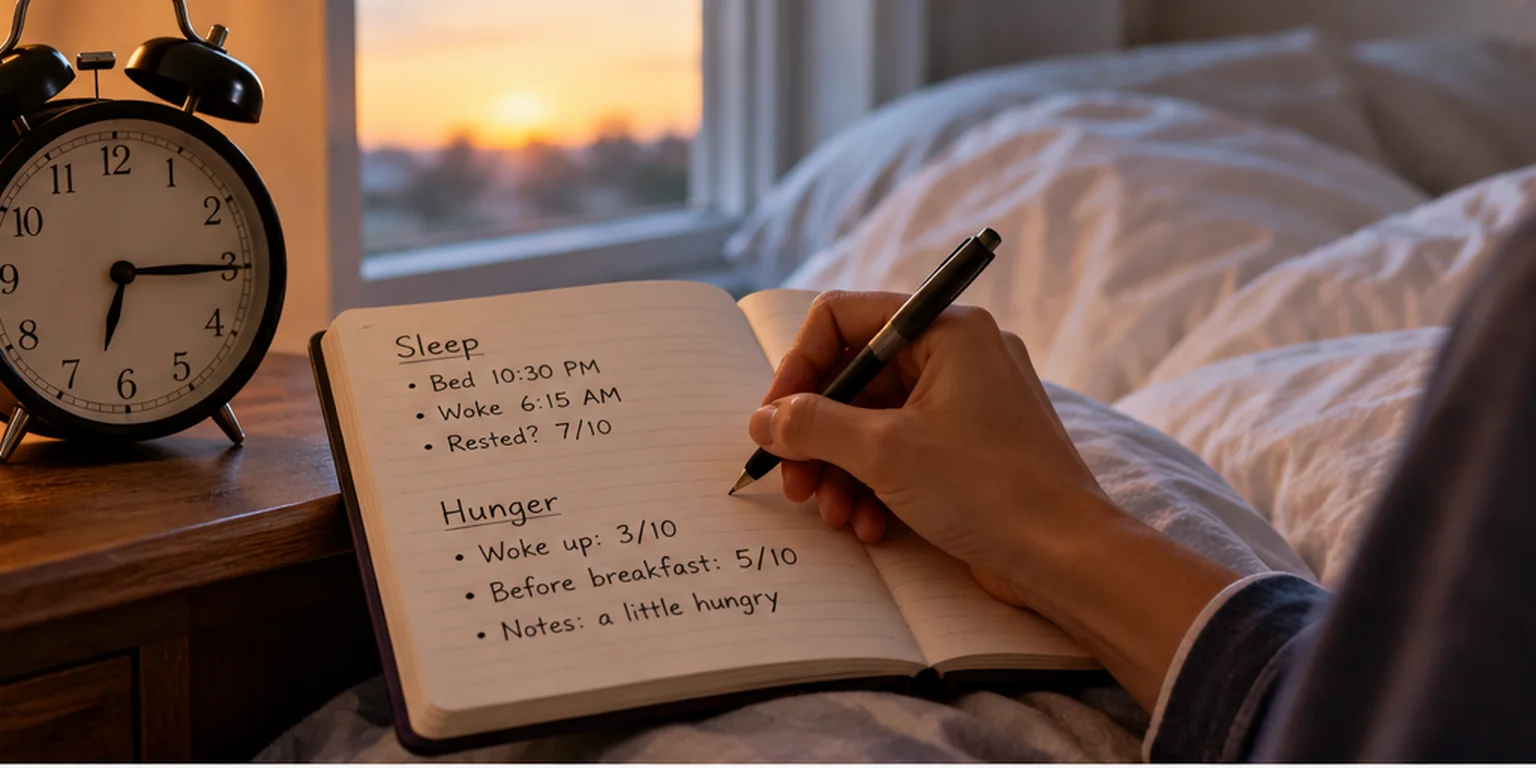
At bedtime or the next morning, record your approximate time in bed and wake time, nighttime interruptions and whether you felt restored. During the day, note one or two meaningful hunger moments, their timing and what you had eaten. Add context such as a late meeting, exercise, alcohol, caffeine or an illness. NHLBI offers a sleep diary that includes sleep quality, medicines, caffeine and daytime sleepiness; you can borrow its simple approach without copying every field.
Example: “Tuesday: late bedtime, restless night; lunch delayed; strong hunger at 4 p.m.” This documents two possible factors rather than declaring sleep the cause. Avoid precise scoring if it makes eating or sleep more stressful.
Separate physical hunger from circumstance
Before connecting two columns, ask what else changed. A very small lunch, long gap between meals, hard workout, stress or attractive food can influence appetite. Hunger is a normal signal, not a failure. Note whether an evening snack followed a skipped dinner or a shorter night. You may discover that meal timing is the more actionable issue.
The hunger in a deficit guide provides additional context. Do not use this log as a reason to ignore hunger or intensify restriction. The point is to make daily decisions more comfortable and informed.

Compare patterns without pretending to prove causation
At the end of seven days, compare similar weekdays and weekends. Did late bedtimes repeatedly coincide with tired mornings and difficult afternoons? Did days with adequate meals feel different? One week is a tiny, uncontrolled sample. It cannot establish that a specific sleep hour determines calorie intake or that better sleep will automatically reduce body fat. Researchers use controlled designs to isolate effects; your diary is for choosing a practical next experiment.
Look for exceptions too. If you slept poorly but appetite felt ordinary, include that day. A useful diary describes variation instead of forcing every entry into a single story.
Choose one experiment you can actually run
If bedtime drifts because of work messages, try a consistent earlier stopping cue. If late caffeine repeatedly appears in the log, shift its timing. If hunger follows an inadequate lunch, improve the meal rather than blaming sleep. Test one change for another week and keep meals and work patterns as stable as is practical. NHLBI recommends consistent sleep timing and limiting evening stimulants as part of healthy sleep habits.
The evening stimulation guide gives concrete options. Your experiment need not be perfect to be useful; ask whether you felt more rested and whether the change fitted your life.
Stop tracking when it stops helping
A diary can increase anxiety in someone already preoccupied with sleep or food. Shorten it to two questions, or stop and seek support if logging becomes distressing. Persistent insomnia, loud snoring, gasping or severe daytime sleepiness deserve healthcare assessment rather than more self-tracking. NHLBI notes that a sleep diary can be brought to a doctor; it is a communication aid, not a diagnostic test.
If shift work, childcare or chronic pain constrains sleep, a generic earlier bedtime may be unrealistic. Record constraints and ask which manageable improvement is available in your situation.
What a product can and cannot do
No weight-loss supplement can turn a seven-day pattern into proof of its effect. Products with caffeine may complicate evening sleep; NIH ODS advises reviewing ingredients and safety, and evidence for weight-loss products is often limited. If a log shows a sleep problem, buying a stimulant is not a sleep strategy.
The Fat Burn Active review is available for a separate product decision. For now, close the diary after seven days, name one possible pattern and choose one low-risk change you can evaluate. That is enough to make the exercise useful.
A worked seven-day example
Suppose Monday through Wednesday include regular meals and a consistent bedtime, while Thursday brings a late shift and a missed afternoon meal. On Friday you wake tired and feel strong hunger at noon. It would be easy to blame sleep alone, yet the long gap without food is an equally plausible explanation. Write both down. On Saturday you may sleep longer but eat differently and move less, so that day is not a clean control group. By Sunday the useful finding may be that the shift schedule needs both an earlier prepared meal and a protected sleep window. Choose one action you can implement this week, perhaps bringing a substantial lunch on Thursday. If appetite remains difficult, ask whether meal composition, restriction, medicines or another issue needs attention. The diary prompts better questions; it cannot prove a hormone has changed. Do not calculate average calories from a few remembered meals and present that as a precise result. If an entry is missing, leave it blank rather than reconstructing it from memory.
You can use a paper page with seven rows and four headings: sleep, daytime energy, hunger moments and context. Spend one minute filling it in. Recording an approximate time is enough; avoid turning bedtime into an exact competition. If different days have different work schedules, label the type of day. Review the list once at the end rather than repeatedly checking whether a pattern has appeared. If notes reveal snoring, gasping or significant daytime sleepiness, seek medical evaluation instead of running another week-long test. Once you have a next step, put the notebook away. The point is to support a kinder, clearer decision about sleep and food, not a permanent monitoring obligation.
Choose a useful next step
Check the current package, ingredients, serving directions, your other caffeine sources, and relevant health conditions. For an evidence-based starting point, read the full Fat Burn Active review. If this product still fits your circumstances, you can inspect its current offer. We may earn a commission if you buy through that link. Choosing no supplement is equally reasonable when the evidence or safety questions do not support a purchase.
Frequently asked questions
Should I weigh every snack?
No. Brief notes on timing and context are enough for this purpose.
Does a bad night always increase hunger?
No. Responses vary, and other factors can affect the same day.
Is a diary a sleep-disorder test?
No. Bring persistent symptoms to a qualified clinician.
Sources
- NHLBI: Sleep Diary
- NIH: Sleep Extension and Intake
- CDC: About Sleep
- NHLBI: Healthy Sleep Habits
- Sleep Curtailment and Food Cravings Study
- NIH ODS: Weight-Loss Supplements
Reviewed against the sources listed above. Educational information only; not medical advice.