Non-stimulant is a constraint, not a benefit claim
Search results often treat “non-stimulant” and “caffeine-free” as synonyms. For a cautious comparison, non-stimulant is broader. A formula can omit added caffeine yet include bitter orange, yohimbe, or another ingredient sold for stimulating effects. Tea, coffee, guarana, yerba mate, and kola sources can also contribute caffeine without placing the familiar word at the front of the label.
Ask for the all-source stimulant total per serving and maximum day. If the manufacturer cannot answer, the product fails the category gate. Passing this gate only establishes absence; it does not establish appetite control, thermogenesis, or fat loss.
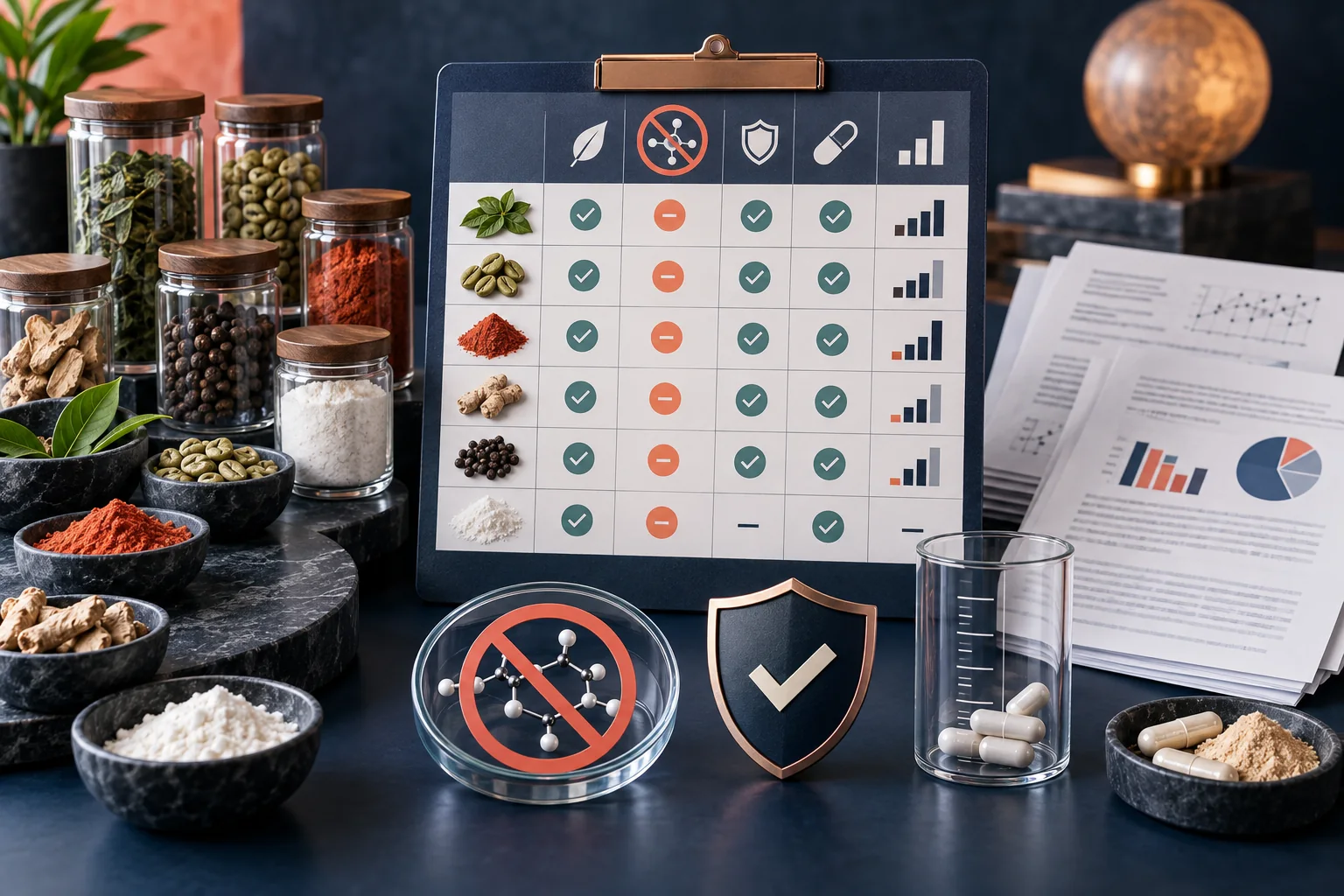
Compare mechanisms in separate lanes
Do not average these lanes into one “potency” score. A fiber intended to support fullness and a capsaicinoid intended to affect thermogenesis solve different problems and need different outcomes.
A seven-step shortlist
- Write why stimulants are being avoided: sleep, anxiety, stacking, preference, or clinical advice.
- Reject hidden botanical caffeine and ambiguous proprietary blends.
- Assign every ingredient one claimed job and one measurable outcome.
- Match form and daily dose to controlled human trials.
- Look for evidence on the complete sold formula separately.
- Compare side effects, interactions, servings, and cost per day.
- Set a review date and stopping rule before buying.
Who may value the category—and who needs more help
A verified non-stimulant option may be relevant to an adult who avoids caffeine, uses coffee or pre-workout already, trains late, or finds stimulation disrupts sleep. The potential advantage is reduced stimulant exposure, not guaranteed fat loss.
Someone with swallowing difficulty, gastrointestinal disease, liver disease, glucose-lowering treatment, multiple medicines, pregnancy, or a history of disordered eating should not assume a botanical or fiber formula is low risk. A clinician or pharmacist can assess the actual label. If hunger is the problem, protein, fiber-rich food, meal timing, sleep, and a less aggressive deficit may address it more directly.
A scorecard that prevents false winners
Score each candidate only after saving the current complete label and directions. Use five fields: disclosure, evidence match, safety fit, practical use, and cost per full day. Mark an item unknown when a fact cannot be verified; do not convert missing data into an average score. A product with fewer ingredients can outrank a crowded formula when its dose, purpose, and limitations are easier to establish.
Set disqualifiers before shopping. Examples include an undisclosed stimulant total, a proprietary blend containing a dose-sensitive ingredient, absent warnings, an unverifiable seller, or a claim of effortless rapid loss. Predefined rules reduce the temptation to excuse a problem after attractive marketing, testimonials, or a temporary discount appears.
Finally, separate category fit from effectiveness. “Caffeine-free,” “transparent,” and “thermogenic” describe different properties. None proves that a product produces meaningful or durable fat loss.
How to match a formula to human evidence
Start with the outcome: body weight, fat mass, waist, appetite, energy expenditure, or exercise performance. These endpoints are not interchangeable. Then match the ingredient species or chemical form, plant part, preparation, daily dose, population, and duration. Record the absolute effect, uncertainty, adverse events, dropout, funding, and whether another independent study reproduced it.
Mechanism evidence can explain why an ingredient is plausible, but a laboratory pathway or acute rise in heat production is not a weight-loss result. Ingredient trials support only the tested ingredient and exposure. A finished-product claim is strongest when the exact sold formula has an adequately controlled human trial. Combining several individually plausible ingredients does not create evidence for the combination.
Transparency makes this comparison possible; it does not make the result favorable. If a dose is hidden or an extract is not characterized, the correct evidence rating is “cannot determine.”
Safety and quality checks come before value
Calculate the maximum daily serving and total exposure from food, drinks, medicines, pre-workouts, and other supplements. Review cardiovascular, sleep, anxiety, gastrointestinal, liver, kidney, glucose, bleeding, and medicine-interaction concerns according to the actual ingredients. Pregnancy or breastfeeding, age under 18, surgery, an eating-disorder history, or a significant condition calls for individualized professional guidance rather than self-experimentation.
Prefer a traceable manufacturer, accessible contact details, lot and expiry information, and credible independent certification when relevant. Certification can support identity, contamination, or manufacturing checks within its scope; it does not prove weight loss. FDA marketing status is not pre-approval for effectiveness.
Stop use and seek urgent care for chest pain, fainting, severe shortness of breath, seizure, serious allergic symptoms, a sustained irregular heartbeat, or signs of liver injury such as jaundice and dark urine. A strong sensation is not evidence that a supplement is working.
Before-you-buy verification
Open the manufacturer page and the seller page side by side. Confirm that the product name, serving size, ingredient panel, directions, warnings, bottle count, refund terms, delivery limits, and seller identity agree. Save dated screenshots. Calculate days per container from the maximum schedule rather than the largest number printed on the front, then compare total delivered cost per usable day.
Do not use star ratings as efficacy evidence. Reviews can reveal practical questions—capsule size, taste, packaging, shipping, or recurring billing—but they cannot verify composition or causation. Treat countdown timers, “doctor recommended” language without a named basis, dramatic before-and-after images, and guaranteed results as reasons to slow down.
When the physical bottle arrives, compare it with the saved panel before opening. If an important amount, warning, seal, or formula has changed, ask the seller in writing and use the return policy rather than testing an uncertain product.
Where Fat Burn Active fits
The current Fat Burn Active presentation names green tea and guarana-related ingredients, so it should not be placed in a non-stimulant shortlist until the current complete label and all-source caffeine are verified.
Use the Best Non-Stimulant Fat Burners: Evaluation Framework criteria to assess Fat Burn Active rather than relying on a headline claim. Our formula evidence analysis explains the remaining uncertainty. If the product fits your needs, view current availability and ordering terms on the official website. We may earn a commission at no extra cost.
Frequently asked questions
Does caffeine-free always mean non-stimulant?
No. Other compounds may be stimulating, and botanical caffeine may be unclear.
Are non-stimulant fat burners effective?
Some ingredients may have small or context-specific effects, but the category label predicts neither dose nor outcome.
Can I take one at night?
Only after checking every ingredient, directions, interactions, and personal response; stimulant-free does not guarantee sleep neutrality.
Sources
- NIH ODS: Weight-Loss Supplements
- FDA: Dietary Supplements
- FDA: Caffeine and Your Body
- FDA Weight-Loss Product Notifications
Sources reviewed September 8, 2026. This article is general educational information, not medical advice, diagnosis, or treatment.