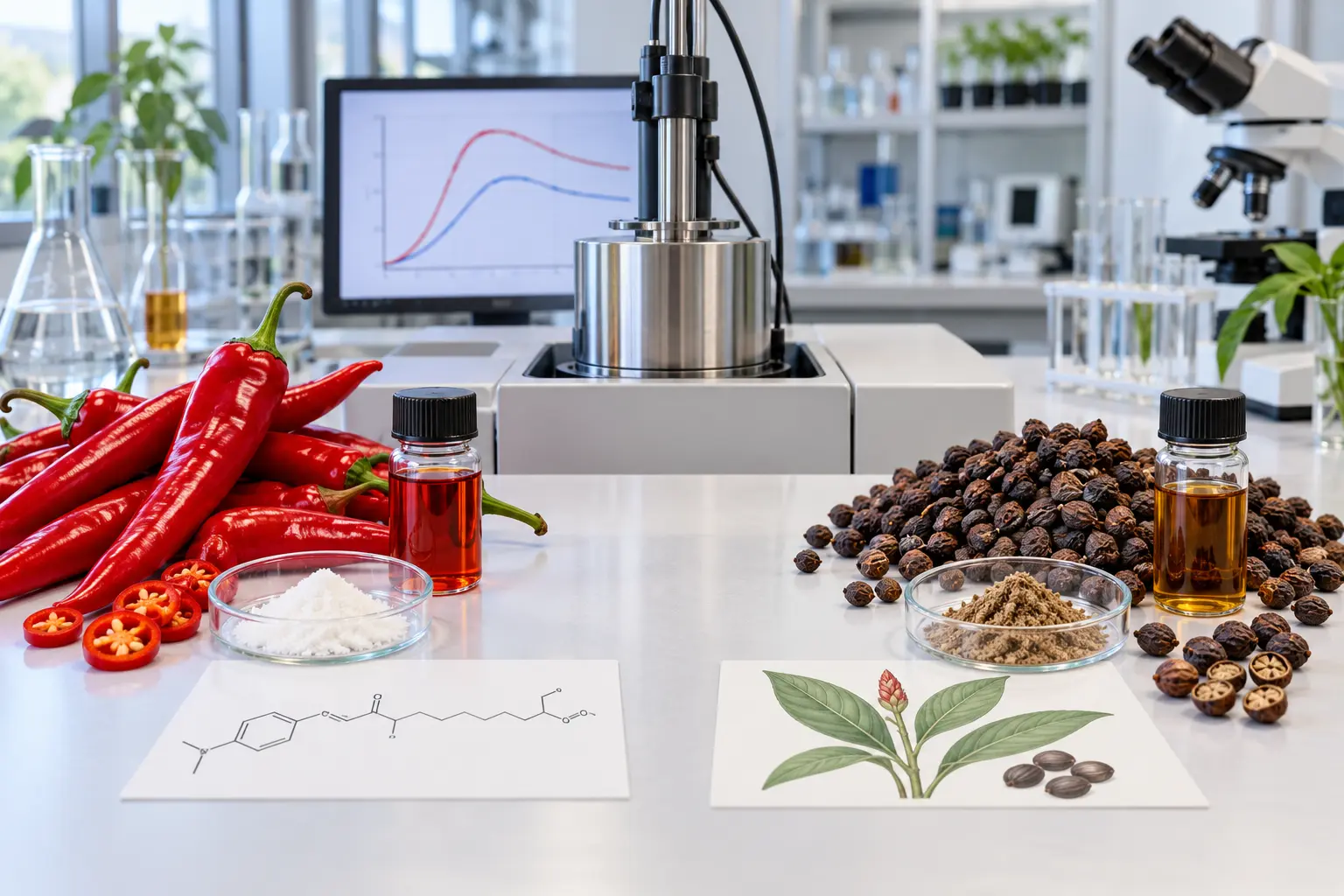
Two thermogenic stories, two evidence objects
Put human outcomes above pathway diagrams
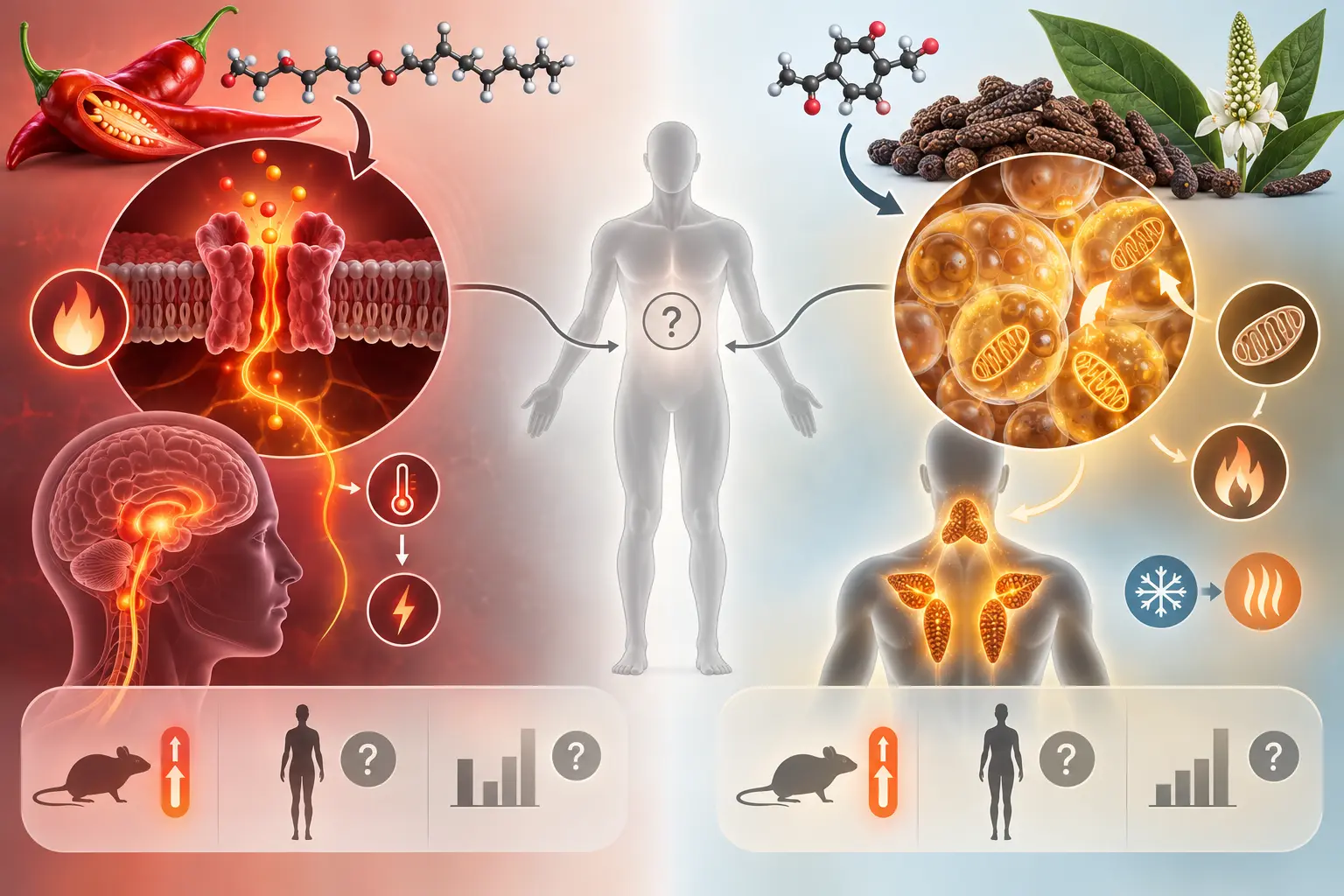
Capsaicin reviews pool different forms, doses, durations, and outcomes. A modest average change in intake or expenditure is not equivalent to a guaranteed change in body weight. Pungency can also affect adherence and gastrointestinal tolerance.
Grains-of-paradise studies have explored acute expenditure and longer body-fat outcomes, sometimes in people characterized by brown-adipose activity. Small samples and defined extracts limit generalization. Buyers usually cannot infer brown-fat status from ordinary symptoms.
Match the actual preparations
Record capsaicin or total capsaicinoid milligrams, not merely chili extract. For grains of paradise, record Aframomum melegueta, seed part, extraction, extract mass, and 6-paradol standardization. A large seed-powder dose is not automatically stronger than a smaller characterized extract.
Example: 80 mg extract at 12.5% 6-paradol calculates to 10 mg specified 6-paradol. That does not mean a human trial of another extract or purified 6-paradol transfers directly.
Choose by tolerability only after evidence fit
Capsaicin may be easier to recognize, but people with reflux, abdominal pain, or sensitivity may find pungent preparations impractical. Grains of paradise may seem gentler because it is less familiar, yet unfamiliarity is not safety evidence. Check medicines, pregnancy, gastrointestinal history, and the complete formula.
If the intended benefit is too small to measure in the user's routine, neither product has a defensible job. Walking, resistance training, meal planning, and sleep should not be displaced by a novelty comparison.
Use a five-field decision card
Write the job first: appetite support, alertness, workout readiness, or a small thermogenic effect. Then compare five fields: the exact intervention, outcome evidence, likely size of benefit, personal risk, and practical cost. A candidate cannot win a field when its dose or preparation is unknown. Mark it “not comparable” instead of awarding points for popularity.
Set a stopping rule before purchase. Examples include worse sleep, palpitations, persistent digestive symptoms, no measurable improvement in the intended behavior, or a label that differs from the saved version. Reassess after a defined period while keeping food, activity, and other stimulant exposure reasonably stable. This personal record cannot prove efficacy, but it prevents a changing routine from being credited to one capsule.
Compare the sold labels, not ingredient names
- Confirm serving size and maximum daily servings.
- Record chemical form or botanical species, plant part, extract ratio, and standardization.
- Calculate the active yield only when both extract mass and percentage are disclosed.
- Add caffeine and stimulant-like ingredients from every product, drink, food, and relevant medicine.
- Separate ingredient studies from research on the complete sold formula.
- Compare delivered cost per full day and the option of using neither.
A study match requires the same intervention, a comparable dose, a relevant population, and the outcome being claimed. Mechanism, warmth, alertness, appetite sensation, energy expenditure, body weight, and fat mass are different endpoints. Never convert a brief physiological signal into a guaranteed long-term result.
Safety can decide the comparison before efficacy
Review blood pressure, heart rhythm, anxiety, sleep, gastrointestinal health, liver or kidney disease, glucose management, pregnancy or breastfeeding, surgery, age, eating-disorder history, medicines, and other supplements. “Natural” does not mean interaction-free. A familiar food source does not establish that a concentrated extract is suitable.
Seek qualified medical or pharmacy advice when a condition or medicine makes the choice uncertain. Stop and obtain urgent care for chest pain, fainting, severe shortness of breath, serious allergic symptoms, seizure, or a sustained rapid or irregular heartbeat. Jitters, sweating, nausea, headache, insomnia, or bowel changes are adverse effects, not evidence of fat loss.
Where Fat Burn Active fits
Fat Burn Active uses phenylcapsaicin and standardized grains of paradise, not necessarily the same capsaicin preparations used in reviews. Each dose needs its own match, and the finished combination needs separate evidence.
Fat Burn Active is optional; no supplement is required for fat loss. Its current formula must be judged as a combination, not as the winner of any isolated-ingredient comparison. Read our independent Fat Burn Active review, verify the current label and all-source caffeine, and compare the product with the option of using neither.
Fat Burn Active is relevant to Capsaicin vs Grains of Paradise because its official listing identifies standardized plant extracts, caffeine sources, vitamins, and zinc in one formula. First read our independent review. If the formula, stimulant profile, evidence limits, and warnings fit your situation, check the current formula and purchase options on the official Fat Burn Active website. We may receive a commission at no additional cost.
Worked comparison: constituent math can mislead
One label provides 2 mg total capsaicinoids. Another provides 80 mg grains-of-paradise extract standardized to 12.5% 6-paradol, a calculated 10 mg. Ten is larger than two, but this is not a potency comparison. The values describe different molecules within different preparations, and the studies may measure different endpoints. Choosing the larger number would be numerically tidy and scientifically unsupported.
Build two evidence rows instead. For capsaicin, record whether research used capsaicin, mixed capsaicinoids, non-pungent capsinoids, food, or another analog. For grains of paradise, record botanical identity, extract method, 6-paradol content, participants' brown-fat characterization, and whether the outcome was acute expenditure, visceral fat, or total body weight.
Design a practical tolerability screen
- Start from the complete label and lowest instructed exposure; never exceed directions.
- Keep other new supplements out of the test period.
- Record reflux, abdominal pain, nausea, bowel changes, warmth, sleep, and appetite.
- Stop for persistent symptoms and seek professional advice when health conditions or medicines apply.
- Judge only the predefined outcome; do not interpret discomfort as effectiveness.
This is not a clinical trial and cannot establish fat loss. It is a way to avoid purchasing months of a product whose preparation is intolerable. If both candidates pass tolerability but neither has a plausible measurable advantage, the correct economic decision is to buy neither.
Do not confuse culinary use with extract evidence
Chili and grains of paradise can be used as foods for flavor when tolerated. A pleasant spicy meal may support an enjoyable eating pattern, but its exposure is not automatically equal to a capsule. Conversely, familiarity as food does not guarantee that a concentrated extract is appropriate for every person.
Preserve the current label and lot details so a later reformulation does not silently change the evidence match or exposure being compared.
Frequently asked questions
Are grains of paradise a type of chili?
No. They are a different botanical, commonly identified as Aframomum melegueta.
Does feeling heat mean more fat loss?
No. Sensation is not a measure of net body-fat change.
Which is better for belly fat?
Neither can reliably target fat loss to one body region.
Sources
- Capsaicin weight-loss meta-analysis
- Capsaicin and capsiate energy-balance review
- Grains of paradise and brown-fat trial
- Daily grains-of-paradise body-fat trial
Sources reviewed September 14, 2026. This article is general educational information, not medical advice, diagnosis, or treatment.