The real question is what the price buys
The word “premium” usually describes positioning, packaging, or a seller’s price. It is not a scientific category. Two bottles can look alike while one lists exact doses and the other hides them inside a proprietary blend. Conversely, an inexpensive product may have a short, transparent label that makes its limitations easier to judge. Neither situation tells you that the finished formula causes meaningful weight loss.
Start with the decision you actually face: what is the incremental benefit, if any, of paying more for this particular formula? Write down each bottle’s labeled servings, maximum daily use, all-source caffeine, ingredient forms, warnings, seller, return terms, and delivered cost. Compare those facts side by side. If the premium item cannot show a useful difference in transparency, verified quality, or relevant evidence, its higher price remains unexplained. If the cheap item omits material doses or relies on a risky stimulant combination, its lower price is not a saving worth chasing.
Normalize price to the day you would actually use
A bottle price is a poor unit of comparison. Suppose one hypothetical bottle costs $24 for 30 servings with one serving daily, while another costs $36 for 60 servings but directs two servings daily. Both provide 30 labeled days; their costs are $0.80 and $1.20 per day before shipping and taxes. If a third product says “up to three servings daily,” calculate both your intended schedule and the maximum labeled schedule. Do not quietly compare one product’s minimum use with another’s maximum.
Add shipping, taxes, required subscriptions, and nonrefundable fees. Then check whether a serving corresponds to the ingredient quantity cited in any study. Price per capsule can make a diluted formula look attractive, while price per gram can make an inappropriate ingredient look like a bargain. Cost per day is useful only after the label, safety, and evidence checks. Never increase a dose simply to match a study; the product’s directions and your personal risk matter.
Check the substance behind a premium claim
Ask for specific, verifiable reasons for a higher price: exact ingredient forms and quantities, a finished-product study, independent testing that identifies the tested product and lot, or clearer manufacturer accountability. A vague statement such as “clinically inspired” is not a trial of the finished bottle. Research on one ingredient at a different dose cannot establish that a multi-ingredient formula works as advertised.
Quality seals can help with manufacturing or identity questions, but they do not establish weight-loss efficacy. Verify a seal with the named program rather than relying on a logo on a sales page. A branded ingredient is still an ingredient, not proof that the entire product works. Also distinguish an accurate current label from an old marketplace image: ingredient versions and dose instructions can change. When the seller cannot provide a complete current Supplement Facts panel and warnings, there is no reliable basis to call either option a good value.
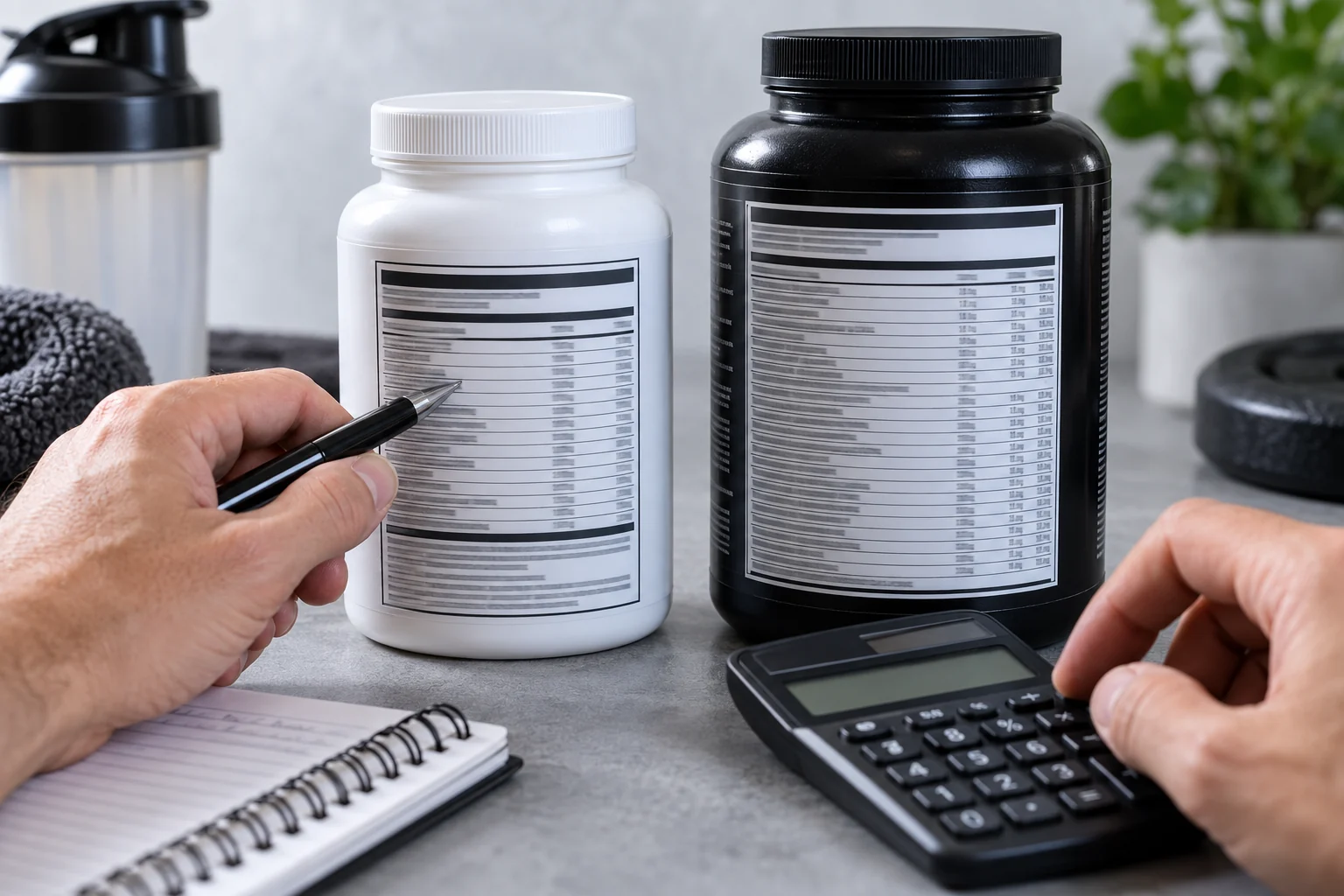
Put safety and evidence ahead of a bargain
The NIH Office of Dietary Supplements describes limited evidence for many weight-loss supplement ingredients and warns that some can interact with medicines or be harmful. FDA does not approve dietary supplements for safety and effectiveness before they reach the market. A low price does not remove those concerns; a high price does not resolve them. Check stimulant overlap with coffee, pre-workout products, and energy drinks, including sources that are not prominently called caffeine.
Do not use a product as a substitute for evaluation of a medical condition or prescribed treatment. If you have cardiovascular, liver, kidney, sleep, anxiety, or medication-related concerns, discuss the complete label with a qualified clinician or pharmacist. A comparison that ends with “neither” can be the most useful result. Evidence-based food, activity, and sleep changes often deserve the first part of a limited budget before a product with uncertain benefit.
A practical decision scorecard
Give both bottles the same five tests. First, can you identify each relevant ingredient and exact daily amount? Second, does human evidence address weight outcomes at comparable doses rather than a brief change in energy expenditure? Third, are warnings, interactions, and all-source stimulants clear? Fourth, can the brand substantiate testing claims and identify the seller? Fifth, what is the final cost per usable day, including fees? Mark each test yes, no, or unknown; do not turn unknown into yes.
| Question | Option A | Option B | Decision rule |
|---|---|---|---|
| Labeled daily dose | Check exact amounts | Check exact amounts | Unknown doses fail either option |
| Human outcome evidence | Match form and dose | Match form and dose | Price is not evidence |
| Quality verification | Verify named testing | Verify named testing | A logo alone is insufficient |
| Delivered daily cost | Calculate from directions | Calculate from directions | Decide only after safety |
Put the comparison into practice
A tie-breaker is the answer you get when you ask a difficult question. Request the current label, the caffeine total from all sources, and the identity of any testing program claimed on the page. A seller who replies with another slogan has not resolved the uncertainty. Do not mistake a polished support response for a laboratory result, but use it to judge whether the company can supply verifiable information.
If a study is offered as proof, check its participants and measured outcome. A brief experiment in healthy adults measuring alertness does not answer whether people lost body fat over months. A product that costs twice as much might offer better disclosure yet still have limited evidence of meaningful weight loss. You can value clearer disclosure without converting it into a promise of results. The fair conclusion may be that one option is easier to assess while neither has demonstrated the claimed benefit.
Use this price test on a real formula
Our Fat Burn Active review provides a product-specific place to check the label and ingredient evidence. Compare its actual delivered cost per day with any cheaper or more expensive alternative using identical daily-use assumptions. Do not call it better merely because of its positioning or because this site has a partner relationship.
If the current label, safety considerations, evidence limits, and price make sense for you, inspect the current product offer before deciding. We may earn a commission if you buy. If a lower-priced transparent option, a different approach, or no supplement suits you better, choose that instead.
Frequently asked questions
Are expensive fat burners stronger?
Price alone does not show potency, safety, or an effect on body fat. Compare disclosed daily doses and relevant human outcome evidence.
Can a cheap product still be reasonable?
It can be easier to assess if it has a transparent label and credible seller, but it still needs a safety and evidence review.
What if the more expensive formula has many more ingredients?
More ingredients create more questions about dose, interactions, and attribution; they do not establish additional benefit.
Sources and further reading
- NIH Office of Dietary Supplements: Weight Loss
- NCCIH: Six Things to Know About Weight-Loss Supplements
- FDA: Questions and Answers on Dietary Supplements
- FTC: The Truth Behind Weight-Loss Ads
- FDA: Dietary Supplement Labeling Guide
Sources reviewed September 2026. Educational information only; not medical advice. Prices in examples are hypothetical.