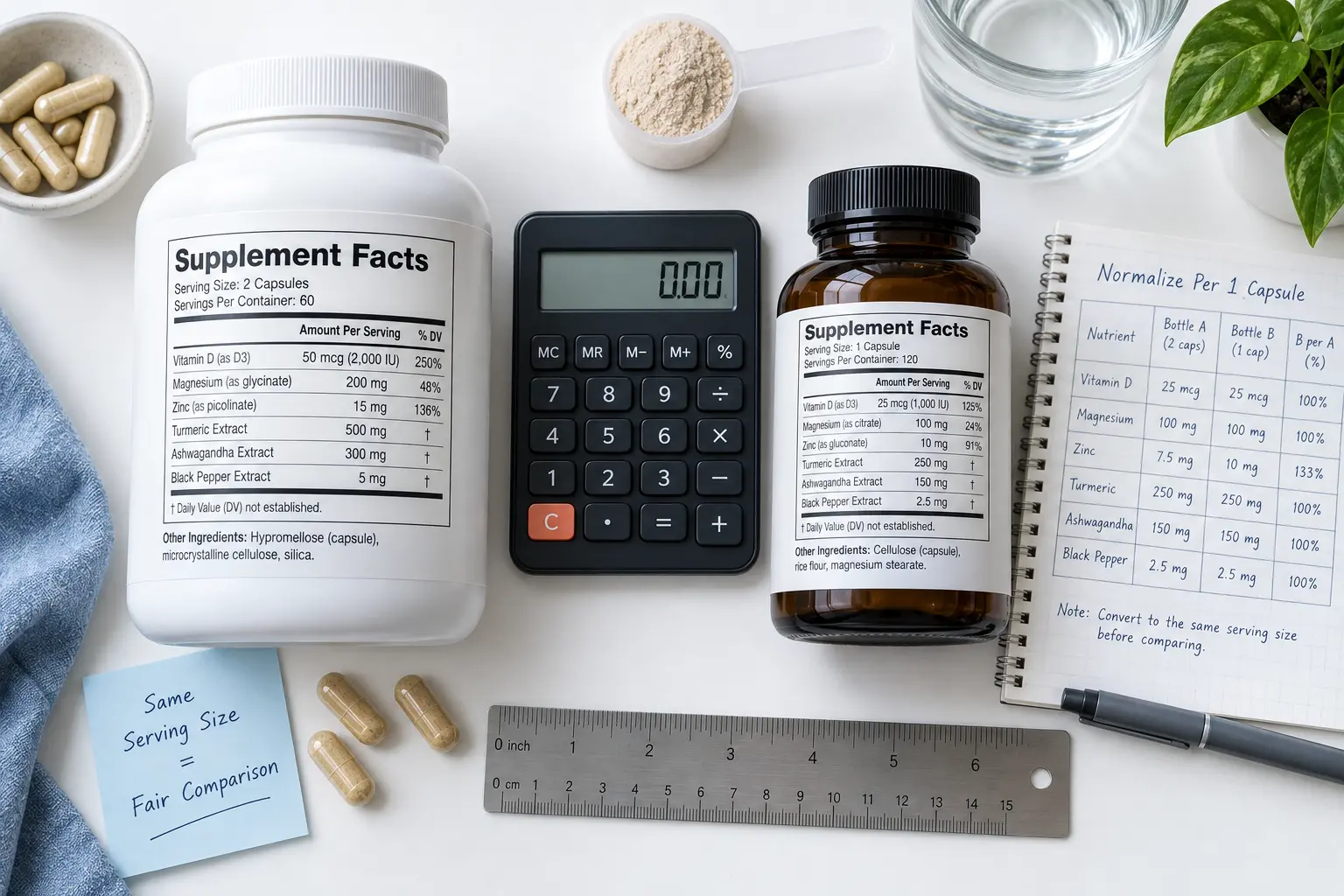
Step 1: define one comparable day
Write each product’s serving size and the maximum number of labeled servings per day. Multiply every per-serving amount by that number. If Product A provides 300 mg in two capsules once daily and Product B provides 200 mg in one capsule up to three times daily, comparing 300 with 200 is wrong; the labeled daily maxima are 300 and 600 mg. That still does not show which is better, but it puts exposure on one scale.
Keep optional and mandatory directions separate. “One to three servings” creates a dose range and a cost range. Never select the highest use merely to make a product look stronger, and never exceed directions to imitate a study.
Step 2: match identity before quantity
Names that look similar may describe different materials. For botanicals, record common name, Latin name when provided, plant part, raw powder or extract, extraction ratio, and standardized active percentage. For minerals, note the compound form and elemental amount. For caffeine, identify both direct caffeine and botanical sources such as guarana, yerba mate, kola, tea, or coffee extracts.
An “equivalent to 5,000 mg herb” statement is not necessarily 5,000 mg of material in the capsule. A 10:1 extract may be presented using a raw-herb equivalent. Compare the physically present extract and the declared active yield where available, not the most dramatic number on the page.
Step 3: calculate active yield
When a label states 500 mg of an extract standardized to 50% of a named compound, the theoretical labeled yield is 250 mg of that compound. Apply this only when the percentage clearly modifies that extract and the terminology matches. Do not invent a percentage from another brand or a research paper.
If one green tea extract declares EGCG and another only says “green tea,” record EGCG for the first and “unknown” for the second. Unknown is not zero, but it also cannot be treated as equivalent. Proprietary blends further limit calculation because the total blend weight does not disclose every component amount.
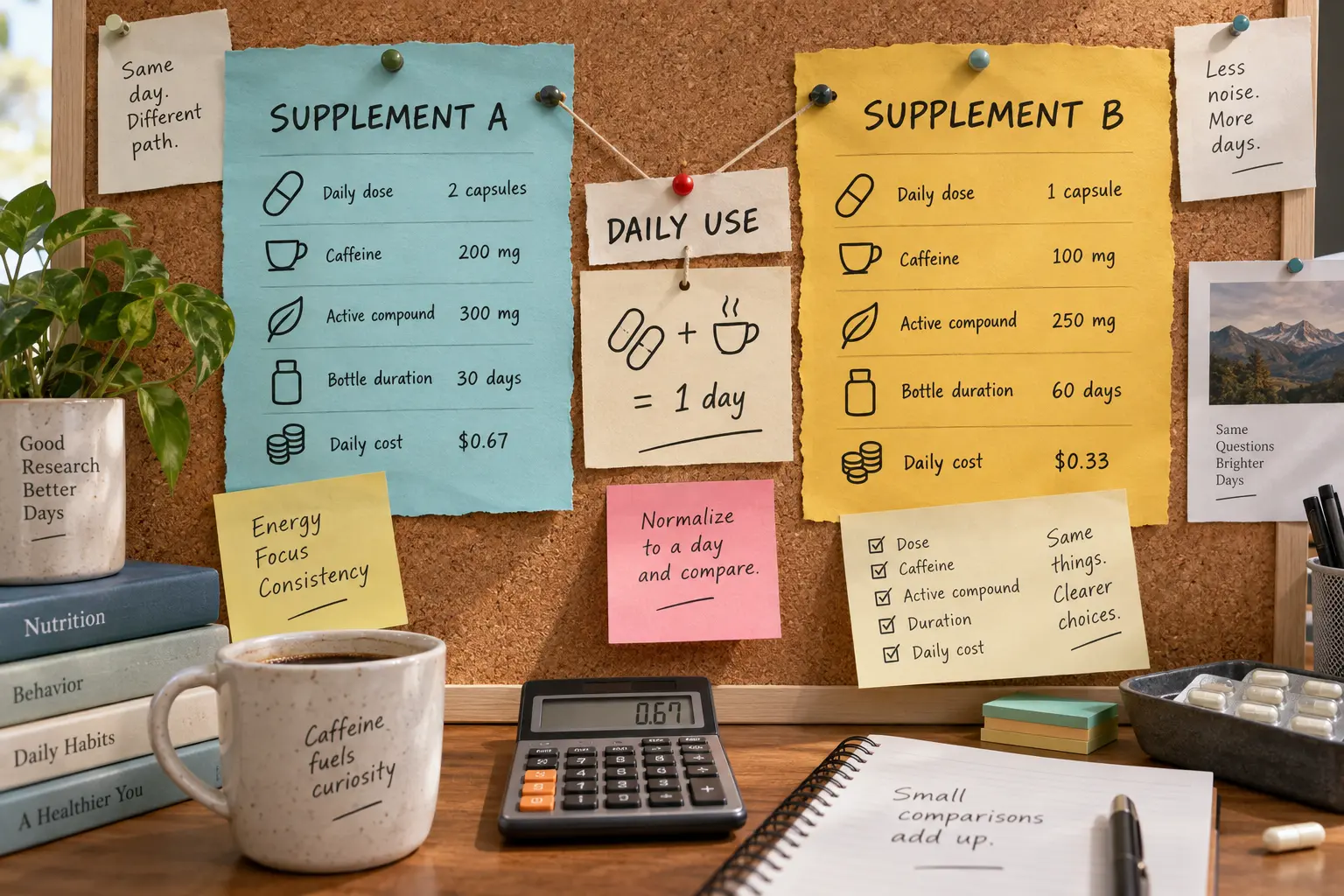
Step 4: total stimulants and overlapping ingredients
Build a caffeine ledger across supplements, coffee, tea, energy drinks, pre-workout, medicines, and botanical sources. Use the label’s all-source total when it explicitly provides one; otherwise mark the calculation incomplete. Also flag duplicated synephrine, yohimbe or yohimbine, green tea extracts, niacin, minerals, and any ingredient relevant to your medicines or conditions.
The comparison question is not merely “Which has more?” Higher exposure can increase insomnia, anxiety, palpitations, blood-pressure effects, headache, or gastrointestinal symptoms. A lower or stimulant-free option may be the more practical match for a person who already drinks coffee or trains late.
Step 5: compare evidence at the correct level
Create separate rows for mechanism evidence, ingredient evidence, combination evidence, and independent finished-product evidence. Match preparation, active yield, dose, duration, population, comparator, and outcome. An acute increase in energy expenditure is not the same endpoint as long-term fat loss. An ingredient study does not automatically validate a multi-ingredient formula containing an undisclosed amount.
Record absolute changes and uncertainty rather than only “statistically significant.” Also compare adverse events, dropout, diet and activity instructions, conflicts of interest, and whether the study duration resembles intended use. If the label prevents dose matching, the evidence row remains unresolved.
Step 6: normalize bottle duration and price
Divide total capsules or scoops by the daily number used in your comparison. Then divide the actual checkout price—including required shipping—by usable days. Account for subscription rules, taxes, bundle expiration, and return conditions. Cost per bottle can be misleading when serving sizes differ.
Price per active amount can be useful only when the active is clearly disclosed and comparable. Do not calculate a precise value from a proprietary blend or unmatched extract. A transparent, tolerable product that fits a routine may offer more practical value than a “stronger” product that disrupts sleep or cannot be evaluated.
Use a decision matrix, not a winner headline
Score only fields that matter to your decision: complete label, relevant active yield, stimulant fit, evidence match, safety constraints, verified seller, daily cost, and unanswered questions. Give uncertainty its own column. Do not award hidden information an average score.
The final answer may be “neither.” Supplements cannot replace a sustainable calorie deficit, adequate protein and fiber, sleep, movement, and clinical care where needed. The panel comparison is a filter for transparency and fit—not proof that either product will produce meaningful weight loss.
Safety and evidence still come first
Dietary supplements are not approved by FDA before marketing in the way drugs are. Read the complete current label and discuss it with a physician or pharmacist if you use prescription or over-the-counter medicines, have cardiovascular, liver, kidney, endocrine, psychiatric, sleep, or gastrointestinal conditions, are pregnant or breastfeeding, are under 18, or have surgery planned. Do not stop or change prescribed treatment to use a supplement.
Stop use and seek urgent care for chest pain, fainting, severe shortness of breath, seizure, confusion, a sustained fast or irregular heartbeat, a serious allergic reaction, or signs of liver injury such as yellow skin or eyes and dark urine. Insomnia, anxiety, tremor, palpitations, severe nausea, or unusual mood changes are adverse effects—not evidence that a fat burner is working.
Apply the same standard to Fat Burn Active
Fat Burn Active should be evaluated with the same rules as any other multi-ingredient weight-management supplement: use the current complete label, calculate the maximum daily exposure, identify stimulant sources, distinguish ingredient research from finished-product evidence, and review personal contraindications. The product name and marketing do not replace those checks.
If you want a practical example, read our independent Fat Burn Active review and the label checklist before buying. If the formula, evidence limits, safety profile, and seller terms remain acceptable, you can verify the current official label and purchase options. We may receive a commission at no extra cost to you.
Frequently asked questions
Should I compare per serving or per day?
Use both, but the maximum labeled daily exposure is the fairest common basis for ingredients, stimulants, duration, and cost.
Is a larger milligram number better?
No. It may reflect a different serving, raw-herb equivalent, inactive bulk, or a less concentrated preparation.
How do I compare proprietary blends?
You can compare total blend weight and ingredient order, but not hidden individual doses. Mark evidence and stimulant calculations as incomplete.
Keep a decision record
Save a small evidence file with dated screenshots, the full label, seller identity, support replies, the studies actually relied on, and your unresolved questions. Record why a claim was accepted, rejected, or left uncertain. This prevents a new advertisement, package redesign, or enthusiastic review from quietly replacing facts you already checked.
Revisit the record when the formula, dose, health status, medicines, caffeine intake, price, or seller changes. A buying decision is valid only for the version and circumstances reviewed. When a material fact cannot be verified, choosing a clearer product is a rational outcome—not a failure to finish the comparison.
Separate deal breakers from preferences before shopping. An undisclosed stimulant amount, a medicine interaction, a mismatched label, or an unverified seller can stop the decision. Flavor, capsule count, and delivery speed can be compared only after those gates are passed. This order prevents a discount or dramatic story from outweighing a safety-relevant unknown.
Sources
- FDA: Questions and Answers on Dietary Supplements
- FDA Dietary Supplement Labeling Guide
- FTC Health Products Compliance Guidance
- FTC: Disclosures 101
- NIH Dietary Supplement Label Database
Sources reviewed September 19, 2026. Educational information only; not medical advice.