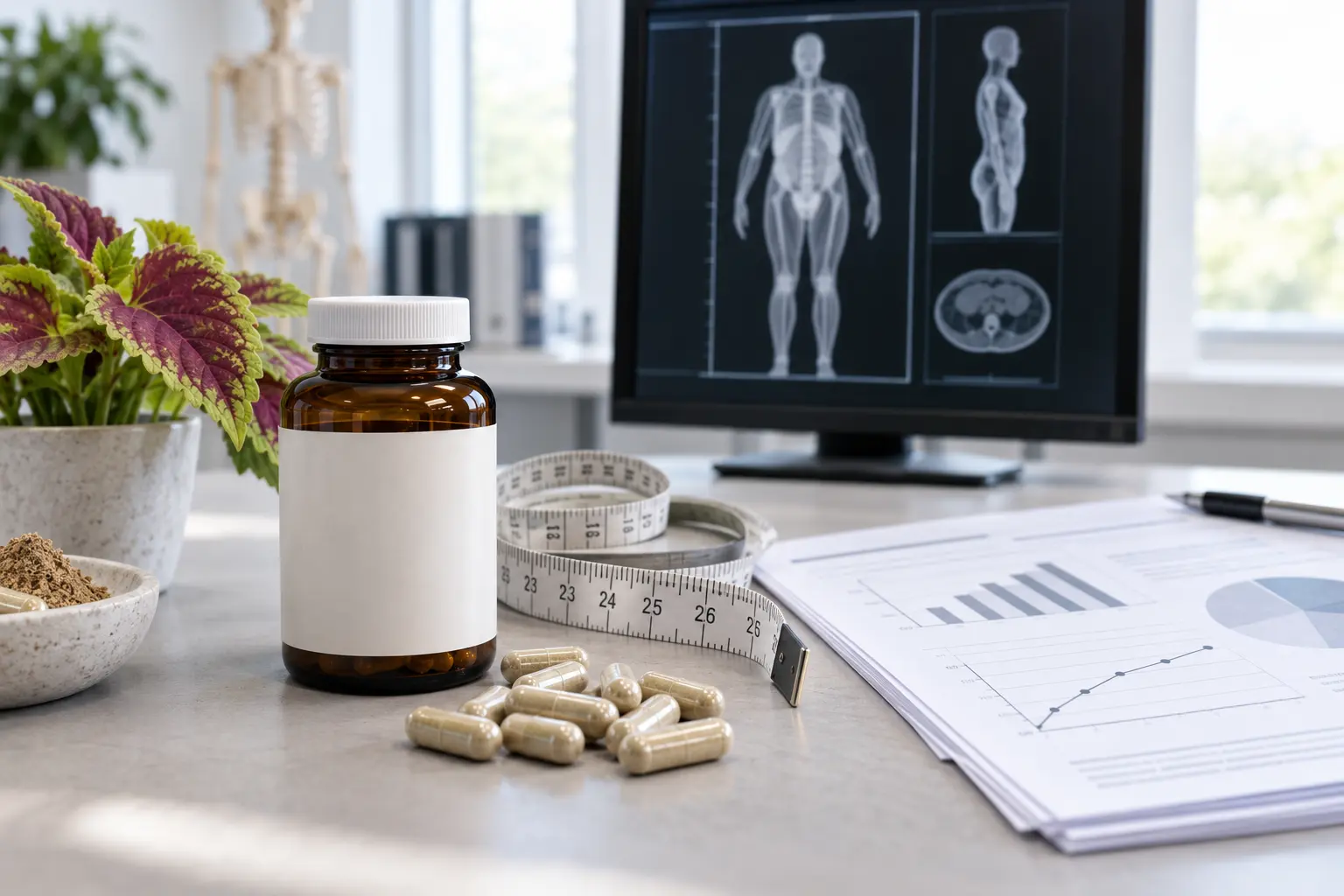
The short answer
Forskolin has limited human evidence for body-composition changes, but it has not shown consistent, dependable weight loss. A favorable result from one small subgroup or one DXA outcome should not be turned into a broad promise to reduce body fat or build lean mass.
This page focuses on clinical body-composition endpoints—fat mass, body-fat percentage, lean mass, waist, and scale weight—rather than botanical sourcing.
What the mechanism can—and cannot—show
Body composition and body weight answer different questions. A person can show little scale change while fat and lean compartments shift, but measurement error, hydration, analysis choices, and multiple endpoints can also produce apparently favorable results. The between-group difference and confidence around it matter.
A biochemical pathway can make a hypothesis plausible. It cannot substitute for randomized human trials measuring weight, waist, fat mass, or another outcome buyers actually care about. Ingredient evidence also cannot be transferred automatically to a proprietary blend or finished formula.

What human evidence says
The best-known 12-week male trial was small. It reported favorable differences for fat mass and body-fat percentage, yet body-weight change was not significantly different and the lean-mass result was a trend. A separate female trial did not support weight loss. The evidence base is too thin for a confident average effect or a reliable prediction for an individual buyer.
Start with the absolute between-group difference, not a percentage quoted from the supplement group alone. Check confidence intervals, sample size, dropout, background diet and activity, adverse events, funding, and whether the exact outcome was selected before analysis. One positive endpoint among many can be a chance finding.
A five-step label audit
- Separate weight, fat mass, body-fat percentage, lean mass, and waist.
- Read between-group results rather than active-group change alone.
- Check how body composition was measured and whether outcomes were prespecified.
- Look for confidence intervals, dropout, multiple comparisons, and replication.
- Verify that the label provides the tested standardized daily dose.
If any required amount is hidden, record it as unknown—not zero and not “probably similar” to a trial. A certificate or trademark can support identity and manufacturing questions, but it does not prove meaningful weight loss.
Worked example
Marketing states that forskolin “changed body composition” and displays a body-fat percentage. The paper also reports no significant body-weight difference and a nonsignificant lean-mass trend. A fair summary includes all three findings, the sample size, duration, and need for replication.
This method prevents four common errors: turning a mechanism into an outcome, treating an ingredient trial as formula evidence, confusing statistical significance with practical importance, and assuming a stronger sensation means greater fat loss.
Set a realistic decision threshold
Before buying, write the intended benefit, the minimum change that would justify cost, the evaluation period, and stopping rules. Use a rolling weight trend, consistently measured waist, body-composition data only when the method is sufficiently reliable, and notes on adherence and adverse effects.
Do not change the diet, training plan, sleep schedule, and several supplements at once. If the trend changes, too many simultaneous variables make the cause unknowable. A null result is useful information; it does not justify escalating beyond the label.
Safety, interactions, and product quality
“Natural” and “non-stimulant” do not mean interaction-free. Botanical extracts and bioavailability enhancers can alter drug exposure or affect blood pressure, digestion, bleeding, or other systems. Risk depends on the full formula, dose, medicines, conditions, pregnancy, surgery, and individual sensitivity.
Choose a complete Supplement Facts panel, lot number, contact information, clear warnings, and independent quality verification where available. Quality testing can support identity and contamination control; it cannot establish efficacy. Stop a suspected product and seek appropriate care for a significant reaction.
Related Active Body Hub guides
Compare this outcome-focused analysis with the Coleus forskohlii extract guide, clinically meaningful effects, and DEXA scans for body composition.
Also see mechanism versus measurable outcome and why exact ingredient amounts matter.
Where Fat Burn Active fits
The same rules apply to Fat Burn Active. The presence of a familiar botanical, absorption enhancer, or fat-metabolism ingredient does not prove that the finished formula produces meaningful weight loss. Assess disclosed daily amounts, stimulant exposure, contraindications, and direct product-level evidence.
The official Fat Burn Active page lists a multi-ingredient thermogenic formula, but the buying decision for Forskolin for Body Composition should follow the evidence check above. Compare our independent review, then, if the product remains a reasonable fit, verify the current label, directions, and purchase options. We may receive a commission at no additional cost.
Body composition is not a synonym for weight loss
Forskolin is an active compound associated with Coleus forskohlii extracts. Its cellular signaling role can motivate research, but the important consumer question is whether a comparable oral dose changes a meaningful body-composition outcome in humans. A trial might show a shift in estimated fat percentage while total body weight barely changes. Those results need different wording. Check the measurement method, comparison group, confidence interval, and whether the finding was a prespecified outcome.
Small studies can give unstable body-composition estimates, especially when hydration, training, diet, or measurement conditions differ. A result in one sex or participant group does not automatically generalize to everyone. Read whether the study used purified forskolin or an extract standardized to it and calculate the daily active amount. The name on a product page may emphasize forskolin while the Supplement Facts panel lists only the parent plant extract.
When a headline says “increased lean mass,” ask whether the researchers directly measured muscle gain or estimated a lean compartment that can also reflect water and other tissue. Compare the baseline and follow-up methods and whether groups differed on exercise or intake. An appealing mechanistic explanation cannot resolve uncertainty in the actual outcome. If the exact multi-ingredient product was not tested, keep the ingredient-level and finished-product conclusions separate.
For a purchase decision, write a realistic threshold: what sustained, measurable benefit would justify the price and potential downsides? If human evidence remains small or inconsistent at the relevant dose, say so. The related coleus page helps translate extract percentages into an approximate forskolin amount; this page should answer whether that amount has dependable body-composition evidence. Neither answer should promise that a formula with additional stimulants is effective or safe for a particular buyer.
Frequently asked questions
Does a mechanism prove this ingredient burns body fat?
No. A pathway or laboratory effect must be confirmed by relevant human outcomes at the same ingredient and dose.
Is a standardized extract automatically effective?
No. Standardization improves dose clarity and repeatability. Efficacy still depends on adequate clinical evidence and a product that matches it.
Can ingredient evidence validate a multi-ingredient formula?
Only indirectly. Different doses, extracts, combinations, and tolerability can change the result. Direct finished-product trials provide stronger formula-level evidence.
How long should I test it?
Do not invent a duration from marketing. Use the label, relevant trial period, professional advice, a predefined review date, and immediate stopping rules for adverse effects.
Keep a one-page evidence note with the exact label, dose, trial population, comparator, outcome, absolute effect, uncertainty, adverse events, funding, and unresolved question. It makes later product claims easier to test against what the research actually showed.
Sources
- Godard et al.: Body composition and forskolin
- Full text: Effects of Coleus supplementation
- Henderson et al.: Coleus in overweight women
- Loftus et al.: Randomized Coleus extract study
- Review of anti-obesity and metabolic effects
- NIH ODS: Weight-loss supplements
Evidence reviewed September 16, 2026. Educational information only; not medical advice.