| Ingredient | Extract | Standardization | Nominal marker |
|---|---|---|---|
| Microencapsulated aXivite | 112 mg | 1% phenylcapsaicin | About 1.12 mg phenylcapsaicin per two capsules |
The marker figure is arithmetic based on the merchant’s published percentage, not independent laboratory verification. Confirm the label on the bottle.
Start with the label, not the trademark
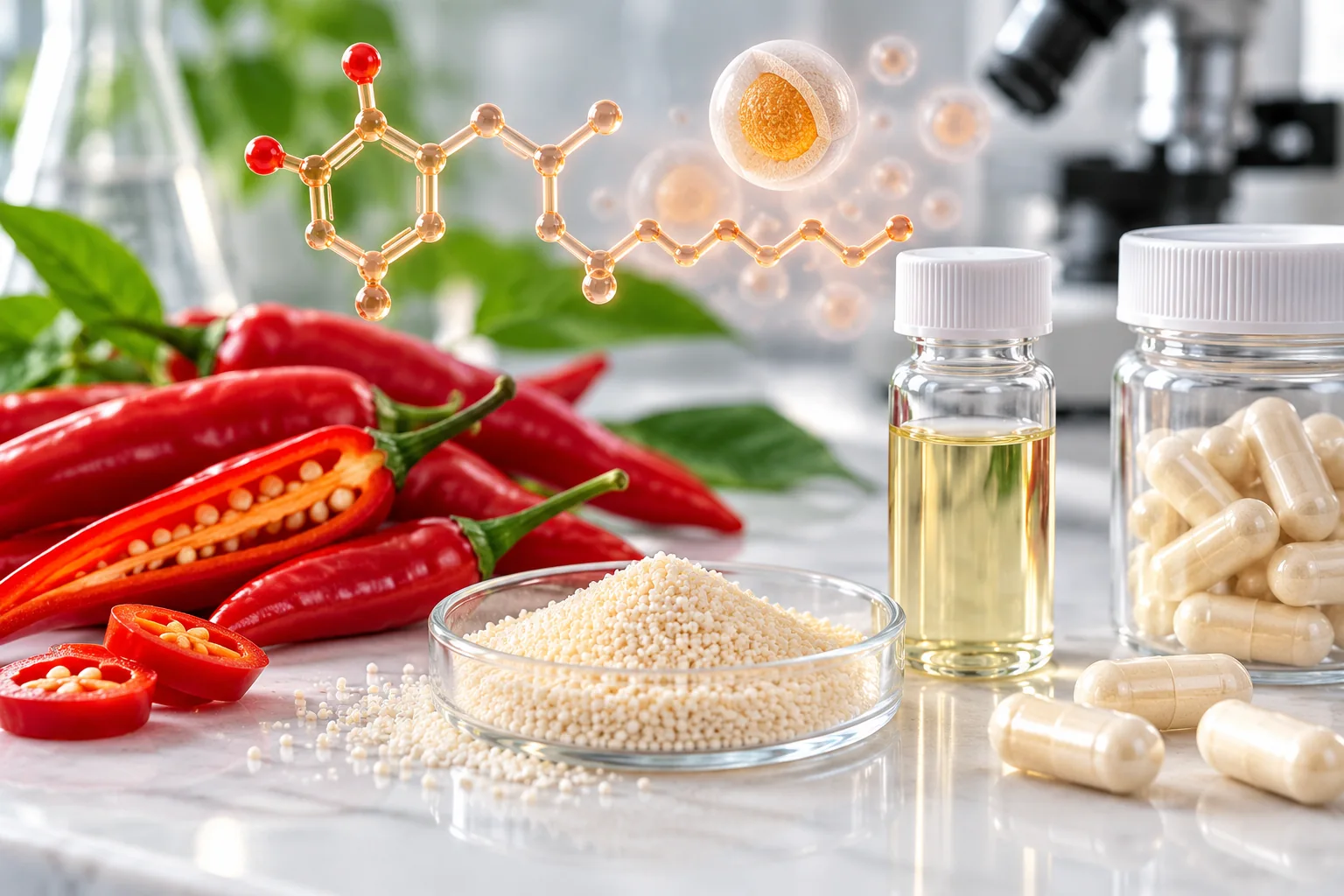
aXivite is a branded phenylcapsaicin ingredient. Fat Burn Active’s US page lists 112 mg of the microencapsulated material standardized to 1% phenylcapsaicin in a two-capsule serving. The calculation 112 × 0.01 yields 1.12 mg nominal phenylcapsaicin. That is not 112 mg of pure phenylcapsaicin, and it is not an independent assay. Packaging, formulation, and the exact product you receive should be checked before applying any online calculation.
Phenylcapsaicin is a synthetic capsaicin analogue; a chili pepper photograph is only an illustration of the related compound family, not proof that the ingredient was extracted from that pepper. Likewise, research on capsaicin or a different capsinoid cannot simply be relabeled as research on this particular ingredient. The trademark helps identify the supplier’s material, while efficacy and safety still require human evidence at relevant exposure.
What the weight-control study measured
A published eight-week placebo-controlled phenylcapsaicin study enrolled 54 people, with 72% completing it. The active groups took 0.560 mg or 1.12 mg daily, while participants also followed a diet and walking program. The paper reported favorable body-composition outcomes, with some results stronger in the lower-dose group. Because the current product page’s nominal 1.12 mg resembles the higher dose, the study is worth reading directly; resemblance alone does not transfer the result to a multi-ingredient capsule.
Consider the study’s size, attrition, concurrent diet and exercise, measurement method, and need for independent replication. The paper itself calls for larger and more diverse samples and notes uncertainty around serum zonulin as a marker of intestinal permeability. Do not turn a reported zonulin change into proof that this product treats gut disease or obesity. Its authors studied phenylcapsaicin, not the combined Fat Burn Active formulation.
Exercise research answers a different question
Other phenylcapsaicin trials have tested immediate exercise performance, perceived effort, or fat oxidation during a workout. Those short-term endpoints are not equivalent to a sustained change in body fat. For example, a crossover study on aerobic capacity and substrate use can show what happened during controlled exercise sessions, but cannot tell you whether buying this bottle causes meaningful weight loss over months.
This distinction is especially important because Fat Burn Active also contains caffeine and other botanical extracts that could affect energy, tolerance, or exercise perceptions. A person who feels more stimulated after taking it has not thereby demonstrated greater fat loss. Separate what was measured, what was inferred, and what the merchant promises. A study at a matching nominal dose is a closer clue than a completely unrelated trial, but it is still only ingredient-level evidence.
Safety and product-level uncertainty
The merchant advises two capsules before a meal or training, not on an empty stomach, and warns against combining its caffeine-containing formula with other caffeine sources. That warning applies even when the phenylcapsaicin amount looks small. Check the entire label and speak with a qualified clinician or pharmacist if medications, cardiovascular concerns, liver disease, or other conditions make a stimulant blend a poor fit. A short ingredient study cannot establish safety for every population or every long-term combination.
There is also a naming trap: microencapsulation describes delivery of the branded ingredient, not proof of fourfold absorption or superior clinical outcomes from this finished formula. If the manufacturer cites such a number, request the direct study, dose, comparator, and formulation. Without that bridge, treat it as a manufacturer claim. Do not raise the number of capsules to chase the lower or higher research arm; doing so alters every other ingredient.
How to use the evidence when deciding
Write three columns: the merchant’s label claim, what an actual phenylcapsaicin human study tested, and what remains unknown for the finished product. You can match a nominal ingredient amount while still lacking a product-level trial, a long-term outcome, and an answer about the contribution of the other extracts. Avoid grading the whole formula as clinically proven simply because a branded component has a published study.
The most useful next step is to review the current label checklist, personal safety, and realistic alternatives. If the unresolved questions are material to you, waiting or choosing no supplement is reasonable. A short study may justify curiosity, not certainty or a promise that your weight will change.
A more careful reading of the eight-week result
When a study has 54 enrollees but only about 72% complete it, inspect why participants left and whether the analysis includes everyone randomized. Attrition can affect confidence in a small body-composition finding, particularly when several measures and doses are explored. The two active doses and placebo arm also create opportunities to highlight a favorable subgroup while neglecting the full pattern. The fact that some effects were stronger at the lower dose argues against assuming a simple more-is-better response.
Diet and walking in all arms help frame the comparison, but do not tell us what would happen without those behaviors or in a buyer using a multi-ingredient stimulant. Check whether body-fat changes are between-arm differences and how they were measured. A well-described branded-ingredient trial is a useful lead for future research; it is not a license to claim that the retail formula has undergone the same test. The safest wording for the product remains an unverified benefit with a relevant ingredient-level signal.
The term microencapsulated describes the physical presentation of the compound and may affect handling or delivery. It does not identify the size of a human weight-loss effect. If you see a percentage improvement in advertising, find the absolute change, the placebo result, and the number of participants included in that analysis. These checks matter more than a striking ingredient name when choosing whether to spend money.
If you are considering the product
First read the full Fat Burn Active review and compare the current package with the manufacturer’s online panel. Check the other stimulant sources, your medicines and health conditions, and whether the expected benefit is worth the cost and uncertainty. If the product still fits your decision, you may inspect the current product offer. We may earn a commission from a purchase. That relationship does not change the evidence standard; choosing no supplement is a valid outcome.
Frequently asked questions
Does 112 mg mean 112 mg phenylcapsaicin?
No. At the stated 1% concentration it implies about 1.12 mg active compound.
Was Fat Burn Active itself studied for eight weeks?
The cited eight-week paper tested phenylcapsaicin under a diet and activity program, not this finished mixture.
Does increased workout fat oxidation mean body-fat loss?
No. It measures short-term fuel use, not sustained changes in stored body fat.
Sources
- Fat Burn Active US formula and warnings
- Eight-week phenylcapsaicin study
- Jiménez-Martínez et al., 2023 exercise trial
- Phenylcapsaicin dose and resistance exercise trial
- NIH ODS: Weight-Loss Supplements
- FDA: Dietary Supplement Questions and Answers
Ingredient evidence and manufacturer claims were reviewed separately. Educational information only; not medical advice.