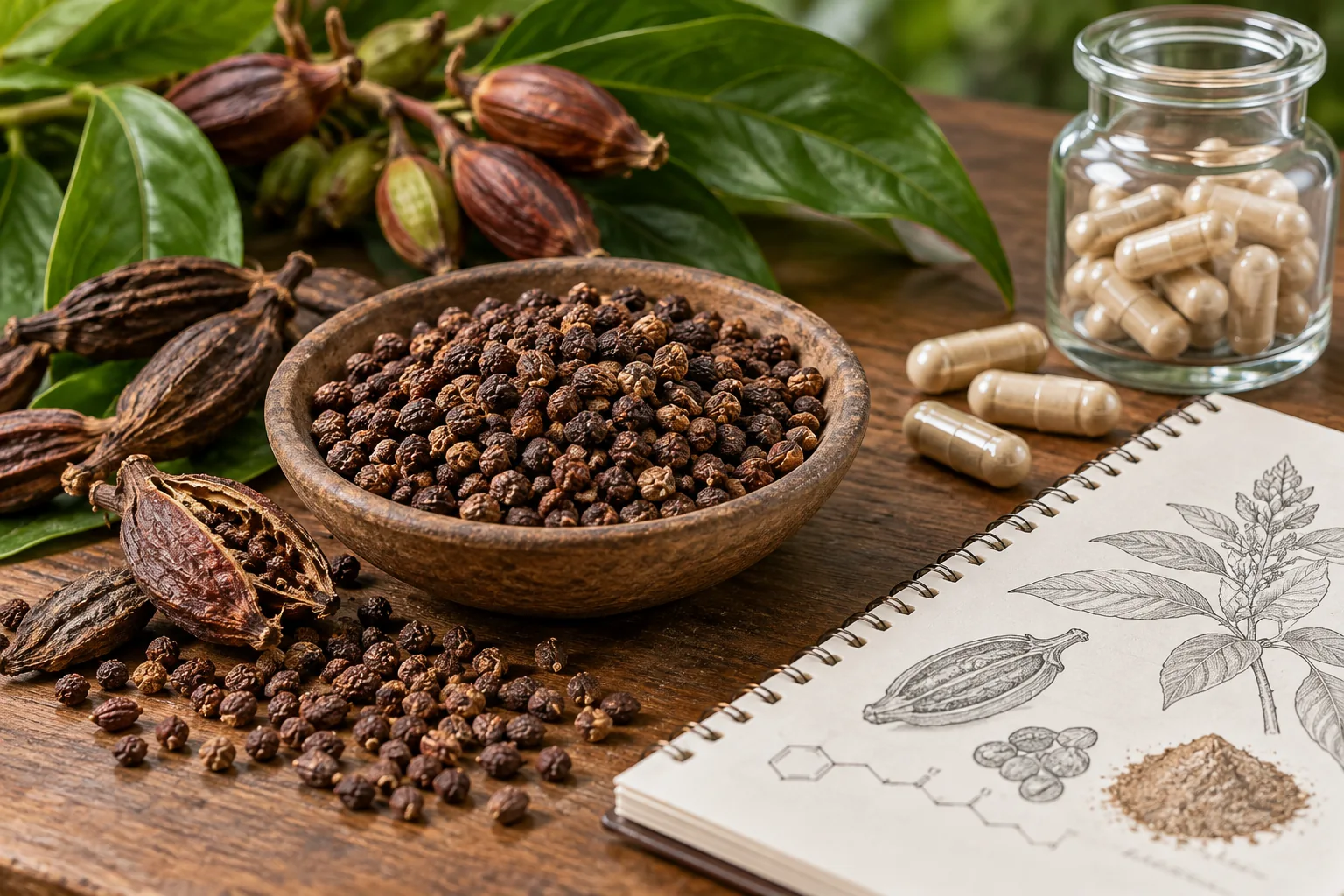
| Ingredient | Extract | Standardization | Nominal marker |
|---|---|---|---|
| Grains of paradise seed extract | 80 mg | 12.5% 6-paradol | About 10 mg 6-paradol per two capsules |
The marker figure is arithmetic based on the merchant’s published percentage, not independent laboratory verification. Confirm the label on the bottle.
What 80 mg on the label does and does not mean
The US merchant page lists 80 mg Aframomum melegueta seed extract at 12.5% 6-paradol for a recommended two-capsule serving. The nominal marker amount is 80 × 0.125 = 10 mg. That is useful information to record, but the calculation does not independently confirm an individual lot’s composition or reveal every other active compound in the extract. Check the package you receive against the online list.
Grains of paradise is a botanical ingredient whose pungent compounds include paradols. A standardized percentage is more helpful than an unspecified powder, yet it does not tell you that this brand has completed a finished-product clinical trial. The formula includes several other extracts and caffeine, so any real-world response would be difficult to attribute to 6-paradol alone without a suitable comparison.
The small human study most often cited
A randomized, single-blind crossover trial followed 19 non-obese women aged 20–22 who consumed 30 mg grains-of-paradise extract daily for four weeks. Researchers reported a difference in visceral-fat-area change versus placebo and higher whole-body energy expenditure. They did not find changes in subcutaneous or total fat. These details narrow the finding: it was not a broad demonstration of clinically meaningful total weight loss in people with obesity.
The Fat Burn Active page lists 80 mg extract, which is a different amount. The trial’s extract cannot be assumed equivalent based on mass alone because the standardization and composition need to match. Its small, narrow sample and short period also limit generalization. A higher number printed on a label does not mean a proportionally larger benefit, nor does it mean the whole multi-ingredient product has the same result.
Acute thermogenesis is a separate endpoint
An earlier human experiment investigated a single grains-of-paradise ingestion and brown adipose tissue activity or energy expenditure. Such physiology can be interesting when exploring a mechanism, but it does not tell a reader how many kilograms of body fat will be lost after months of use. The four-week trial adds a body-composition measure, yet it remains small and leaves total fat unchanged. Both studies can inform a cautious hypothesis without serving as a guarantee.
Be wary when a sales page phrases increased energy expenditure as if fat tissue must visibly disappear. The body can adjust food intake, activity, and energy expenditure in ways an acute test does not capture. The practical buying question is whether independently replicated human studies of a comparable extract and dose show a useful, sustained outcome. That bar has not been met for the finished Fat Burn Active formula.
Dose, population, and formula matching
A rigorous comparison asks which species and part of the plant were used, how an extract was made, whether 6-paradol was measured, the daily serving schedule, who participated, what the placebo was, and how body fat was measured. The manufacturer provides an extract amount and marker percentage, but not all of those trial-to-product bridges. Do not use a study in young, non-obese women to predict an identical response for older adults or people with medical conditions.
Nor should you double or split product doses to imitate an isolated-ingredient protocol. Changing two-capsule directions would also change caffeine, synephrine, EGCG, and other exposures. Read the full product warnings and discuss relevant medications or cardiovascular concerns with a clinician or pharmacist. The whole-formula thermogenic guide provides broader context.
A decision that respects uncertainty
The most favorable interpretation is that a small early human trial produced a signal for one measure of visceral fat with a particular grains-of-paradise extract over four weeks. The less favorable, equally important detail is that subcutaneous and total fat were unchanged, and the result has not established a sustained clinical benefit from this finished supplement. A product description that mentions only the positive endpoint presents an incomplete picture.
If you compare Fat Burn Active with another product, use the same standard for both: current disclosed formula, relevant human outcome evidence, personal safety, and actual cost. You can value the disclosed 6-paradol percentage without treating it as proof. Choosing a less complex product, a different approach, or no supplement may fit the evidence and your circumstances better.
What the reported fat measure can tell you
Visceral-fat area is a specific imaging-derived body-composition measure, not interchangeable with total fat mass, waist size, or scale weight. The four-week crossover study’s signal merits examination because its placebo comparison addresses a sharper question than a testimonial. But a small change on one endpoint in 19 young participants cannot determine the long-term clinical value of daily capsules for a broad audience. A crossover design also calls for attention to treatment order and washout.
For a closer match, a follow-up study would test the same characterized extract, at the same daily marker amount, against placebo in a larger and more representative sample. It would prespecify a meaningful primary outcome and report both total and visceral fat after adequate follow-up. The current product gives a nominal 6-paradol concentration but no direct evidence that its combination replicates the reported signal. Until such data exist, comparing exact numbers on two labels is informative for exposure, not a prediction of benefit.
Pay particular attention to the direction and size of the between-period comparison rather than the before-and-after value for one group. If a study's outcome is reported only in a subgroup, find out how the subgroup was chosen. Also look for adverse-event reporting, because a small trial may be unable to detect uncommon reactions. These questions are fair even when the preliminary result seems encouraging.
If you are considering the product
First read the full Fat Burn Active review and compare the current package with the manufacturer’s online panel. Check the other stimulant sources, your medicines and health conditions, and whether the expected benefit is worth the cost and uncertainty. If the product still fits your decision, you may inspect the current product offer. We may earn a commission from a purchase. That relationship does not change the evidence standard; choosing no supplement is a valid outcome.
Frequently asked questions
Is 80 mg all 6-paradol?
No. At the stated 12.5% marker concentration, the nominal 6-paradol amount is about 10 mg.
Did the four-week trial show total body-fat loss?
No. It reported a visceral-fat-area signal but no change in subcutaneous or total fat.
Does a larger extract amount guarantee a larger effect?
No. Different extract composition, dose-response, people, and the full formula prevent that inference.
Sources
- Fat Burn Active US formula
- Sugita et al., 2014 four-week trial
- Sugita et al., 2013 acute energy study
- NIH ODS: Weight-Loss Supplements
- FDA: Dietary Supplement Questions and Answers
Ingredient evidence and manufacturer claims were reviewed separately. Educational information only; not medical advice.