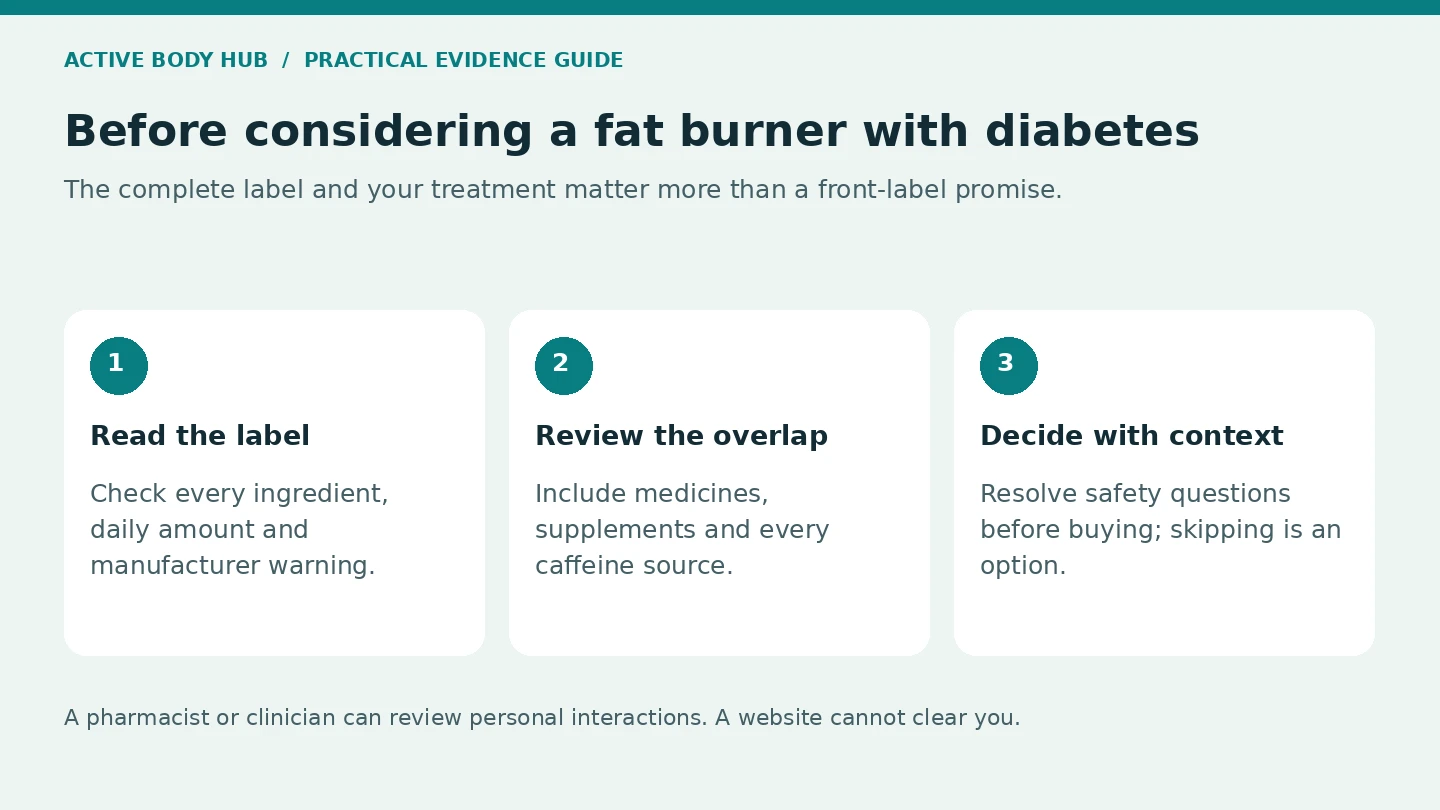
Start with the question a product page cannot answer
A product can be legally sold, have an attractive label, and still be an unsuitable choice for a particular person. The important question is not whether a capsule is described as natural. It is whether its actual ingredients and amounts fit your health conditions and treatment. A review or seller cannot establish this without your medical context.
Diabetes can coexist with high blood pressure, cardiovascular disease, kidney disease, and other concerns. A formula marketed to increase energy or suppress appetite may complicate a routine that already depends on predictable meals and activity. More alertness, sweating, or a lower appetite does not prove better glucose control or meaningful fat loss. [1]
Identify every stimulant source
Caffeine may appear as a separate ingredient or within guarana, tea, and coffee extracts. Bitter orange can supply synephrine. Reading only the largest caffeine number may miss other sources. An extract percentage can help calculate a nominal amount, but an unspecified caffeine contribution leaves the total incomplete.
For Fat Burn Active, the manufacturer lists 76 mg of caffeine anhydrous and 200 mg of guarana standardized to 22 percent caffeine per two capsules. Those figures yield a known minimum of 120 mg before any unquantified caffeine from green tea. [3] This is label arithmetic, not an independent test result or a safe personal dose. Do not add coffee or pre-workout to compensate for an uncertain effect.
Consider meal changes and low-glucose risk
If a product reduces appetite and you eat less than usual, the change may matter for your diabetes regimen. Insulin and some other glucose-lowering medicines can cause hypoglycemia. Ask your care team how meal timing, activity, and monitoring should be coordinated before making a major change. Never use a stimulant to mask weakness or delay an appropriate meal.
Tremor, sweating, a racing heart, and feeling unwell should not automatically be dismissed as a fat burner working. These symptoms can have different causes, including low glucose or a stimulant reaction. Follow your individualized diabetes response plan and seek medical help when symptoms are severe or do not resolve. An online article cannot distinguish the cause for you.
Check botanical ingredients and medicine interactions
Caffeine can affect glucose control. A systematic review of small trials found worsened glucose responses in participants with type 2 diabetes after caffeine, commonly at 200–500 mg. Those findings do not predict your response to a lower dose or a mixed formula. They are a reason to review exposure with your care team, not to change medicines yourself. [7]
Take the complete label, prescriptions, other supplements and usual drinks to a pharmacist. Include piperine-containing products in the review rather than assuming botanical ingredients cannot interact. If amounts or warnings cannot be verified, defer purchase until the uncertainty is resolved.
Recognize what the evidence does not establish
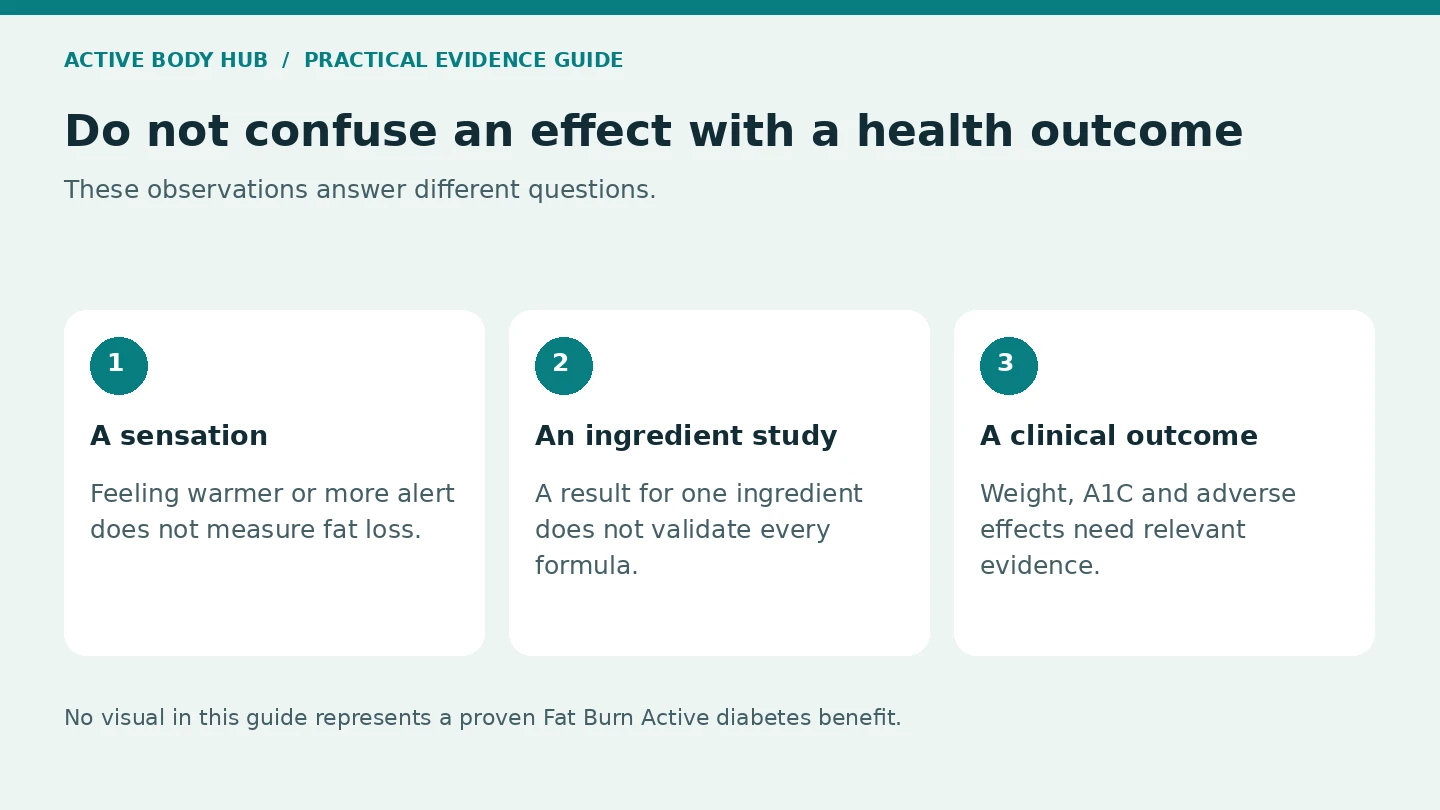
An ingredient study does not test every capsule containing it. Short-term energy expenditure cannot establish long-term fat loss or better A1C. Check preparation, dose, population, duration and outcome.
NCCIH concludes that evidence is insufficient to show dietary supplements can manage or prevent type 2 diabetes. This does not mean every ingredient has identical risks or no biological effect. It means a seller should not turn preliminary findings into a reliable diabetes solution. Claims that a supplement replaces medication are a strong reason to walk away.
Use a practical buy-or-skip checklist
Before buying, define the goal and expected value. Obtain the current label, warnings and all-source caffeine amount. Have the formula reviewed with your medicines, agree on relevant monitoring, and know when to stop.
Skip or defer when critical safety information is missing, the label conflicts with your medical situation, or the pitch depends on glucose-lowering promises that are unsupported. You can pursue weight management without a fat burner. A meal review, suitable activity, sleep support, or prescribed treatment discussion may address the actual obstacle more directly.
Where to go next
For a named product, read our Fat Burn Active and diabetes guide and the full product review. They separate manufacturer label facts from conclusions about effectiveness. This is a route to clearer information, not an endorsement for every person with diabetes. Any purchase decision still needs to respect your care plan and the current product warnings.
Bring the specific problem—hunger, a plateau or treatment-related gain—and when it started to your appointment. Keep prescribed care in place while the cause and options are reviewed.
Separate documented concerns from uncertainty
A useful safety review should tell you how strong each concern is. It should not turn a general warning about supplements into an allegation that one named product is contaminated or will cause a particular complication.
| Question | What is supported | What remains uncertain |
|---|---|---|
| Can glucose fall when meals change? | Insulin, sulfonylureas and meglitinides can cause low glucose. [4] | Your individual response requires your care plan. |
| Does bitter orange have safety concerns? | Serious events have been reported with multi-ingredient products. [5] | Reports do not establish which ingredient caused an event. |
| Does a label prove safety? | It describes declared ingredients and warnings. | It does not independently verify a batch or every combination. |
OTC does not describe one category
Do not group a stimulant-based supplement, a prescribed diabetes medicine and every nonprescription weight-management product under the same label. They can have different ingredients, regulatory pathways, evidence and warnings. Evaluate the exact product and purpose. This article concerns supplements sold as fat burners, not a personalized assessment of every weight-loss medicine.
Prepare a useful pharmacist review
Bring photos of the complete current label, the maximum intended daily amount, your medicines, other supplements and usual drinks. Ask which concerns are documented, which are theoretical and which cannot be assessed because information is missing. Record the answer instead of interpreting silence on a sales page as reassurance.
If you develop a suspected reaction, stop using the supplement and seek appropriate medical advice. Severe chest symptoms, fainting, difficulty breathing or confusion need urgent help. Keep the packaging and ingredient list available. For suspected low glucose, follow your established diabetes response plan rather than guessing whether the symptoms are merely caffeine effects.
Evaluate a named product
For formula-specific details, read Fat Burn Active and diabetes. Our full product review contains affiliate links; we may earn a commission if you buy. It does not provide medical clearance.
Frequently asked questions
Does stimulant-free mean safe with diabetes?
No. Removing caffeine does not establish effectiveness, rule out other active ingredients or resolve medicine interactions. Review the complete formula.
Does FDA approval appear on ordinary supplement labels?
Dietary supplements are not approved by FDA for safety and effectiveness before marketing. A claim of registration or a facility claim is not product approval. [6]
Does a warning about contaminated supplements prove this product is contaminated?
No. A category-level warning does not establish a finding about a particular product or batch. Avoid both unsupported reassurance and unsupported accusations.
Sources and editorial notes
- NCCIH: Diabetes and Dietary Supplements
- NIDDK: Healthy Living with Diabetes
- Fat Burn Active: Official Formula and Warnings
- NIDDK: Low Blood Glucose
- NCCIH: Bitter Orange
- FDA: Information for Consumers on Dietary Supplements
- Whitehead and White: Systematic Review of Caffeine and Glucose in Diabetes (2013)
Prepared with AI assistance and source verification by Active Body Hub. No clinical review, personal product use or laboratory testing is claimed. Sources checked October 25, 2026. Manufacturer information establishes label facts, not independent evidence of efficacy. This article concerns adults and type 2 diabetes or prediabetes; it does not provide type 1 diabetes treatment instructions.