The direct answer: a fat burner is not diabetes therapy
People often search for a product after struggling with weight, appetite, or glucose results. That is understandable, but these are different outcomes. A capsule that changes alertness or the sensation of warmth has not necessarily improved glucose control. Weight-management marketing cannot be treated as proof that a product treats the underlying condition.
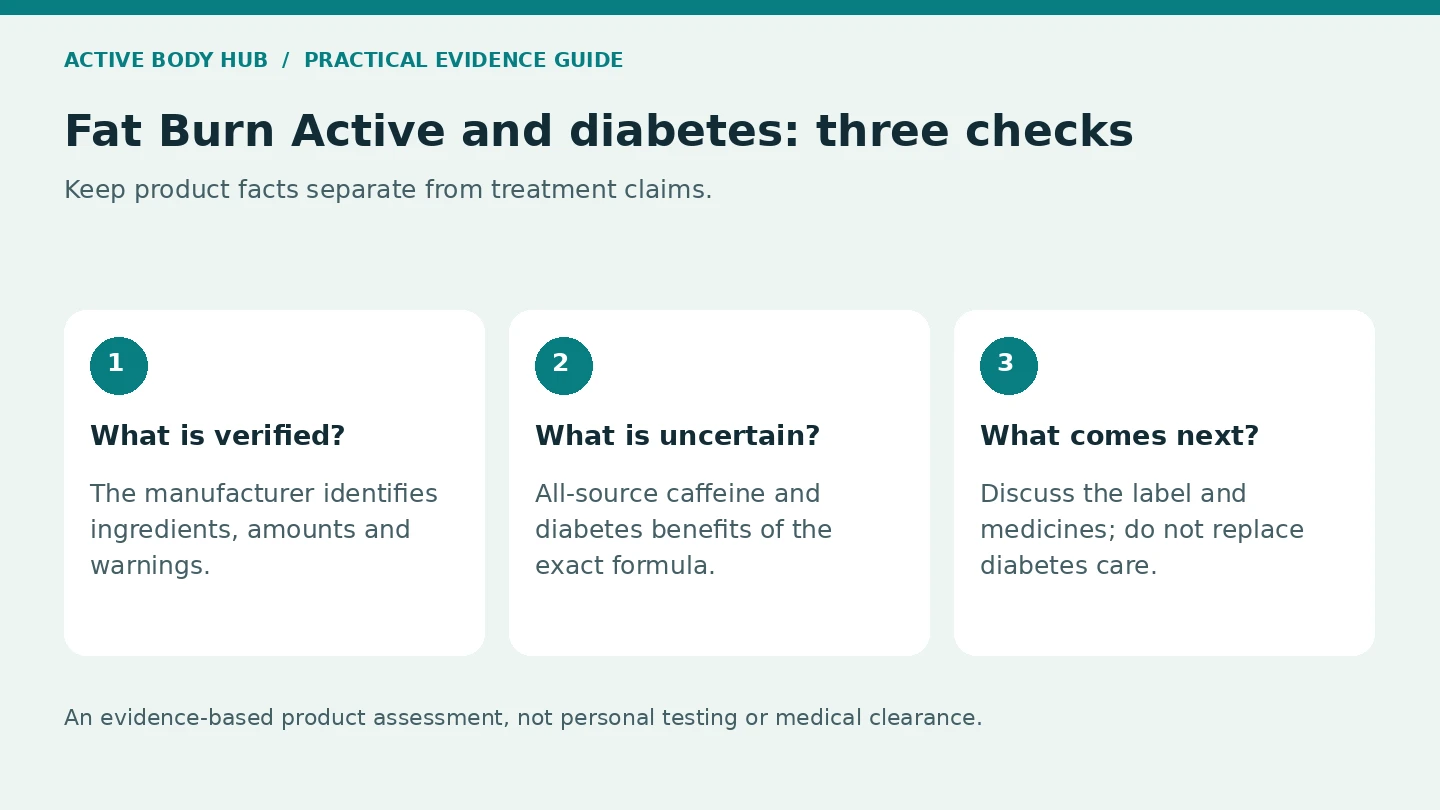
We did not verify a clinical trial of the exact marketed formula establishing diabetes benefits. This describes the reviewed evidence, not proof that no study exists. Ask for finished-product glucose outcomes rather than ingredient summaries or testimonials.
What the current manufacturer table discloses
The official page lists a daily serving of two capsules. It specifies 250 mg Coleus forskohlii extract, 250 mg green tea extract, 200 mg guarana, 112 mg aXivite phenylcapsaicin preparation, 100 mg bitter orange extract, 80 mg grains of paradise, 76 mg caffeine anhydrous, and 2 mg BioPerine. It also lists vitamin B6, pantothenic acid, and zinc.
Several percentages allow nominal active-yield calculations: 25 mg forskolin, 100 mg EGCG, 44 mg caffeine from guarana, 1.12 mg phenylcapsaicin, 6 mg synephrine, 10 mg 6-paradol, and 1.9 mg piperine. These calculations describe declared specifications. They are not independent verification of a delivered bottle and do not establish efficacy at those amounts.
Caffeine is the clearest unresolved exposure
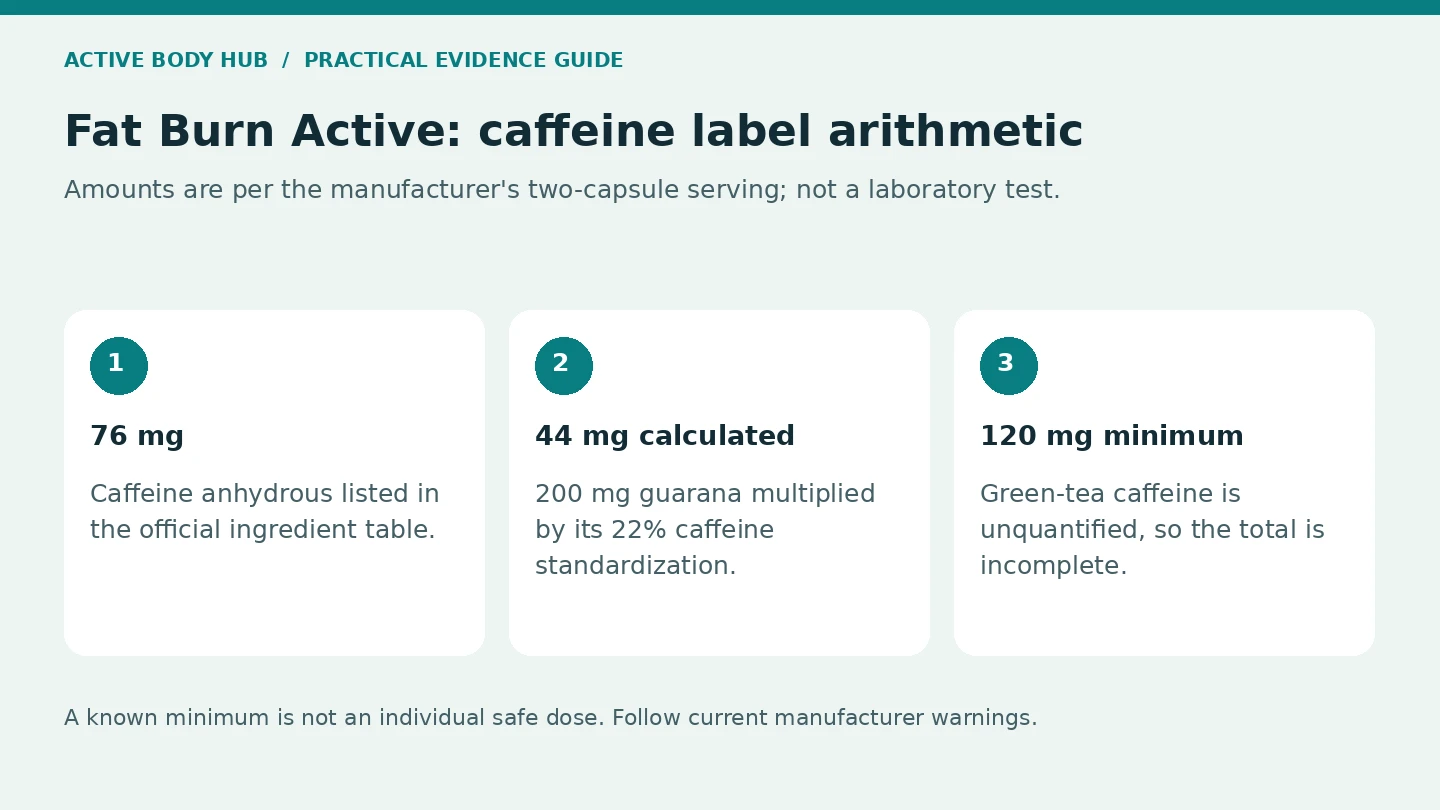
The 76 mg caffeine anhydrous plus calculated 44 mg from guarana gives a known minimum of 120 mg per two capsules. [1] The table does not quantify green-tea caffeine, so the all-source total remains unresolved. A minimum is not the same as a complete daily exposure estimate.
The manufacturer's warning says not to combine the product with other caffeine sources or ingredients with similar effects. It also says not to use it in cardiovascular disease or caffeine hypersensitivity. Do not replace those restrictions with a general population caffeine guideline. If a warning conflicts with your situation, a product review is not permission to disregard it.
What the ingredient research can—and cannot—tell you
Research on one ingredient does not validate a multi-ingredient formula. Compare the preparation, dose, population and outcome. Even a reassuring study in healthy volunteers cannot establish safety for someone with diabetes taking medicines. NCCIH describes the bitter-orange evidence as limited and inconsistent. [5]
Zinc participates in normal physiology, but its presence does not establish a diabetes benefit. Preliminary findings for green tea or grains of paradise likewise do not prove that Fat Burn Active improves diabetes outcomes. [2]
Safety questions to review with your care team
Bring the current label, prescription list, other supplements, and typical caffeine intake. Ask whether the stimulant combination, bitter orange, botanical extracts, and piperine are compatible with your conditions and medicines. Include heart, blood-pressure, kidney, and liver concerns. A pharmacist can help identify interaction questions that a generic product page cannot resolve.
Discuss appetite or meal changes, especially with medicines that can cause low glucose. Coordinate meals, activity and monitoring; never alter treatment to fit a supplement. Follow your care plan and seek assessment for concerning symptoms.
Manufacturer directions are more specific than a sales headline
The official page recommends two capsules with 300 ml water and says not to consume them on an empty stomach. It warns against exceeding the daily amount, using the product in children, pregnancy or breastfeeding, and combining it with other green-tea products on the same day. Read the complete current packaging because directions can change.
The label also warns against a daily EGCG intake of 800 mg or more. That warning does not mean every lower intake is safe for every person. Do not increase capsules to copy an ingredient study or combine multiple products to create a stronger stack. The current label and an individual professional review take priority over enthusiastic testimonials.
Deciding whether to investigate further or skip
If your aim is to treat diabetes, lower A1C, replace medicine, or prevent complications, this product does not have verified evidence for that purpose in our review. Prioritize your treatment plan and the actual obstacle to progress. For weight management, you can begin with meals, suitable movement, and clinical support without purchasing a fat burner.
If you still want to evaluate the supplement, use the full review for formula context and purchasing checks. An affiliate link is not medical clearance. Skip when value is unclear or warnings conflict with your situation.
Read the dose and evidence side by side
The most useful calculation is one you can reproduce. Multiply the declared extract amount by its standardized percentage; do not confuse extract mass with the active compound. This table uses the current manufacturer listing, not independent laboratory verification. [1]
| Label ingredient | Nominal calculation | What it does not prove |
|---|---|---|
| Guarana | 200 mg × 22% = 44 mg caffeine | A complete caffeine total |
| Green tea | 250 mg × 40% = 100 mg EGCG | A demonstrated diabetes benefit |
| Bitter orange | 100 mg × 6% = 6 mg synephrine | Individual cardiovascular safety |
| BioPerine | 2 mg × 95% = 1.9 mg piperine | Absence of medicine interactions |
News about an experimental “fat-burning diabetes pill” concerns a different drug or research program, not Fat Burn Active. A similar phrase in a headline does not connect the products, prove their formulas match, or transfer a clinical result to this supplement.
What would count as relevant product evidence?
A relevant trial would identify the exact formula, daily dose, participant characteristics, duration, comparison group, glucose or weight outcomes, and adverse events. Results would need to be interpreted alongside other research and limitations. A study measuring a short-term metabolic response cannot answer all of these questions.
Product-name searches with diabetes and randomized-trial terms found no qualifying finished-product diabetes trial. Ingredient papers and promotional pages were not counted as product-level evidence; the search was not proof of exhaustive absence.
A reasonable purchase decision can be no purchase
If your main goal is diabetes control, the evidence reviewed does not justify choosing this supplement for that purpose. If you are evaluating weight support, compare the expected benefit, unresolved information, current warnings and cost with doing without a supplement. A professional discussion does not override an explicit manufacturer restriction.
Check the full product assessment
Our full Fat Burn Active review brings together the label, evidence limits and buying checklist. It contains affiliate links; we may earn a commission if you buy. The commercial relationship does not change this article’s safety conclusion.
Frequently asked questions
Is 120 mg the complete caffeine amount?
No. It is the nominal minimum from caffeine anhydrous and guarana. The green-tea caffeine contribution is not quantified on the reviewed table.
Do the listed ingredients establish a blood-sugar benefit?
No. A label confirms what is declared, not a diabetes outcome. Research on one ingredient does not automatically support the whole formula.
Was this product tested by the editorial team?
No personal use or laboratory testing is claimed. This assessment compares manufacturer information with independent evidence and safety guidance.
Sources and editorial notes
- Fat Burn Active: Official Ingredient Table and Directions
- NCCIH: Type 2 Diabetes and Dietary Supplements—Science
- NIDDK: Healthy Living with Diabetes
- NIH ODS: Weight-Loss Supplements
- NCCIH: Bitter Orange
Prepared with AI assistance and source verification by Active Body Hub. No clinical review, personal product use or laboratory testing is claimed. Sources checked October 25, 2026. Manufacturer information establishes label facts, not independent evidence of efficacy. This article concerns adults and type 2 diabetes or prediabetes; it does not provide type 1 diabetes treatment instructions.