
The goals side by side
Who might emphasize each approach
A person with substantial weight-related health risk may prioritize a clinically appropriate reduction in total mass while protecting lean tissue. A beginner returning to resistance training may see a useful recomposition pattern. An experienced, lean trainee seeking more muscle may find distinct muscle-gain and fat-loss phases easier to manage than expecting both changes at once.
These are planning examples, not diagnoses. Age, training history, health, medications, pregnancy, disability, preferences and available support can change the best route.
Three category mistakes
First, “toning” is not a separate tissue process; the visible result usually involves muscle development and fat level. Second, muscle does not turn into fat, nor fat into muscle. They are different tissues changing through different processes. Third, a stable scale does not automatically mean recomposition. It may reflect no change, measurement noise, or offsetting changes.
Precise body-fat percentages from consumer devices can create false confidence. Use trends and accept uncertainty.
Two practical eight-week plans
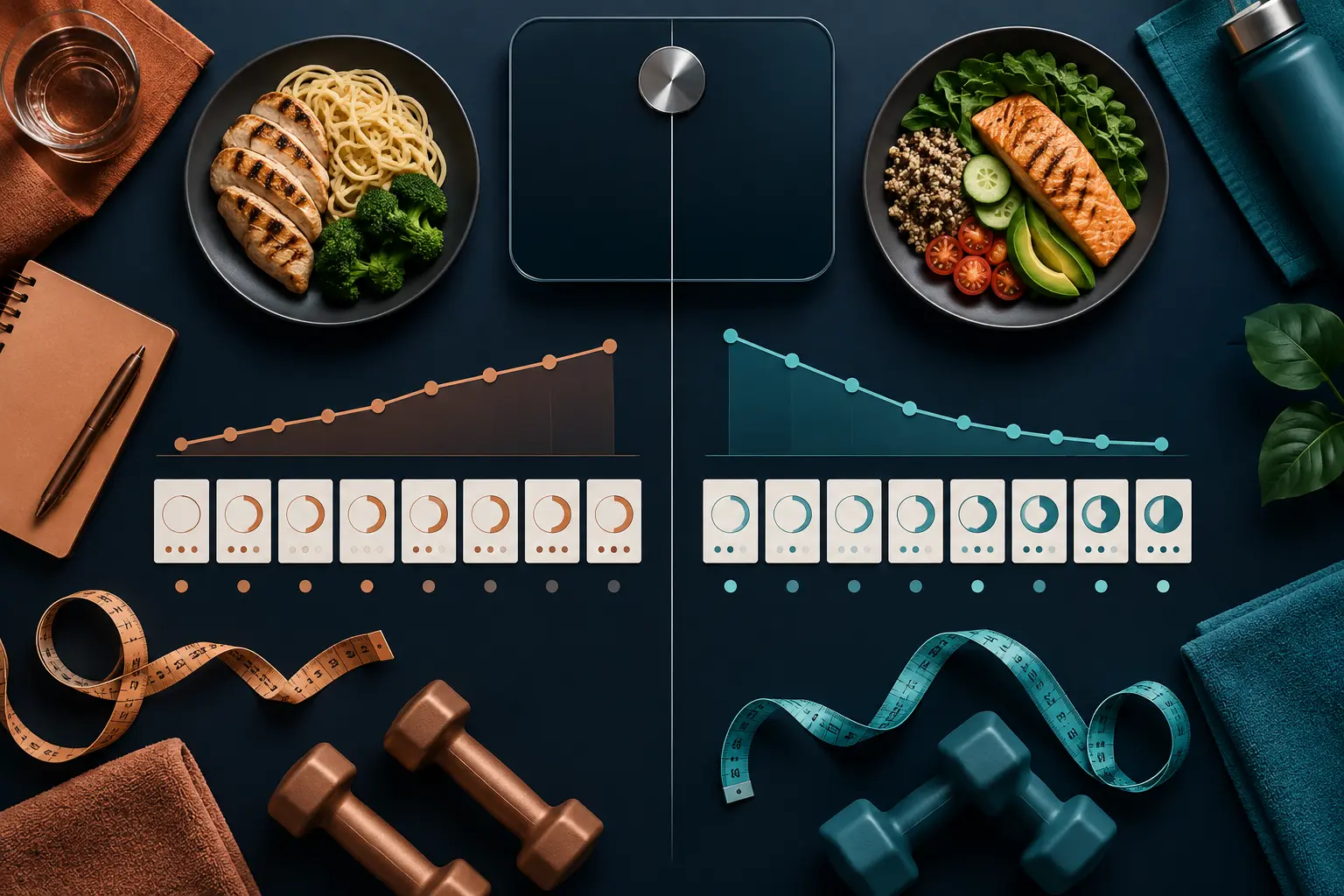
Weight-loss emphasis: establish a sustainable deficit, keep resistance training two or more days when appropriate, accumulate aerobic and daily movement, distribute protein, and compare weekly weight averages plus waist. Adjust only after several consistent weeks.
Recomposition emphasis: use progressive resistance training as the anchor, keep calories near a small deficit or individualized maintenance range, prioritize protein and recovery, and evaluate waist and performance every four weeks. The expected scale change may be minimal.
When to switch strategies
Move from recomposition to a defined weight-loss phase when waist and body fat remain higher than desired, performance is established, and slow scale movement no longer matches the priority. Move from aggressive weight loss toward maintenance or recomposition when strength, recovery, hunger, mood or adherence deteriorates.
Set the decision before starting: desired outcome, minimum duration, stop rules, and the measurements that would justify continuation. This prevents choosing a new plan every time the scale changes.
Example: same week, different success
Chris and Dana both maintain the same scale average for a month. Chris has unchanged waist and inconsistent training, so recomposition is not established. Dana's waist falls, squat repetitions improve, and standardized photos change under consistent conditions.
The same scale result supports two different decisions. Chris simplifies adherence and reassesses energy intake. Dana continues the training-centered plan rather than forcing faster weight loss.
A deeper check before changing the plan
Use a goal hierarchy to choose. First list the health or functional outcome: lower blood pressure risk, easier mobility, improved strength, smaller waist, sport performance, or appearance. Second choose the tissue priority. Third select the metric that can actually observe that priority. Only then choose calories and training. Starting with a trendy diet reverses this order.
For weight loss, define a sustainable range rather than a daily deadline. Track weekly averages and waist while protecting strength. For recomposition, define the key lifts or functional tasks that should improve and the waist or standardized visual measure expected to change. A body-fat percentage can be supplementary, but it should not be the only success gate.
Both strategies require exit rules. A weight-loss phase should pause or change when nutrition, recovery, symptoms, or adherence deteriorate materially. A recomposition phase should be reconsidered when months pass without improvement in performance or composition measures despite consistent execution. Waiting forever is no more evidence-based than changing every week.
Neither approach is morally superior. Weight reduction can be valuable, and scale stability can be valuable. The correct choice depends on the job. Some people will move between phases: reduce weight, maintain, build strength, and later reassess fat loss. Maintenance is an active phase used to stabilize routines and recover, not an empty space between “real” plans. Writing the goal, duration, dashboard and next decision on one page keeps strategy from changing with every mirror glance.
The final interpretation rule
Review the hierarchy monthly. If the primary health or function goal changes, the strategy may change too. Keep measurements comparable during the transition and expect water shifts when calories, carbohydrate or training volume changes. Do not use the first week of a new phase to judge its long-term tissue effect. A deliberate switch preserves learning from the earlier phase instead of rewriting it as failure.
Use a four-signal decision system
Collect a rolling body-weight average, a repeatable waist measurement, performance or daily-function notes, and a short adherence record. Interpret them together every two to four weeks. A stable scale with a smaller waist and maintained strength suggests a different response from falling weight with worsening strength, fatigue, and unchanged waist.
Change one major variable at a time. If calories, training, sodium, carbohydrate, supplements, and measurement conditions all change together, the result cannot explain which action helped. Set the next review date before making an adjustment and use the least aggressive change that addresses the evidence.
Seek qualified care for rapid unexplained change, swelling, fainting, chest symptoms, serious weakness, persistent menstrual change, signs of an eating disorder, or symptoms suggesting an endocrine or other medical condition. Body-composition advice cannot diagnose the cause of a symptom.
Where Fat Burn Active fits
Fat Burn Active cannot reveal which tissue changed, target a chosen fat depot, or protect muscle simply because it changes appetite, alertness, or scale weight. Finished-product claims would require relevant trials on the complete formula with appropriate body-composition outcomes. Ingredient mechanisms are not product proof.
Treat Fat Burn Active as an optional addition, not a substitute for The Difference Between Weight Loss and Body Recomposition. Review its listed ingredients and limitations in our product analysis. If the evidence, warnings, and cost fit your decision, verify the current formula and purchase options. We may earn a commission.
Frequently asked questions
Can a home scale tell whether I lost fat?
No. It measures total mass. Smart-scale body-fat estimates are influenced by hydration and prediction equations; standardized trends may help, but a single percentage is not proof.
Should I react to one fast weekly change?
Usually not. Check measurement conditions, hydration, sodium, carbohydrate intake, digestion, illness, and training before interpreting tissue change.
Does maintaining muscle prevent all lean-mass loss?
No method guarantees that. Resistance training, adequate protein and a sensible deficit can improve the odds, while individual response and measurement error remain.
When is professional measurement useful?
When the result would change clinical or training decisions. Even laboratory methods have assumptions, so use the same method and comparable conditions.
Sources
- Preserving Healthy Muscle During Weight Loss
- Resistance Training and Body Composition
- Body-Composition Measurement Methods
- Physical Activity Guidelines for Americans
Sources reviewed September 14, 2026. This article is general educational information, not medical advice, diagnosis, or treatment.