
Why the problem feels personal
The scale stops, fatigue rises, and a small amount of food feels like proof that the body stores everything. Water retention, constipation, tracking error, reduced movement, and episodes of overeating may be hidden inside the same period.
When the expected result and the scale disagree, people often assume their body is uniquely broken. That conclusion can push intake lower, increase fatigue, reduce movement, and make the original problem harder to interpret. The first solution is measurement and context—not another extreme rule.
What is happening physiologically
The body responds to low energy availability by changing hormones, appetite, movement, reproductive function, temperature, and expenditure. These defenses narrow the deficit and protect survival, but they do not cancel physical energy accounting.
Total daily energy expenditure includes resting needs, digestion, structured exercise, and non-exercise movement. Body size and composition affect the first component; behavior and adaptation affect the others. None is measured perfectly by a watch or calculator.
What the evidence supports
Semistarvation research and modern weight-loss studies show powerful adaptation and hunger. They support caution about aggressive diets, not the claim that eating less necessarily produces fat gain.
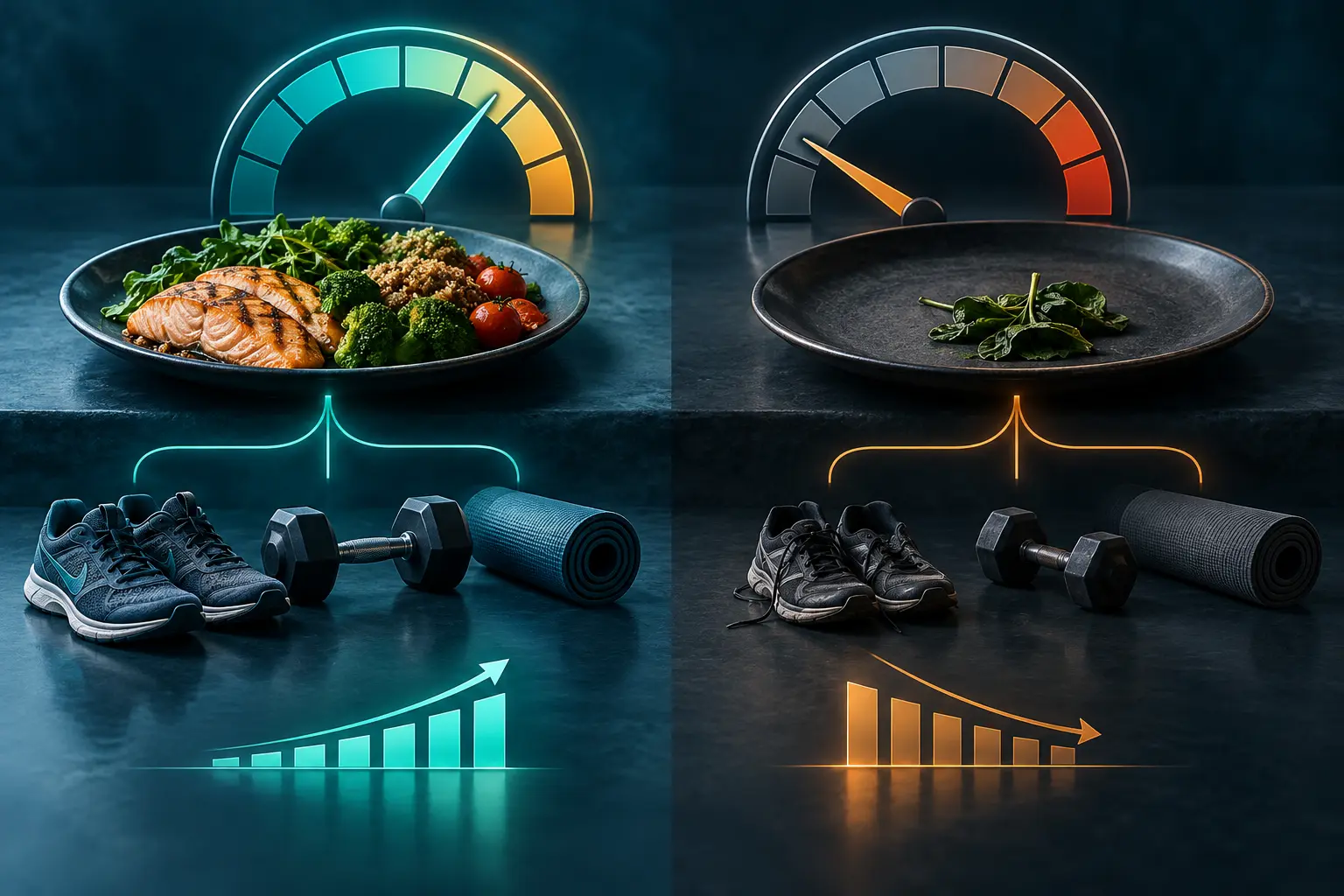
A practical response
- Increase intake when restriction is unsafe or unsustainable.
- Confirm intake and trend without moral judgment.
- Restore regular protein- and nutrient-containing meals.
- Protect strength and ordinary movement.
- Seek care for symptoms of low energy availability.
The measurement dashboard
No single number settles the question. Look for agreement between average weight, waist, intake, movement, performance, hunger, sleep, and the conditions under which data were collected.
Claims that need more caution
A higher-calorie meal may increase scale weight through glycogen, water, sodium, and food mass. That is not proof that eating more instantly repaired metabolism or created equivalent fat.
Acute changes in hormones, body temperature, fat oxidation, or appetite are not the same as proven long-term fat loss. Mechanism evidence should not be upgraded into a clinical outcome without comparable human studies.
When a medical review matters
People with eating disorders, pregnancy, adolescence, frailty, diabetes medicines, or symptoms of malnutrition should not experiment with severe deficits. Refeeding after prolonged severe restriction may require supervision.
Unexplained rapid weight change, severe fatigue, fainting, persistent cold intolerance, marked changes in heart rate, swelling, or other concerning symptoms deserve professional assessment rather than online self-diagnosis.
Where fat burners fit
No supplement repairs a supposedly broken metabolism. A stimulant may temporarily change alertness or expenditure while worsening sleep or tolerance. If considering the featured product, read our Fat Burn Active review for the formula, evidence limits, dose uncertainty, and safety context.
Frequently asked questions
Can eating too little prevent weight loss?
It can narrow the real deficit and undermine adherence, but a true sustained deficit still requires stored energy.
Why did weight rise after eating more?
Water, glycogen, sodium, and digestive mass can rise rapidly.
Should I use a cheat meal?
No metabolic reset is guaranteed; use a sustainable plan instead.
A supplement is not required to benefit from What Is Starvation Mode—and Can Eating Too Little Stop Weight Loss?. If your foundations are already in place, use the independent Fat Burn Active review to judge whether the formula has a useful optional role. If it fits your expectations and stimulant tolerance, check current product details and ordering terms. We may receive a commission.
Interpret the apparent paradox
Suppose someone reports eating very little while weight is unchanged. That experience should be taken seriously without accepting an impossible mechanism. The useful audit includes the length of the observation, average rather than lowest intake, weekends and untracked bites, movement decline, constipation, fluid retention, medicines, and whether the restriction triggers overeating. The solution is not accusation or harsher restriction. It is safer nourishment, better measurement, an appropriate time window, and clinical support when symptoms or disordered eating are present.
A four-week diagnostic instead of a guess
Week 1: preserve the baseline. Do not immediately cut food or double exercise. Record morning body weight under similar conditions, waist once, ordinary meals, steps or active minutes, training, sleep, hunger, and relevant symptoms. Mark unusual events such as travel, illness, restaurant meals, alcohol, hard training, menstrual-cycle changes, constipation, or a missed medicine. The aim is not perfect surveillance; it is enough context to distinguish a trend from noise.
Week 2: check the size of the claimed problem. Compare seven-day averages, not the best or worst day. Review portions that are easy to miss—oil, sauces, drinks, snacks, tasting while cooking—and compare current movement with the period when progress was faster. Treat watches and calorie calculators as estimates. If two devices disagree, use one consistently and calibrate decisions against the observed trend.
Week 3: change one controllable variable. Examples include adding a repeatable walk, measuring one calorie-dense ingredient, restoring a protein-containing breakfast, or reducing the intended deficit when fatigue is driving poor adherence. Keep everything else reasonably stable. One controlled change produces information; several simultaneous changes only produce a new mystery.
Week 4: decide from direction, symptoms, and cost. Continue when weight or waist is moving appropriately and the plan remains livable. Adjust modestly when execution is reliable but the trend is genuinely flat. Pause the deficit when recovery, mood, concentration, training, or eating behavior is deteriorating. A successful decision improves both the data and the ability to continue.
How to discuss the result with a professional
Bring a concise record: the date and size of the change, typical meals rather than one unusually “good” day, current medicines and supplements, sleep, activity, menstrual or reproductive changes, digestive symptoms, and any history of restrictive or binge eating. State what you have already tested and for how long. This is more useful than arriving with a self-diagnosis of a slow or broken metabolism.
A clinician may decide that symptoms warrant examination or testing, but broad online laboratory panels can create confusion when there is no clinical question. Normal results also do not mean the experience is imaginary; behavior, recovery, appetite, body composition, and measurement error remain real contributors. Conversely, lifestyle advice should not be used to dismiss persistent red flags.
What not to buy as a solution
Be skeptical of products that promise to “reset,” “repair,” or permanently accelerate metabolism without defining the outcome, comparison group, dose, and duration. Testimonials cannot separate the capsule from simultaneous dieting, exercise, expectation, or normal fluctuation. Even a statistically significant change in heart rate, body temperature, or short-term energy expenditure may be too small to produce meaningful fat loss and may come with sleep, anxiety, blood-pressure, or tolerance costs.
If you use any supplement, list every active ingredient and dose, check duplication with coffee, pre-workouts, medicines, and other products, and stop when adverse effects occur. Supplements cannot replace adequate energy, nutrient intake, resistance training, sleep, or evaluation of a medical problem.
A durable decision rule
Use the least aggressive change that the evidence justifies, define the measure and review date before starting, and keep an exit rule. If the expected improvement does not appear, reconsider the explanation instead of escalating indefinitely. This protects health, reduces wasted effort, and turns a frightening metabolism story into a series of testable, reversible decisions.
Sources
- Minnesota Starvation Experiment review
- Adaptive thermogenesis review
- NIDDK Body Weight Planner
- Metabolic adaptations to weight loss review
Evidence reviewed September 8, 2026. Educational information only; not medical advice.