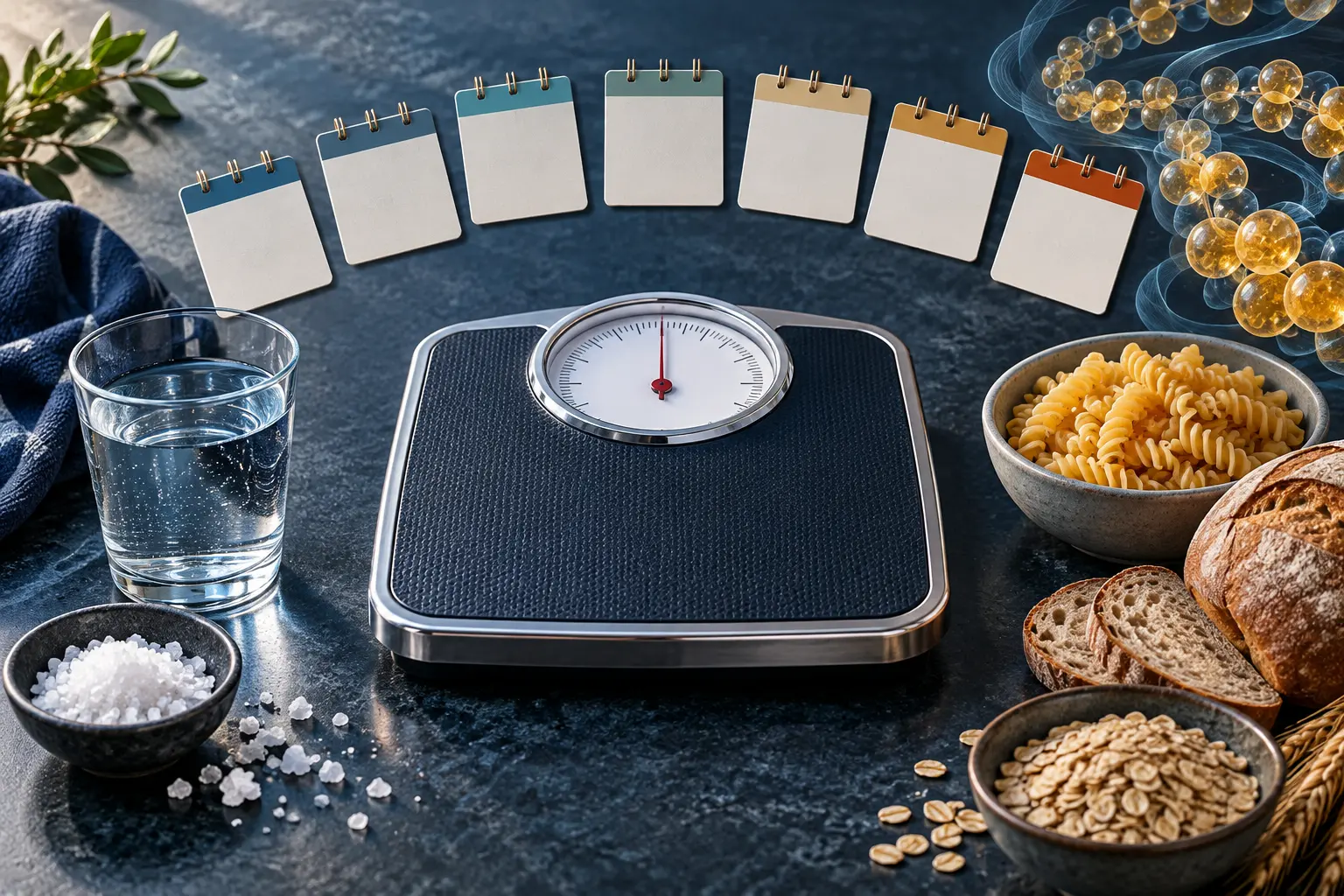
The number that ruins a good plan
You follow the plan, step on the scale, and see an overnight increase. Treating that reading as instant fat gain can trigger unnecessary restriction or quitting. The scale reports mass but does not explain its source.
The main causes of short-term changes
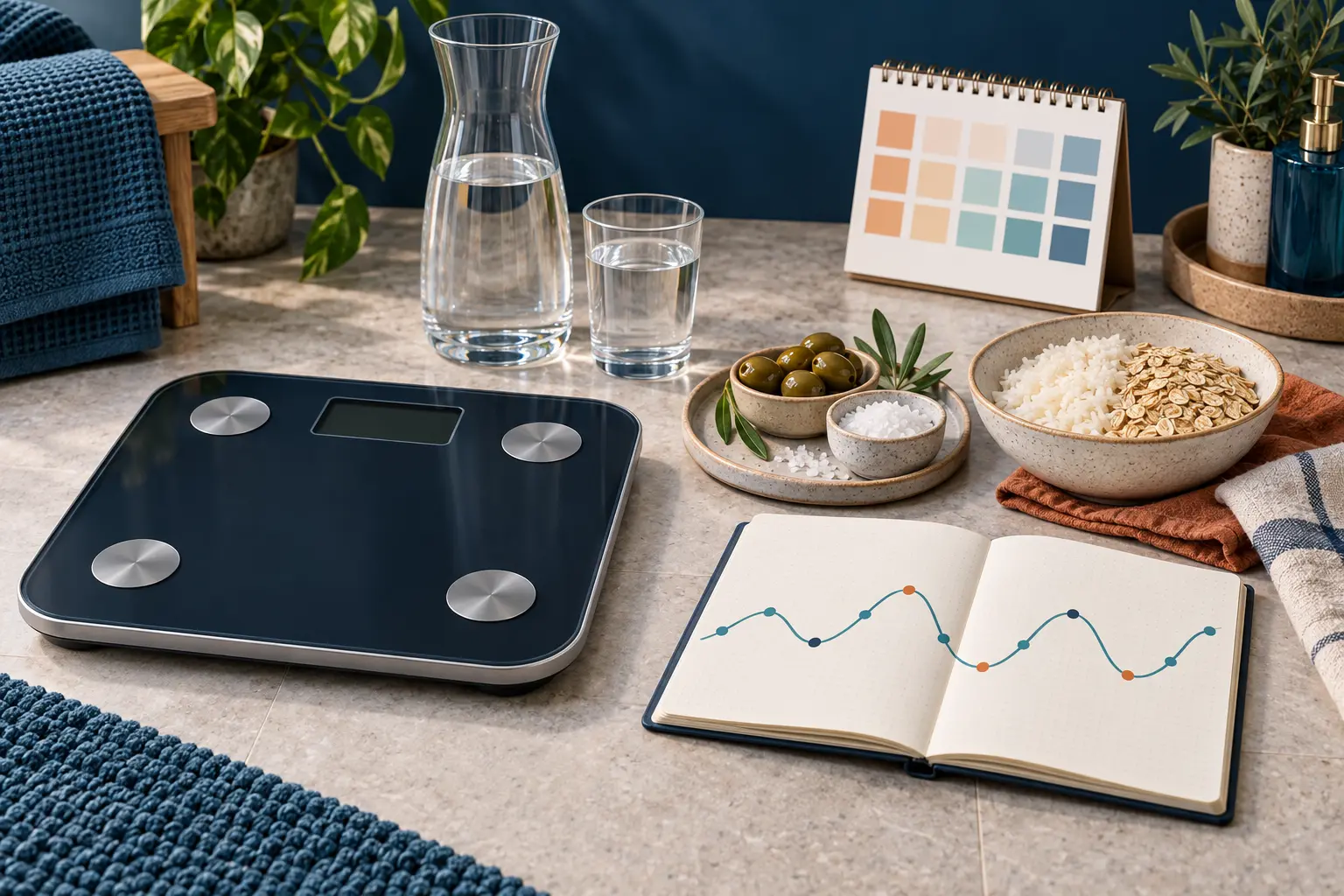
Why an overnight jump is rarely equivalent fat gain
Meaningful fat gain requires sustained net energy storage. A rapid scale increase after a salty restaurant meal is more plausibly dominated by food and fluid than an equal increase in adipose tissue.
The seven-day trend method
- Use the same scale on a hard, level surface.
- Weigh under similar morning conditions.
- Record readings without reacting to each one.
- Calculate a seven-day average.
- Compare averages across at least several weeks.
- Add waist and adherence notes.
When fluctuation needs medical attention
Seek medical advice for rapid unexplained gain with swelling, shortness of breath, chest symptoms, reduced urination, or after a medicine change. Intentional dehydration is not a safe way to improve the number.
Can supplements distort the scale?
Stimulants, laxative-like ingredients, diuretics, altered appetite, and changes in food or fluid intake can move body weight without proving fat loss. See fat-burner side effects.
Map the likely cause before changing calories
Use a four-step trend protocol
- Weigh under similar morning conditions after using the bathroom and before food when daily weighing is appropriate for you.
- Record the number without changing the plan because of one result.
- Calculate a seven-day average and compare it with several previous weeks.
- Annotate unusual restaurant meals, travel, illness, hard training, poor sleep, constipation, or medication changes.
A sharp rise after one meal is usually too fast to represent an equivalent increase in body fat. That does not make the number imaginary: it reflects real mass, but the mass may be water, glycogen, digestive contents, or inflammation. Fat change is better inferred from a repeated trend under comparable conditions.
Know when the scale should not lead the plan
If daily weighing triggers anxiety, restriction, bingeing, or repeated compensation, use less frequent measurements or another progress marker with professional support. Rapid swelling, shortness of breath, chest symptoms, reduced urination, faintness, or unexplained persistent change warrants medical assessment rather than a stricter calorie target.
Where Fat Burn Active fits
Diuretics, laxatives, dehydration, sweating, or stimulant-driven appetite changes can move the scale without proving body-fat loss. Fat Burn Active is optional and cannot replace nutrition, activity, resistance training, sleep, measurement, or medical care. Evidence about an isolated ingredient does not prove that the finished formula produces the same result at the sold dose.
Treat Fat Burn Active as an optional addition, not a substitute for Why Does Weight Fluctuate Day to Day?. Review its listed ingredients and limitations in our product analysis. If the evidence, warnings, and cost fit your decision, verify the current formula and purchase options. We may earn a commission.
Frequently asked questions
How much fluctuation is normal?
There is no universal amount; body size, intake, cycle phase, exercise, and health context matter.
Should I weigh every day?
Daily weighing can improve trend quality if it does not worsen anxiety or unhealthy behavior. Weekly standardized measurements are another option.
A seven-day diagnostic
When the scale jumps, first check sodium, carbohydrate intake, bowel contents, a late meal, menstrual-cycle phase, travel, alcohol, inflammation from hard training, and weigh-in timing. These factors can move water and digestive mass faster than fat tissue can change. Keep conditions consistent—after waking, after using the bathroom, before food—and calculate an average. Only adjust the plan when the multi-week trend, not an isolated peak, supports the decision.
A four-week review process
- Week 1 — establish the baseline. Keep normal routines, collect the measures above, and note unusual travel, illness, restaurant meals, hard training, poor sleep, or other events that can distort the result.
- Week 2 — choose one controlled change. Define a behavior you can actually measure, such as a meal structure, a walking range, or a training target. Avoid changing food, exercise, supplements, and sleep at the same time.
- Week 3 — check execution before outcome. Ask whether the planned behavior happened often enough. A plan cannot be judged fairly from perfect weekdays followed by unrecorded weekends or from data collected under changing conditions.
- Week 4 — compare averages and context. Review direction, size, consistency, hunger, recovery, and practical cost. Continue when the trend and experience are acceptable; simplify or adjust one variable when they are not.
How to avoid a false conclusion
Association is not always cause. A lower scale reading after a new food, supplement, or workout may reflect water, meal timing, or random variation. A higher reading does not prove fat gain. Look for a repeatable pattern, a plausible mechanism, and agreement between several measures. Consumer wearables and home body-composition devices are useful for trends but are not laboratory instruments.
What a useful decision looks like
A useful conclusion is specific and reversible: keep the current approach for another review period, reduce the size of the change, improve measurement consistency, or ask a qualified professional about an individual concern. It is not “this one tactic always works” or “nothing works.” Record why you made the decision and what result would cause you to reconsider it. That simple rule reduces hindsight bias and helps separate a genuine response from ordinary fluctuation.
When to adjust
Keep the method stable long enough to see a trend. Change one major variable at a time, document the change, and reassess the result rather than reacting to a single day. Stop and seek qualified medical guidance when symptoms, medicines, a diagnosed condition, pregnancy, disordered-eating concerns, or an unusually rapid unexplained change make self-directed experimentation inappropriate.
Sources
- Body composition assessment
- NCBI Bookshelf: body-fluid physiology
- Body-composition methods
- NIDDK: Factors affecting weight and health
Evidence reviewed September 8, 2026. Educational information only; not medical advice.