Why one metric creates bad decisions
Daily weight is noisy, smart-scale body-fat percentages are hydration-sensitive, photographs change with lighting, and tape placement can drift. Choosing whichever result feels best—or worst—creates confirmation bias.
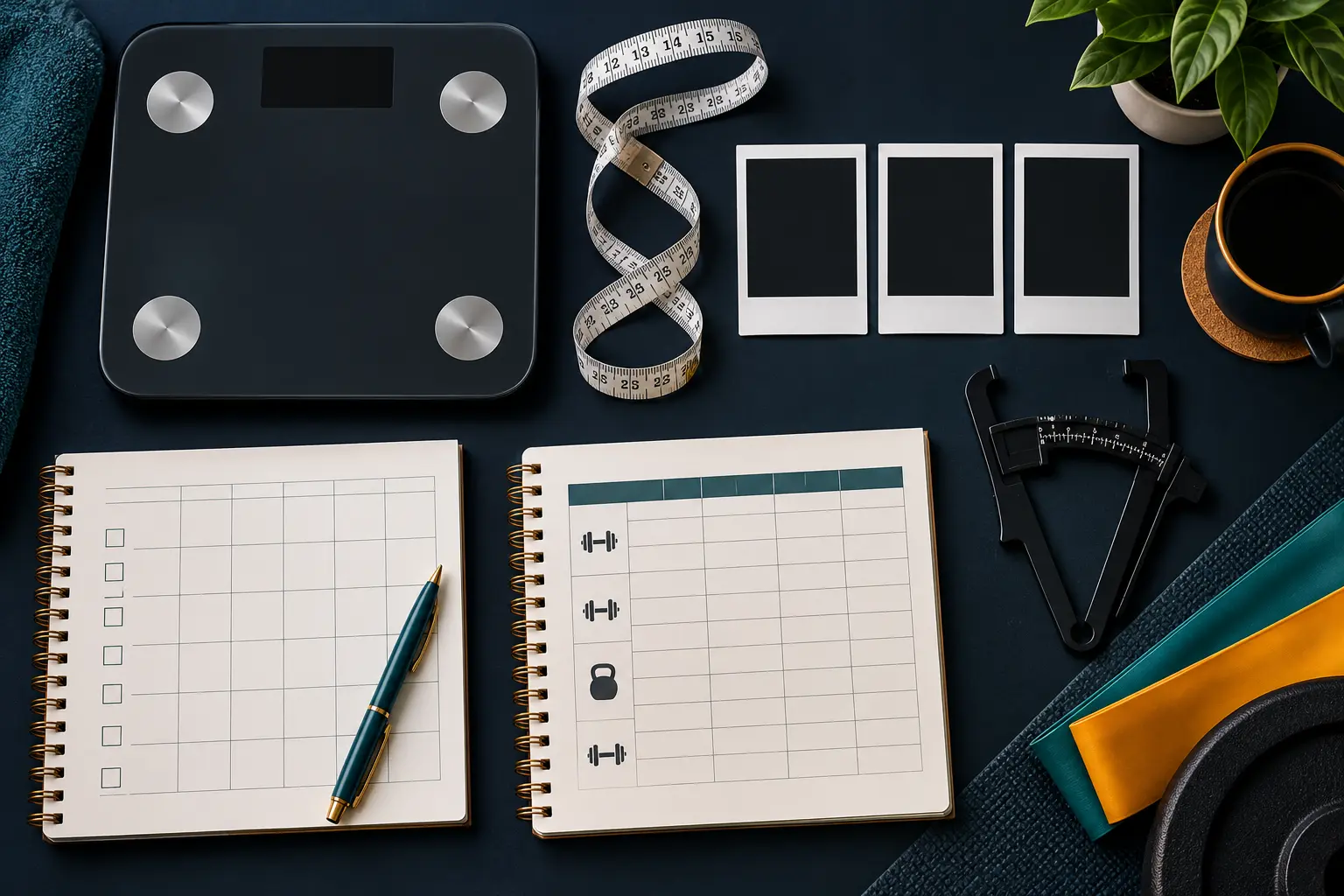
The five-part measurement dashboard
A repeatable protocol
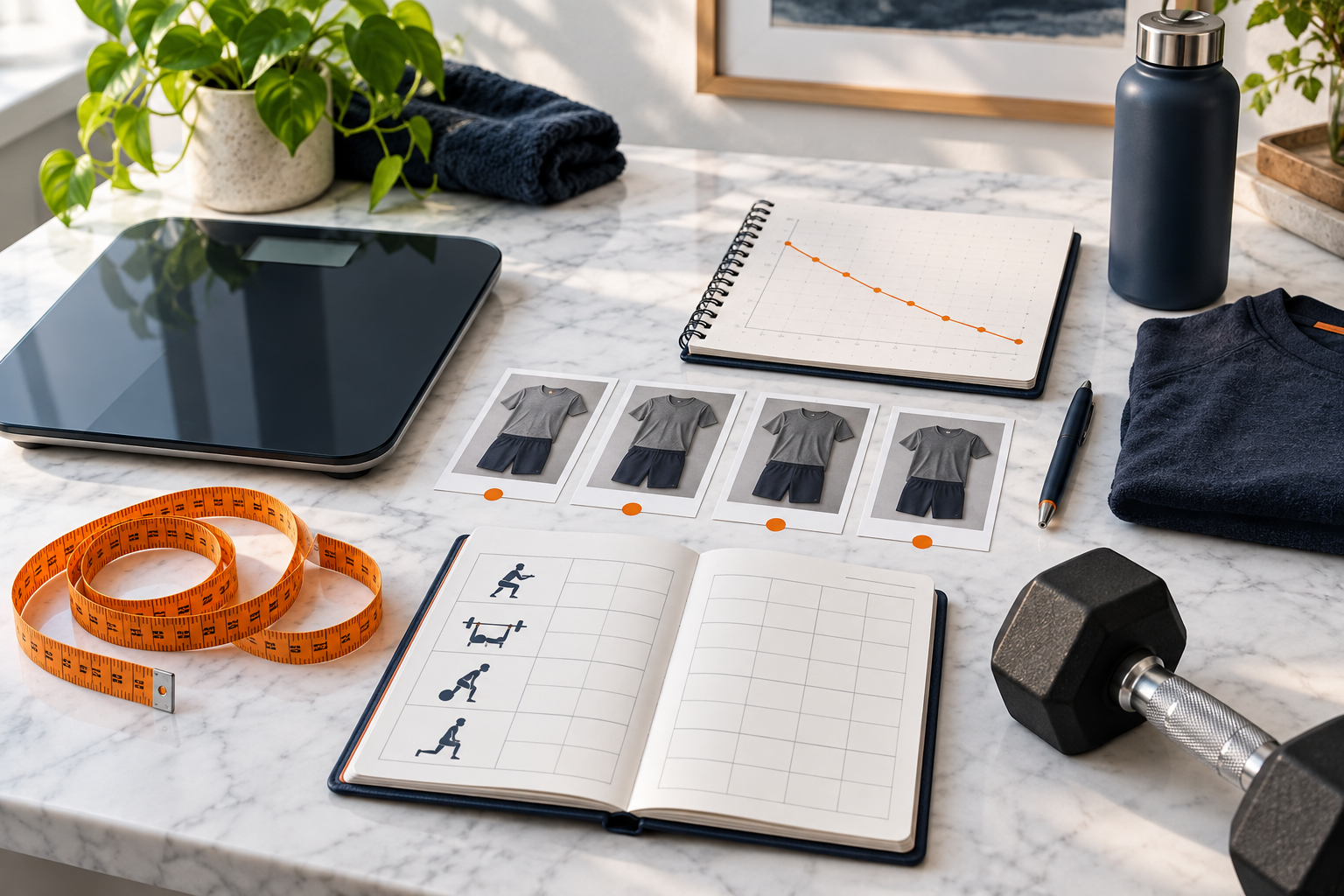
- Weigh in the morning under similar conditions.
- Calculate seven-day averages.
- Measure waist at the same landmark every two to four weeks.
- Take front, side, and back photos with matched light, distance, and clothing.
- Record key exercises, steps or activity, sleep, and adherence.
- Review all signals on a scheduled date.
How to interpret conflicting signals
If weight is flat but waist falls and strength is stable, recomposition or water masking may be plausible. If weight falls rapidly while strength and function deteriorate, the plan may be too aggressive. If nothing changes and adherence is high, reassess energy intake and activity.
What body-fat tools add
Bioelectrical impedance, skinfolds, DXA, air displacement, and imaging use different assumptions. More advanced does not mean error-free. Repeat the same method under similar conditions and avoid comparing percentages from unrelated devices.
Know what tracking cannot diagnose
Unexpected rapid change, swelling, weakness, disordered-eating behaviors, or concerning symptoms need qualified medical assessment. Progress data do not replace health care.
How to test supplement claims
Establish a baseline before adding a product and change one variable at a time where practical. Stimulation, appetite change, or water loss is not proof of fat loss. Compare claims with our Fat Burn Active review.
Use a four-week measurement protocol
Define the method before looking at the result. Weigh under similar morning conditions and calculate weekly averages. Measure the waist at the same landmark every two to four weeks. Take photographs with matched light, distance, clothing, and posture. Select a few repeatable strength or function markers and record whether the intended nutrition and activity behaviours actually happened.
Rules for conflicting signals
Home tools do not diagnose exact tissue change. Compare like with like and avoid switching devices whenever a result is disappointing. Unexpected rapid change, swelling, weakness, fainting, breathing difficulty, or disordered-eating behaviour requires qualified assessment rather than more aggressive tracking.
Where Fat Burn Active fits
A scale change after starting a supplement cannot show whether fat, water, glycogen, digestive contents, or lean tissue changed. Fat Burn Active is optional and cannot replace nutrition, activity, sleep, medical care, or a reliable measurement system. Evidence about an individual ingredient does not prove that the finished formula produces the same outcome at the sold dose.
A supplement is not required to benefit from How to Measure Fat-Loss Progress Accurately. If your foundations are already in place, use the independent Fat Burn Active review to judge whether the formula has a useful optional role. If it fits your expectations and stimulant tolerance, check current product details and ordering terms. We may receive a commission.
Keep the dashboard manageable
More data is not always better. Choose the smallest set you will collect consistently and schedule reviews rather than checking repeatedly. People whose measurements increase anxiety, compulsive restriction, or binge–compensate cycles should reduce tracking and seek qualified support. A useful system improves decisions without dominating daily life.
Frequently asked questions
How often should I measure my waist?
Every two to four weeks is often enough to reduce noise while preserving a useful trend.
Should I use a smart scale?
It can support a standardized trend, but do not treat its body-fat percentage as an exact diagnosis.
Build a low-noise measurement system
Choose the smallest set of measures you can repeat accurately. Daily or frequent weights can be averaged; waist can be measured weekly; photos and clothing checks need less frequent review. Bioelectrical-impedance scales are sensitive to hydration and should be treated as trend tools. DEXA and other clinical methods also have error and are rarely needed for routine decisions. Record conditions so apparent changes can be interpreted rather than merely collected.
A four-week review process
- Week 1 — establish the baseline. Keep normal routines, collect the measures above, and note unusual travel, illness, restaurant meals, hard training, poor sleep, or other events that can distort the result.
- Week 2 — choose one controlled change. Define a behavior you can actually measure, such as a meal structure, a walking range, or a training target. Avoid changing food, exercise, supplements, and sleep at the same time.
- Week 3 — check execution before outcome. Ask whether the planned behavior happened often enough. A plan cannot be judged fairly from perfect weekdays followed by unrecorded weekends or from data collected under changing conditions.
- Week 4 — compare averages and context. Review direction, size, consistency, hunger, recovery, and practical cost. Continue when the trend and experience are acceptable; simplify or adjust one variable when they are not.
How to avoid a false conclusion
Association is not always cause. A lower scale reading after a new food, supplement, or workout may reflect water, meal timing, or random variation. A higher reading does not prove fat gain. Look for a repeatable pattern, a plausible mechanism, and agreement between several measures. Consumer wearables and home body-composition devices are useful for trends but are not laboratory instruments.
What a useful decision looks like
A useful conclusion is specific and reversible: keep the current approach for another review period, reduce the size of the change, improve measurement consistency, or ask a qualified professional about an individual concern. It is not “this one tactic always works” or “nothing works.” Record why you made the decision and what result would cause you to reconsider it. That simple rule reduces hindsight bias and helps separate a genuine response from ordinary fluctuation.
When to adjust
Keep the method stable long enough to see a trend. Change one major variable at a time, document the change, and reassess the result rather than reacting to a single day. Stop and seek qualified medical guidance when symptoms, medicines, a diagnosed condition, pregnancy, disordered-eating concerns, or an unusually rapid unexplained change make self-directed experimentation inappropriate.
Sources
- Body-composition methods
- Clinical body-composition assessment
- University of Virginia: body composition
- CDC: Steps for losing weight
Evidence reviewed September 8, 2026. Educational information only; not medical advice.