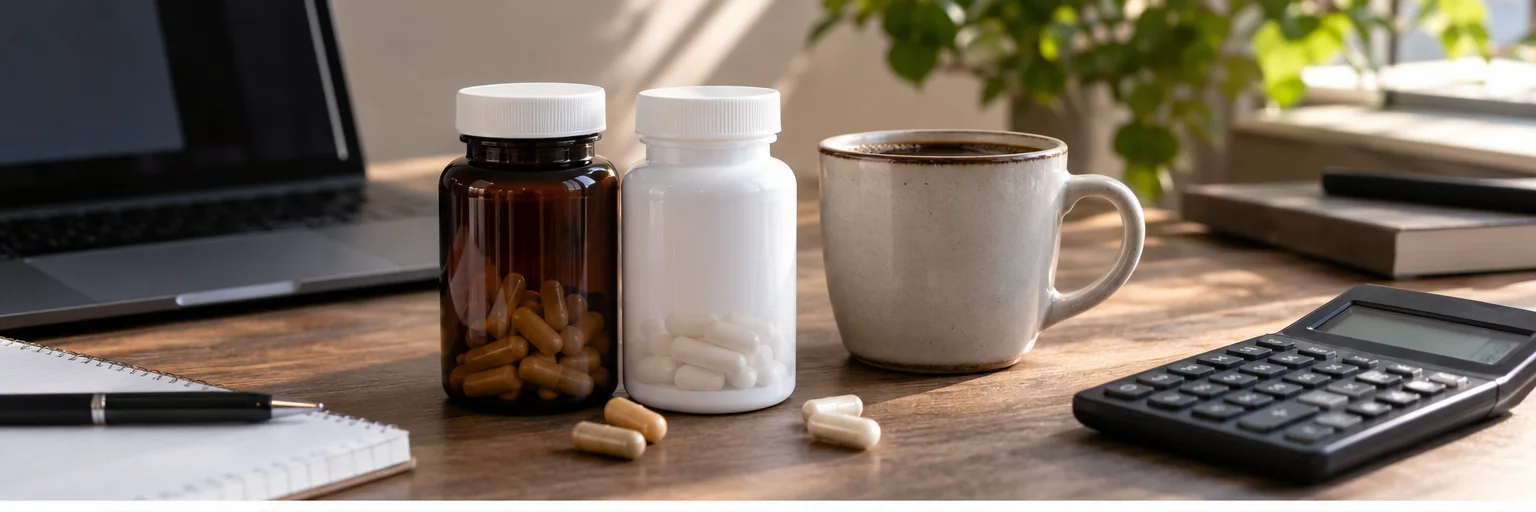
This guide concerns practical decisions about supplement use. It does not establish that a fat burner treats a medical condition or produces weight loss.
Why a front-label comparison fails
Product A says 100 mg caffeine per capsule; Product B says 180 mg per serving. A appears lighter until you see that its directions allow two or three capsules a day and that a guarana blend has no individual amount. A usable comparison starts with the daily serving, not the number printed most prominently. You also need to count coffee, energy drinks and pre-workout. The daily caffeine guide handles that personal inventory; this guide puts two complete product labels side by side.
Normalize the serving schedule
Write caffeine per serving, servings per day and the daily maximum for each product. Make separate workout and rest-day rows if directions differ. If a label states the amount per capsule but recommends three daily, multiply correctly. Do not compare one capsule of A with the full daily portion of B. Check whether the online panel is current; an old retailer photo may not match the bottle delivered. The two-panel guide explains how to align serving sizes before comparing ingredients.
Count botanical sources without guessing
Guarana, kola nut, yerba mate, coffee extract and green tea can contribute caffeine. An extract weight is not pure caffeine weight. If a total caffeine amount from all sources is stated, confirm whether the botanicals are included rather than counting them twice. If it is unclear, mark the contribution unknown and ask the seller. FDA advises paying attention to caffeine from all sources and notes that sensitivity differs. A blank amount is not evidence of zero exposure. The guarana guide shows why a plant name can obscure the familiar stimulant.

Other stimulant questions stay separate
A fat burner can include bitter orange or other stimulant-like compounds. Their milligrams are not interchangeable with caffeine milligrams, so do not invent one combined “stimulant score.” Record each amount, evidence and concern separately. A proprietary blend total cannot reveal how much of each ingredient is present. NIH ODS discusses uncertain benefits and safety concerns across weight-loss products. The synephrine and caffeine guide covers one common overlap. A product with less caffeine can still be poorly matched to a buyer with medicines or a health condition.
Bring your whole day into the calculation
Suppose you drink a large coffee in the morning and sometimes use pre-workout. Put those items in both A and B scenarios. A second serving of a fat burner at 3 p.m. may affect sleep even if a daily total seems acceptable to someone else. Feeling tired because of short sleep is not a reason to increase stimulation. A clinician or pharmacist can review your exact labels and medicines; do not stop a prescription to make a supplement fit. If palpitations or other concerning effects appear, stop the optional product and seek appropriate care.
A worked A-versus-B example
A states 100 mg caffeine per capsule and recommends two daily: 200 mg disclosed. It also has guarana in a blend. B states 180 mg caffeine from all sources at its daily serving and discloses its other ingredients. You cannot honestly rank the exact caffeine total because A's guarana contribution is unknown. B is easier to quantify but that does not certify safety or efficacy. These numbers are illustrative, not actual product facts or dose advice. The next question is whether either formula has good human evidence for the buyer's intended body-fat outcome.
Where Fat Burn Active fits
Start with the Fat Burn Active review and its current formula before comparing it with another bottle. Do not use the fictional numbers above as its doses. Match its real daily serving, ingredients, caffeine sources and evidence against a competitor under the same rules. The review helps decide whether looking at a current offer makes sense; it is not a personal safety clearance. If a critical amount remains hidden or symptoms and medicines matter, postpone a purchase while seeking clarification.
A compact decision table
Create columns for declared caffeine per day, botanical caffeine unknowns, other stimulant ingredients, timing, medicine questions and expected outcome. Include the source and date of each label. If the daily maximum differs from your likely serving, show both. A marketing phrase such as “clean energy” cannot fill an unknown cell. A quality seal may help with specified contents but does not prove fat loss. If neither product provides a transparent and suitable choice, no stimulant supplement is a valid result. Food, sleep and a workable activity plan may address the original problem more directly.
Questions for the seller
Ask whether declared caffeine includes every botanical source at the maximum daily serving, whether finished batches are checked, and whether a recent revision changed the amounts. Save the dated response beside a photograph of the current bottle. If the reply repeats “natural energy” without a number, the uncertainty remains. Do not estimate an undisclosed dose from another brand: extracts vary. A missing critical amount may make a formula unsuitable for someone sensitive to caffeine. A pharmacist can review the exact package alongside medicines and other products.
When the ranking changes
A one-capsule comparison can reverse when the recommended daily serving is two or three. Coffee habits on weekends, pre-workout on training days and late dosing also create separate exposure scenarios. Record each with both candidates, instead of giving one product a favorable assumption. A formula change requires a new calculation. Even when both caffeine totals are known, the smaller number is not a personal tolerance guarantee. Sleep problems, anxiety, medicines and health conditions can matter more than the numerical gap. If an answer remains unknown, write unknown rather than zero.
Recheck the decision
A disclosed daily total helps compare exposure, not predict benefit. If neither formula has convincing evidence for lasting body-fat change, a lower stimulant load is not itself a reason to buy. Consider whether sleep, meals or sustainable activity address the original goal. Bring both complete labels to a pharmacist when medicine questions arise. Record the date and repeat the calculation if a serving or formula changes. One number never grants permanent personal approval.
Compare the whole formula before deciding
Check the current package, ingredients, serving directions, your other caffeine sources, and relevant health conditions. For an evidence-based starting point, read the full Fat Burn Active review. If this product still fits your circumstances, you can inspect its current offer. We may earn a commission if you buy through that link. Choosing no supplement is equally reasonable when the evidence or safety questions do not support a purchase.
Frequently asked questions
Can I add plant extract milligrams to caffeine milligrams?
No. Extract mass and caffeine dose are different.
Is the lower labeled caffeine option always better?
Not if its other stimulant contributions are unknown.
Does feeling alert prove fat loss?
No. Alertness and sustained body-fat change are different outcomes.
Sources
- FDA: Caffeine from All Sources
- NIH ODS: Weight-Loss Supplements
- FDA: Supplement and Medicine Interactions
- FDA: Supplement Labels
- NIH ODS: Caffeine in Performance
Reviewed against the sources listed above. Educational information only; not medical advice.