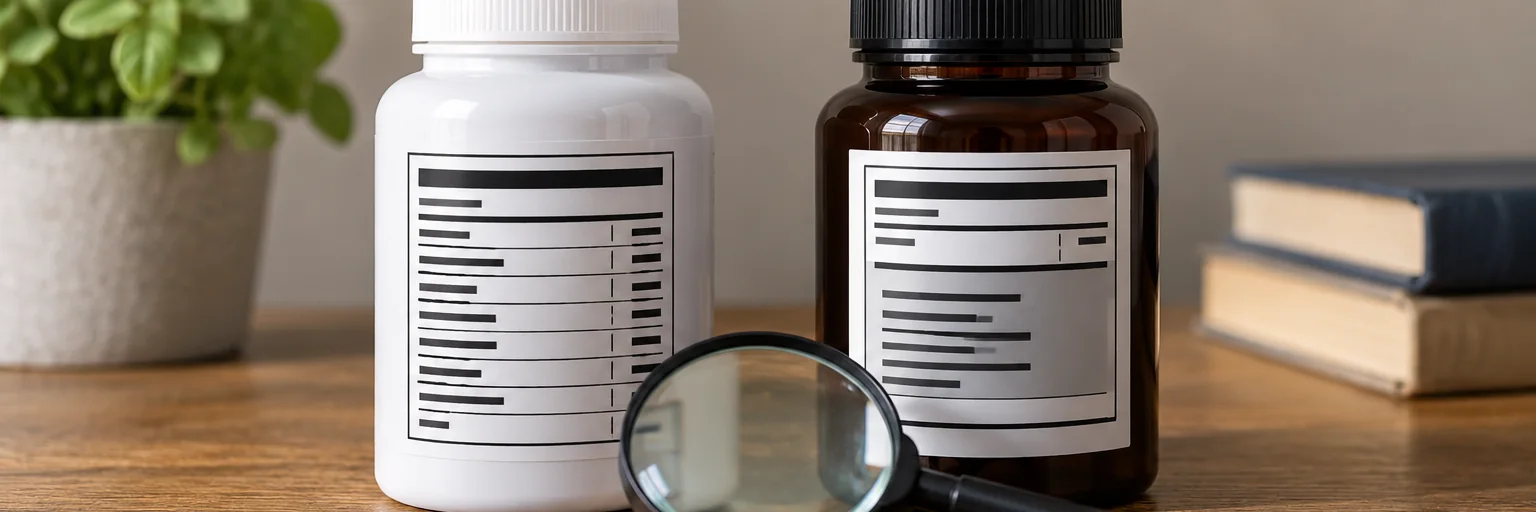
This guide concerns practical decisions about supplement use. It does not establish that a fat burner treats a medical condition or produces weight loss.
More ingredient names can mean less information
Bottle A lists six botanicals under a single 600 mg proprietary blend. Bottle B lists four ingredients and each amount. A's longer list may look impressive but gives less information for matching studies or assessing overlap. The number of names is not a transparency score. The two-panel guide covers broad comparison. Here the practical question is whether you can reconstruct the dose and form of what the seller claims makes a difference.
Align the actual daily serving
Record the number of capsules per serving, servings per container and daily directions. Multiply amounts if the label shows a single serving but instructions call for two or three in a day. Workout and rest-day recommendations may need separate columns. An old retailer image can contradict the current manufacturer panel; document the mismatch before using either. The Supplement Facts guide
Identify form and active constituent
A label might say 300 mg green coffee extract, or it might declare 150 mg chlorogenic acids. These are different statements. If an extract is standardized to a percentage, you can calculate a stated constituent amount only when the extract mass and basis are both disclosed for the same serving. Likewise, guarana milligrams are not caffeine milligrams. The chlorogenic acid guide
The proprietary-blend boundary
A 700 mg blend containing five ingredients does not reveal the amount of each. Do not divide by five or guess from their order. An ingredient's placement is not a clinically useful dose estimate. If a seller cites a trial at a particular amount but hides its amount in the retail formula, dose equivalence cannot be established. The blend guide
A calculation that can and cannot be made
Bottle A lists 400 mg of an extract standardized to 50% of a compound. If accurate, that implies 200 mg of the stated compound per serving. Bottle B lists 200 mg of that compound directly. The arithmetic matches, but extraction, other constituents and caffeine may still differ. Now imagine A only states “400 mg proprietary blend, standardized extract included.” Its extract amount is no longer known, so the 50% badge cannot yield a compound dose. Do not let a precise-looking graphic replace a missing starting number.
Transparency is necessary for a fair evidence test
A fully disclosed formula can still lack useful weight-loss evidence. First establish what the bottle contains, then ask whether human studies tested that material, at that amount, for the outcome the seller promises. A trial of isolated caffeine alertness cannot prove a multi-ingredient capsule reduces fat. The evidence comparison
Safety and value also depend on dose
Unknown caffeine from a blend complicates comparison with coffee or pre-workout. A clear label permits a more useful pharmacist conversation, though it cannot guarantee no adverse effects. Price per day also tells you less when the advertised actives are hidden. The value guide
Where Fat Burn Active fits
Build a five-column sheet
Use rows for ingredient name, exact form, amount at daily use, active constituent and caffeine contribution. Add a source-date note for each label. Mark “clear,” “partial” or “unknown,” then ask which unknowns are decisive. A missing decorative vitamin dose may matter less than an undisclosed stimulant. This is not an efficacy score: a transparent formula can still fail to deliver a meaningful benefit. If medicines or conditions apply, bring both complete panels to a clinician or pharmacist rather than relying on a label comparison alone.
A three-level disclosure rubric
Mark each important ingredient as exact daily amount and form disclosed, partial information, or individual dose unknown. A blend total is partial information for the mixture but unknown for each member. Standardization without extract mass is partial. Apply this especially to the ingredients behind the main claim and ingredients with meaningful safety concerns. A current package photograph is a stronger source than a marketing summary. Date any customer-service response and keep it with the label. Do not award equal weight to a minor missing decorative botanical and an undisclosed stimulant contribution.
Side-by-side label audit
Imagine A lists 250 mg green tea extract with a stated standardization and 100 mg total caffeine from all sources per day. B lists a 600 mg energy blend containing green tea, guarana and caffeine without individual amounts. A permits questions about study matching and other daily caffeine. B does not support the same calculations. This only identifies the disclosure difference; it does not establish that A is effective, safe for everyone or independently tested. Ask for current daily directions and whether botanical caffeine is included in the stated total. If a seller will not resolve a critical unknown, keep it unknown.
What disclosure cannot prove
Exact numbers allow a fairer evidence comparison, but they are still manufacturer statements. Independent quality verification has a defined testing scope and should be checked against the precise product. It cannot substitute for a trial showing the claimed weight-loss outcome. A precise constituent calculation also depends on an accurate extract amount and the same serving basis. Keep three separate notes: what is stated on the label, what is independently checked, and what human outcomes have been demonstrated. That separation prevents a neat panel from becoming a substitute for efficacy.
Recheck the decision
A product name may stay the same while its serving or formula changes. Note the label date, seller and bottle size. When a study uses a branded extract, confirm the retail product identifies the same material and dose. Similar ingredient names need not mean equal exposure. Save the current manufacturer panel and directions so another reader can reproduce the judgment. Recheck at checkout. A more transparent label makes the evidence question answerable; it does not automatically win on efficacy or safety.
Compare the whole formula before deciding
Check the current package, ingredients, serving directions, your other caffeine sources, and relevant health conditions. For an evidence-based starting point, read the full Fat Burn Active review. If this product still fits your circumstances, you can inspect its current offer. We may earn a commission if you buy through that link. Choosing no supplement is equally reasonable when the evidence or safety questions do not support a purchase.
Frequently asked questions
Is blend weight a dose of each ingredient?
No. It is a total for the combined ingredients.
Does a transparent label prove efficacy?
No. It allows evidence matching but does not create evidence.
Can ingredient order reveal exact amounts?
No. It does not disclose individual doses.
Practical decision checkpoint
Put the two labels side by side and create a row for each active ingredient. Record the per-serving amount, number of servings recommended each day, and whether extracts are standardized. A named ingredient without an amount is less informative than a disclosed amount, but an amount alone does not prove benefit. Mark caffeine from every listed source separately. If one product uses a proprietary blend, compare what is genuinely known rather than guessing its components. The more important question is whether either label supports a safe, evidence-based decision for this reader.
Sources
- FDA: Dietary Supplement Labels
- NIH ODS: Weight-Loss Products
- FTC: Evidence for Health Claims
- FDA: Caffeine Sources
- FDA: Supplement Ingredients
Reviewed against the sources listed above. Educational information only; not medical advice.