What the format can—and cannot—change
After swallowing, ingredients still need to disintegrate or dissolve, survive digestion, and be absorbed. A powder mixed with water may disperse before a capsule shell opens, but that does not establish a meaningful difference in body-weight outcome. Ingredient chemistry, dose, formulation, food, and individual physiology matter more than a blanket “fast absorption” claim.
Capsules limit the mass that fits into each unit, so larger doses may require several capsules. Powders can carry gram-level ingredients in one serving and add flavoring, acids, sweeteners, anti-caking agents, and color. Either format can use proprietary blends or transparent amounts. Read the Supplement Facts panel and other-ingredients list.
The practical trade-offs
A scoop is a volume measure, not a laboratory balance
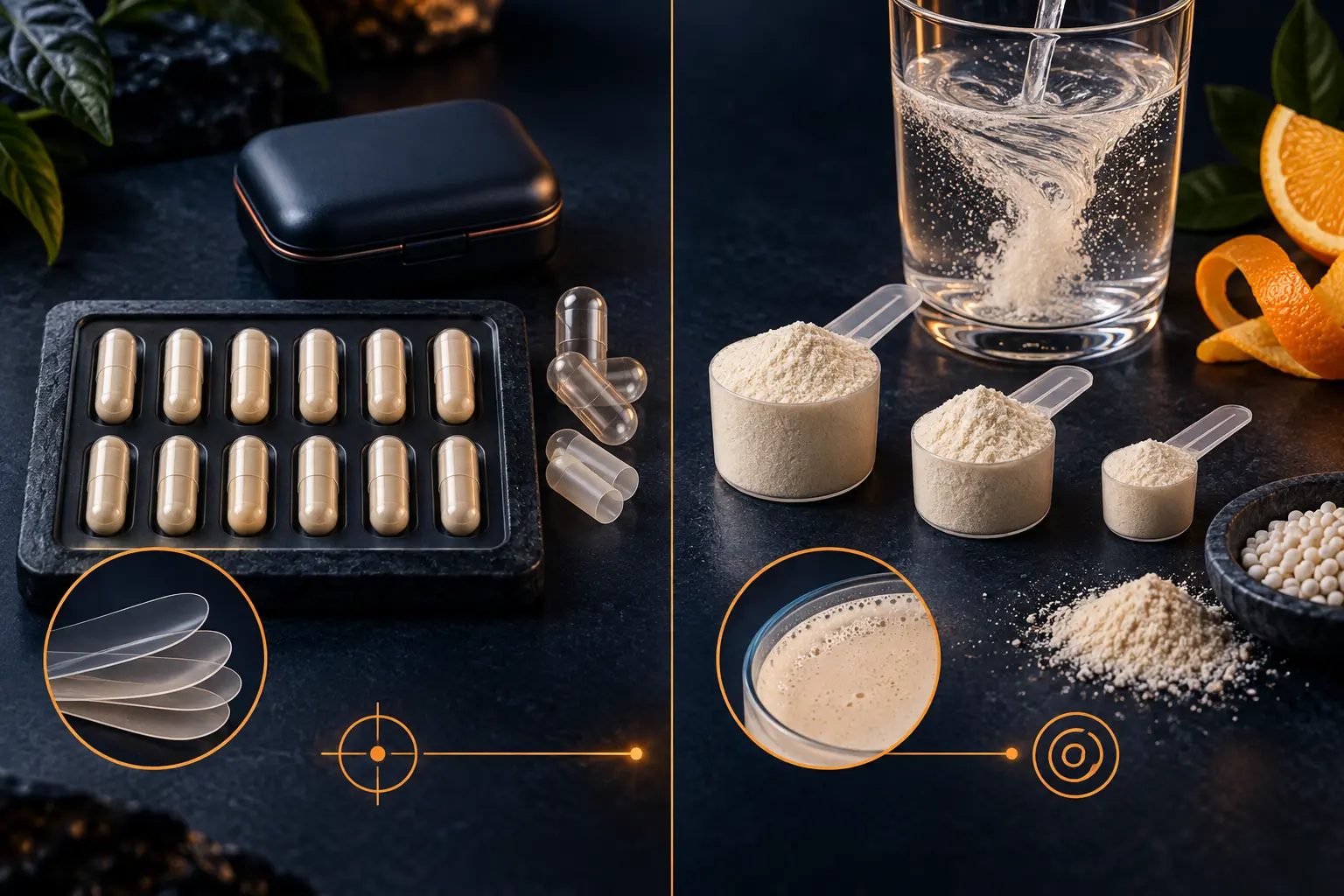
Powder density can vary with settling, humidity, and how the scoop is filled. A rounded, heaped, or compacted scoop may differ from a level scoop. Follow the label; do not use a kitchen spoon as a substitute. If precision is important and the directions allow it, a suitable gram scale can show how your usual scoop compares with the stated serving mass.
Capsules provide fixed units, but the dose is only clear when individual ingredients are disclosed. “Two capsules” does not reveal how much caffeine sits inside a proprietary blend. Count maximum servings in either format.
Keep powders dry and both formats away from children. Discard products with damaged seals, unusual odor, contamination, or storage outside label conditions.
Choose the format you will use correctly
A theoretically ideal formula has no value if its taste causes skipped servings, while a convenient capsule is not useful if it encourages mindless stacking. Consider travel, work, water access, stomach response, dietary restrictions in capsule shells or flavor systems, and whether the routine fits meal and sleep timing.
Cost comparisons should use price per full daily serving, not container size. Include how many servings the maximum directions create, shipping, and wasted product. A large tub can look economical while delivering fewer full doses than expected.
Worked example: compare daily exposure, not package size
Product A contains 90 capsules, with three capsules per serving and two servings permitted daily. At maximum use, the bottle lasts fifteen days. Product B contains 300 grams and lists a ten-gram serving, so it provides thirty servings—unless scoop variation or taste leads to larger or abandoned portions.
Now compare exact active amounts, caffeine, other ingredients, evidence, adverse effects, and price per day. If Product B has a proprietary blend and Product A discloses every amount, the smaller-looking package may support a better evidence review. If neither formula matches meaningful human outcome research, format convenience does not settle effectiveness.
Use the label, not the category name
Category names are not standardized performance grades. Copy the serving size, maximum daily servings, every active ingredient, each stated amount, botanical form and standardization, other ingredients, warnings, and directions. Expand proprietary blends rather than treating their total weight as a usable dose. Count caffeine from anhydrous caffeine, coffee, tea, guarana, yerba mate, kola, drinks, medicines, and any second supplement.
Next, match each claim to the outcome actually studied. An ingredient trial at a comparable dose may inform plausibility, but it does not prove the complete formula. Acute changes in alertness, warmth, hunger ratings, fat oxidation, or energy expenditure are not interchangeable with multi-week changes in food intake, body weight, waist, or fat mass. When the dose or finished-product evidence is missing, preserve that uncertainty.
A five-part decision test
- Define the job. Write the one problem the product is supposed to solve: training performance, a repeatable meal plan, appetite management, convenience, or something else.
- Choose a measurable outcome. Use workout output, daily intake, sleep, weekly average weight, waist, adherence, or side effects—not tingling, sweating, or a vague feeling of activation.
- Compare the exact exposure. Require disclosed daily doses and evidence in relevant people for a relevant duration.
- Price the trade-offs. Include sleep, anxiety, heart-rate effects, gastrointestinal symptoms, taste, portability, complexity, and monthly cost.
- Set an exit rule. Decide when you will stop for adverse effects or lack of a meaningful benefit.
This prevents a supplement from becoming the default answer to several unrelated problems. It also makes “neither” a legitimate result when food, sleep, activity, or a simpler product solves the job more directly.
Keep the comparison fair: change one variable, use the same baseline routine, and record both benefit and harm. A personal trial cannot prove causation or detect uncommon adverse events, but it can expose a product that adds cost and complexity without a clear practical result. Do not extend use merely because a container remains.
Where Fat Burn Active fits
Check which format Fat Burn Active uses, then judge the complete daily serving, label transparency, convenience, and evidence. Its format should not be treated as proof of faster absorption or greater fat loss.
Use the Capsules vs Powders for Fat-Burner Formulas criteria to assess Fat Burn Active rather than relying on a headline claim. Our formula evidence analysis explains the remaining uncertainty. If the product fits your needs, view current availability and ordering terms on the official website. We may earn a commission at no extra cost.
Safety can decide the comparison
Do not stack stimulant products simply because their front labels use different category names. Avoid dry scooping powders. Stop use and seek medical help for chest pain, fainting, severe shortness of breath, a sustained racing or irregular heartbeat, severe agitation, confusion, or an allergic reaction. Sweating, insomnia, palpitations, nausea, constipation, anxiety, and tremor are adverse effects, not proof that a formula is burning fat.
People who are pregnant or breastfeeding, under 18, sensitive to caffeine, have an eating-disorder history, or manage cardiovascular, kidney, liver, endocrine, psychiatric, or sleep conditions need individualized advice. A pharmacist or clinician should review potential interactions with stimulants, decongestants, antidepressants, blood-pressure or diabetes medicines, anticoagulants, and concentrated botanicals.
Frequently asked questions
Do powders work faster than capsules?
They may disperse sooner, but that does not prove a meaningful fat-loss advantage.
Are capsules more accurately dosed?
They provide fixed units, but transparent ingredient amounts and manufacturing quality still matter.
Can I open capsules and mix them?
Only if the product directions or a pharmacist confirms it is appropriate; some contents are irritating or formulated for a specific release.
Sources
- FDA: Dietary Supplement Labeling Guide
- FDA: Questions and Answers on Dietary Supplements
- NIH ODS: Dietary Supplements for Weight Loss
- USP: Dietary Supplements
Sources reviewed September 8, 2026. This article is general educational information, not medical advice, diagnosis, or treatment.