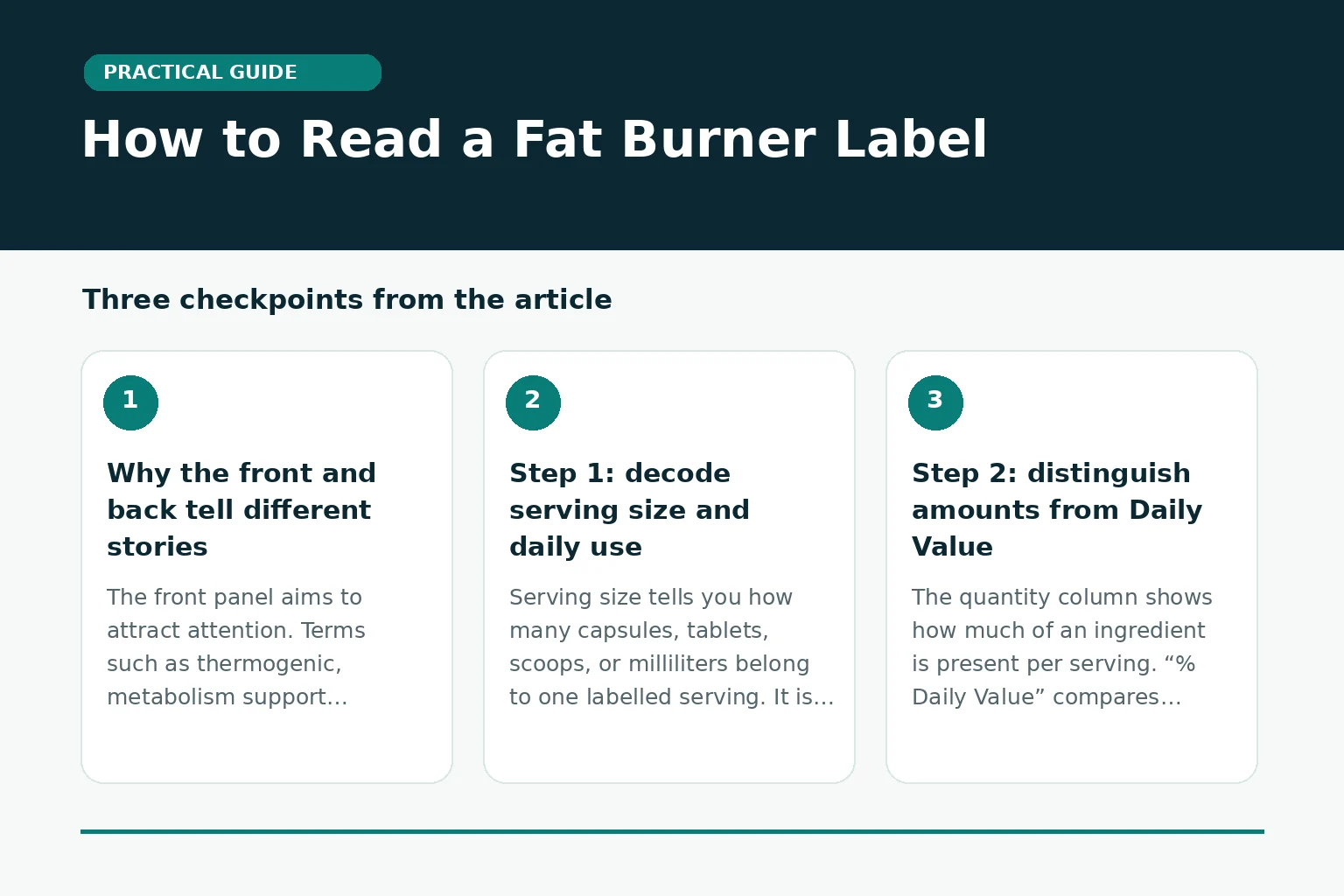
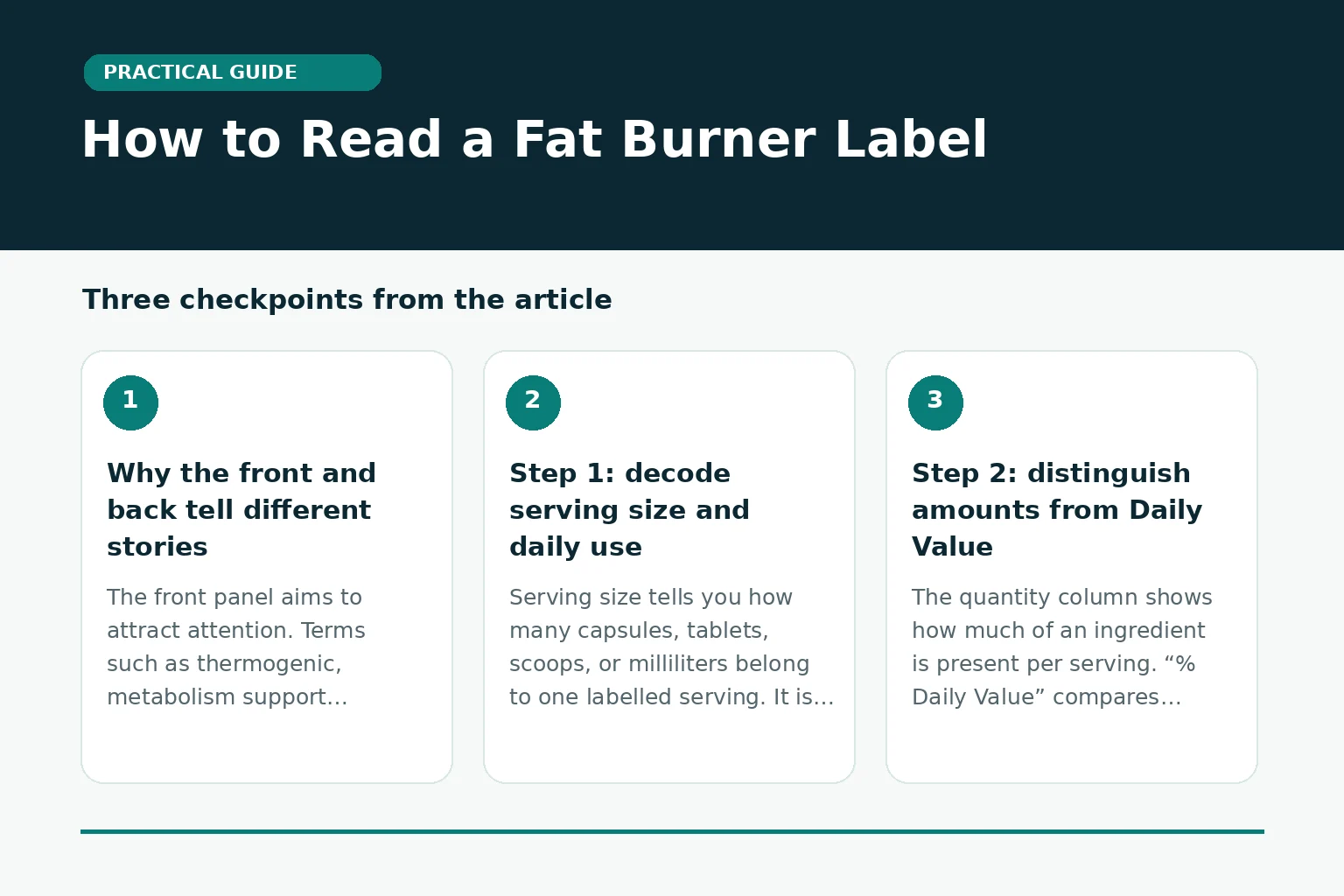
Why the front and back tell different stories
The front panel aims to attract attention. Terms such as thermogenic, metabolism support, clinically researched, natural, and advanced may describe positioning without defining dose or outcome. The Supplement Facts panel is where serving size, listed dietary ingredients, and amounts are presented. Directions, warnings, other ingredients, distributor details, and disclaimers may appear elsewhere on the container.
A common mistake is recognizing one ingredient on the front and assume the formula matches a study. It may use a different form, a smaller amount, or a multi-ingredient blend that was never tested. Turn the bottle around and build an inventory before reading testimonials or benefit bullets.
Step 1: decode serving size and daily use
Serving size tells you how many capsules, tablets, scoops, or milliliters belong to one labelled serving. It is not always the number used in a full day. Directions may recommend one serving twice daily, a lower introductory amount, or different timing around meals and exercise.
Calculate three numbers: amount per unit, amount per serving, and maximum amount per instructed day. If two capsules provide 200 mg and the directions allow two servings, daily exposure is 400 mg—not 200 mg. Repeat the calculation for every ingredient with a disclosed amount.
Step 2: distinguish amounts from Daily Value
The quantity column shows how much of an ingredient is present per serving. “% Daily Value” compares certain nutrients with reference values. Many botanical and specialty ingredients state that a Daily Value has not been established. That does not mean proven effectiveness or permission to use any amount.
Watch the units. One gram equals 1,000 milligrams, and one milligram equals 1,000 micrograms. Compare like units and the same chemical form. For minerals, the label may state the elemental amount and name the source in parentheses.
Step 3: identify proprietary blends
A proprietary blend lists a name, a total blend weight, and ingredients usually ordered by weight, but it may omit the amount of each component. Knowing that the blend totals 600 mg does not reveal whether the first ingredient supplies 500 mg and the last only a trace.
This creates two practical problems. You cannot determine whether each ingredient resembles a researched dose, and you may not be able to calculate total stimulant exposure. Ingredient order provides limited information, not enough to reconstruct the formula.
Step 4: find caffeine in every form
Look for caffeine anhydrous and for caffeine-containing sources such as coffee, tea, guarana, yerba mate, and kola nut. A product may state total caffeine separately; if it does not, the amount can remain uncertain even when one source is listed. Add the supplement total to coffee, tea, energy drinks, soft drinks, chocolate, pre-workout formulas, and relevant medicines consumed that day.
FDA states that for most adults, 400 mg of caffeine per day is an amount not generally associated with negative effects, while sensitivity and metabolism vary widely. This is not a target, and it does not make 400 mg appropriate for every person. Pregnancy, medicines, medical conditions, anxiety, sleep timing, and individual sensitivity can require much lower exposure or avoidance.
Pay attention to timing and serving multiplication. A label that looks moderate per capsule can become high when combined with several daily servings and normal beverages.
Step 5: interpret extracts and standardization
A plant name alone is incomplete. Useful details include the plant part, extraction ratio or solvent when relevant, and standardization to a named constituent. For example, an extract standardized to a percentage of a compound lets you calculate the approximate amount of that constituent: extract weight multiplied by the percentage. It still does not prove benefit.
Do not compare extracts only by raw milligrams when forms and standardization differ. A trademark can identify an ingredient, but it is not a clinical result; verify the studied dose, outcome, and population.
Step 6: separate label facts from marketing claims
Required disclaimers do not transform a weak claim into strong evidence. Likewise, a QR code leading to a generic certificate may not match the product, lot, contaminants, or active-ingredient assay you need to verify.
Step 7: read warnings, directions, and other ingredients
Warnings can identify age restrictions, stimulant cautions, pregnancy advice, health conditions, medicine interactions, timing, and when to stop use. Absence of a warning is not proof that an interaction is impossible. Multi-ingredient products may have limited interaction research.
“Other ingredients” lists capsule materials, colors, flavors, sweeteners, and flow agents. Review allergens and dietary restrictions. Find the responsible company, contact information, lot and expiration markings, and tamper-evident packaging. Do not use a product with a broken seal or illegible label.
Step 8: connect the label to research correctly
- Write the exact ingredient form and maximum daily amount.
- Search for controlled human studies using the same form and a comparable dose.
- Match the claimed outcome: appetite, acute expenditure, weight, waist, or body fat are not interchangeable.
- Check duration, participant characteristics, comparison group, dropouts, adverse events, and funding.
- Look for trials of the complete sold formula. If absent, do not add separate ingredient findings together as if they prove the blend.
NIH's Office of Dietary Supplements reviews common weight-loss ingredients and frequently finds small, inconsistent, or insufficient effects. The correct label conclusion may be “dose disclosed but meaningful product benefit remains unproven.” That is more useful than a yes-or-no verdict built from marketing.
Red flags visible before the first dose
Reject a product when the label image is missing or too blurry to read, the formula on the sales page conflicts with the bottle, caffeine is hidden in a blend, or the seller promises rapid, guaranteed, or effortless loss. Be cautious with drug-like claims, “secret” ingredients, dramatic before-and-after images, and pressure timers.
FDA maintains notifications about weight-loss products found with undeclared pharmaceutical ingredients. A notification list cannot prove every unlisted product is safe. It shows why traceability, realistic claims, and professional review matter.
Reading the Fat Burn Active label
Use the same worksheet for Fat Burn Active: record serving size, maximum daily servings, every ingredient form and amount, all caffeine sources, warnings, other ingredients, and manufacturer details. Then compare the exact record with our Fat Burn Active review. Where an amount or finished-product trial is unavailable, preserve the uncertainty instead of filling it with ingredient assumptions.
Review Fat Burn Active, then official details. We may receive a commission if you purchase through the official details link, at no extra cost to you.
Frequently asked questions
Does “clinically studied ingredients” mean the product was tested?
No. It may refer only to research on one or more ingredients. Look specifically for a trial of the formula at the sold dose.
What does “Daily Value not established” mean?
It means no Daily Value has been set for that ingredient. It does not establish effectiveness or safety.
Can ingredient order reveal the dose?
Within a proprietary blend it may indicate descending weight, but it cannot reveal exact amounts or justify equal division.
Does third-party tested mean effective?
No. Appropriate testing can support identity, purity, or label accuracy within its scope; it does not prove weight loss.
Sources
- FDA: Questions and Answers on Dietary Supplements
- NIH ODS: Dietary Supplements for Weight Loss
- FDA: Spilling the Beans on Caffeine
- FDA: Weight-Loss Product Notifications
Sources reviewed September 8, 2026. This article is general educational information, not medical advice, diagnosis, or treatment.