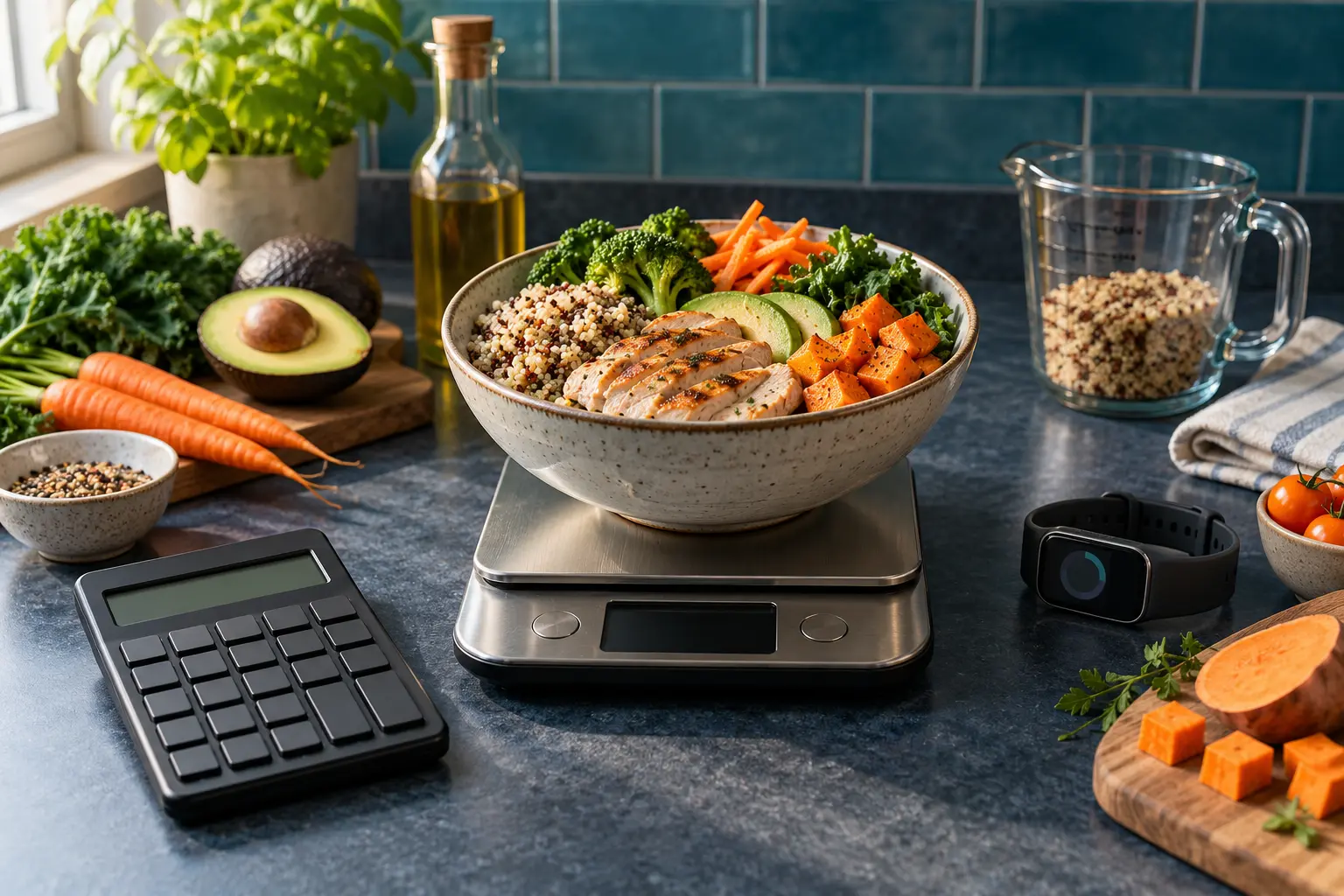
Start with the three numbers people confuse
Resting energy expenditure is the energy used to maintain basic functions at rest. Total daily energy expenditure adds digestion, daily movement, work, and exercise. Maintenance intake is the average intake that corresponds with a broadly stable weight under current conditions. These numbers overlap conceptually but are not interchangeable.
Most online calculators estimate resting needs from age, sex, height, and weight, then multiply by an activity category. The activity multiplier is often the weakest input because labels such as “moderately active” are interpreted differently. The result may look exact to the last calorie even though the underlying uncertainty is large.
A dynamic tool such as the NIDDK Body Weight Planner improves on a fixed “3,500 calories per pound” rule by modeling how energy needs change with time and weight. It still depends on honest inputs and cannot forecast illness, travel, appetite, or every behavioral change.
A five-step calculation process
- Estimate current maintenance. Enter current measurements and a realistic activity level into a validated planner. Record a range rather than treating one number as truth.
- Choose the time horizon. Prefer a gradual goal that leaves room for adequate food, training, sleep, and ordinary life.
- Select a moderate starting change. Reduce a repeatable portion or drink, improve meal structure, and/or add achievable movement.
- Define the observation period. Collect comparable weights and adherence data for at least two to four weeks when medically appropriate.
- Calibrate. Keep the plan if the trend and recovery are acceptable; adjust one lever if the result is persistently different from the goal.
The arithmetic is maintenance estimate minus planned intake equals planned deficit. But the word planned matters. Actual intake, expenditure, and adherence determine the real-world result.

Worked example without false precision
Suppose a planner estimates that an adult maintains weight near 2,300 calories per day. That does not prove their body expends exactly 2,300 calories. It gives a center point. Instead of immediately choosing an extreme intake, they create a smaller change by replacing a caloric drink, measuring cooking oil, and adding a consistent walking routine.
For 21 days, they record morning weights under similar conditions and calculate weekly averages. Week one falls quickly, week two slows, and week three continues gradually. The early movement may include glycogen, water, and digestive contents. The later average is more useful for calibration.
If the trend is too fast and hunger, mood, sleep, or performance worsens, the plan needs more energy or professional review. If the trend is flat and adherence was high, the initial maintenance estimate may be too high or movement may have declined. Change one variable rather than declaring the body “broken.”
Measure the inputs that cause the largest errors
A short measurement audit can improve an estimate without requiring permanent intensive tracking. People for whom calorie tracking triggers anxiety, obsession, restriction, or bingeing should use a different structure with qualified support.
Turn scale data into a usable trend
Weigh under comparable conditions when regular weighing is appropriate: same scale, hard floor, similar time, and similar clothing. Calculate a seven-day average and compare it with previous averages. Add waist measurements every two to four weeks at the same landmark.
Sodium, carbohydrate, menstrual-cycle phase, constipation, travel, illness, and difficult training can obscure tissue change. Do not alter the calculation after one high or low reading. Conversely, do not wait indefinitely when several well-documented weeks show no movement.
The calibration has two outputs: whether the estimated deficit exists and whether it is tolerable. A mathematically effective plan that repeatedly produces dizziness, bingeing, poor sleep, or collapsing training quality is not an acceptable plan.
How to adjust without starting over
When the trend is slower than intended, first identify the most likely error: portions, restaurant frequency, drinks, declining movement, or an unrealistic activity multiplier. Make one small change that can be observed, such as measuring one energy-dense ingredient, setting a minimum step range, or standardizing breakfast.
When the trend is faster than intended or function is deteriorating, add food and reassess. Preserve protein, fiber-rich foods, dietary fat, micronutrients, and social flexibility. Recalculate after meaningful weight change because a smaller body generally uses less energy.
Keep the result as a range. Daily life will never match an exact calorie value, and successful maintenance requires skills that survive variation rather than dependence on perfect arithmetic.
Product context
A supplement is not part of the calorie-deficit calculation and should never be counted as a guaranteed number of calories burned. Fat Burn Active is optional: it cannot create a targeted result, correct an inaccurate calorie estimate, or replace a repeatable food, activity, sleep, and resistance-training plan. Evidence about one ingredient is not proof that the finished formula produces the same outcome at the sold dose.
A supplement is not required to benefit from How to Calculate a Calorie Deficit Without Guessing. If your foundations are already in place, use the independent Fat Burn Active review to judge whether the formula has a useful optional role. If it fits your expectations and stimulant tolerance, check current product details and ordering terms. We may receive a commission.
Safety and when to get help
Calorie targets and exercise plans need individualization during pregnancy or breastfeeding, adolescence, frailty, recovery from illness or surgery, and when someone has diabetes, cardiovascular, kidney, liver, gastrointestinal, endocrine, or eating-disorder concerns. Medicines can affect appetite, fluid balance, glucose, heart rate, and weight. Do not change prescribed treatment to accelerate weight loss.
Stop self-directed restriction and seek qualified care for fainting, chest pain, severe weakness, repeated vomiting, rapidly worsening symptoms, loss-of-control eating, or a persistent unexplained weight change. General web information cannot diagnose a plateau, a reaction, or a medical condition.
Frequently asked questions
How long should I test one change?
Usually several weeks of comparable observations are more informative than a few days, unless symptoms or a clinician-directed plan require earlier action. Keep major variables stable enough to interpret the result.
Does hunger prove the deficit is working?
No. Hunger is a useful experience to manage, but it does not measure energy balance. Meal composition, sleep, stress, routine, and expectations can all affect it.
Should exercise calories be eaten back?
Wearables provide estimates, not a precise food allowance. Avoid automatically matching every displayed calorie; calibrate the whole plan against the longer trend and recovery.
Sources
- NIDDK Body Weight Planner
- Research behind the Body Weight Planner
- CDC: Steps for Losing Weight
- Dynamic model of human weight change
Sources reviewed September 8, 2026. This article is general educational information, not medical advice, diagnosis, or treatment.