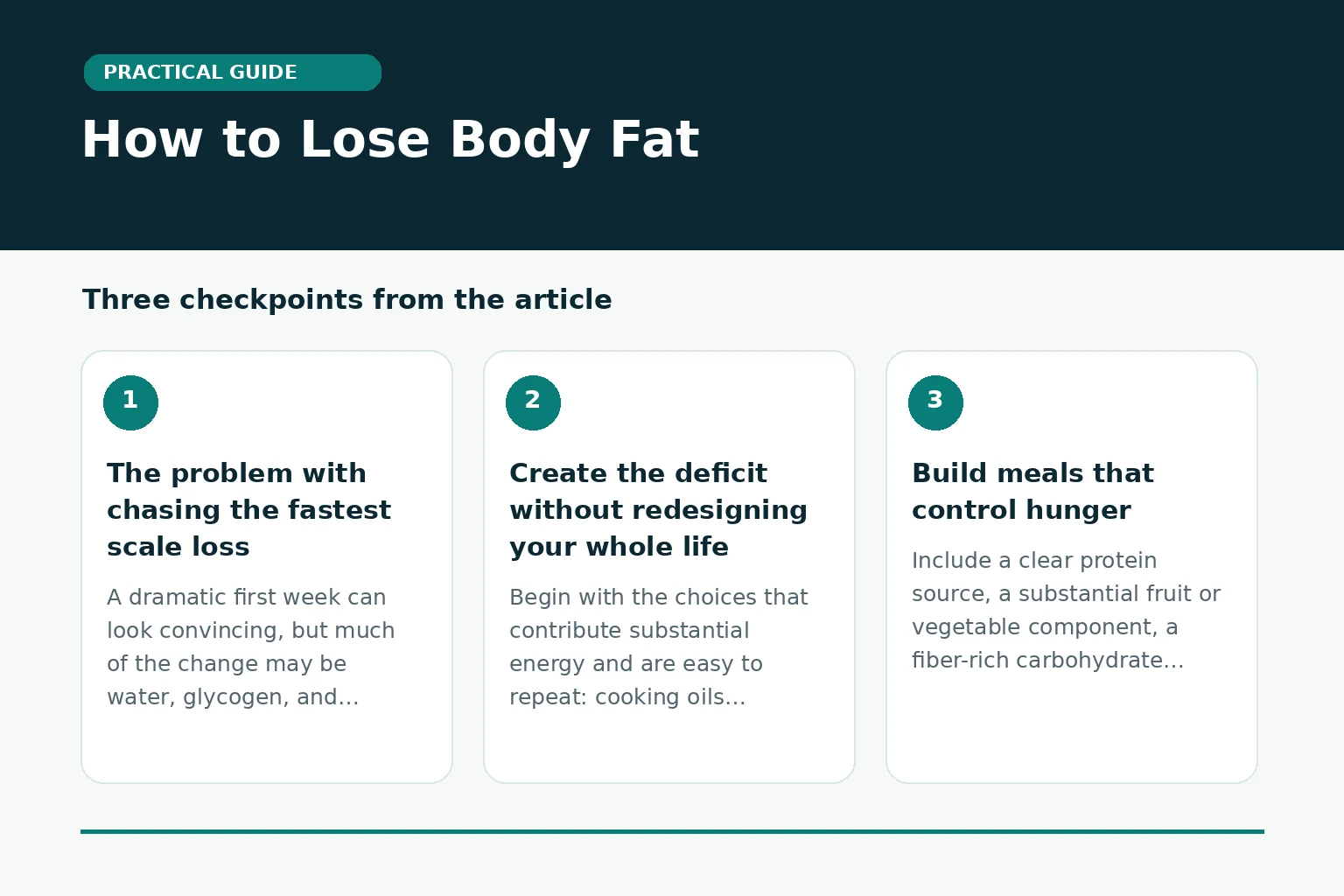
The problem with chasing the fastest scale loss
A dramatic first week can look convincing, but much of the change may be water, glycogen, and digestive contents. Pushing harder can increase fatigue, hunger, training decline, and loss of lean tissue. The person then has a smaller number but a plan that cannot survive ordinary life.
Body-fat loss is slower and less visually obvious than marketing suggests. It requires repeated decisions across weeks, while water can temporarily hide progress. The solution is not perfect motivation; it is a system that remains workable on busy days, weekends, and plateaus.
The five-part fat-loss foundation
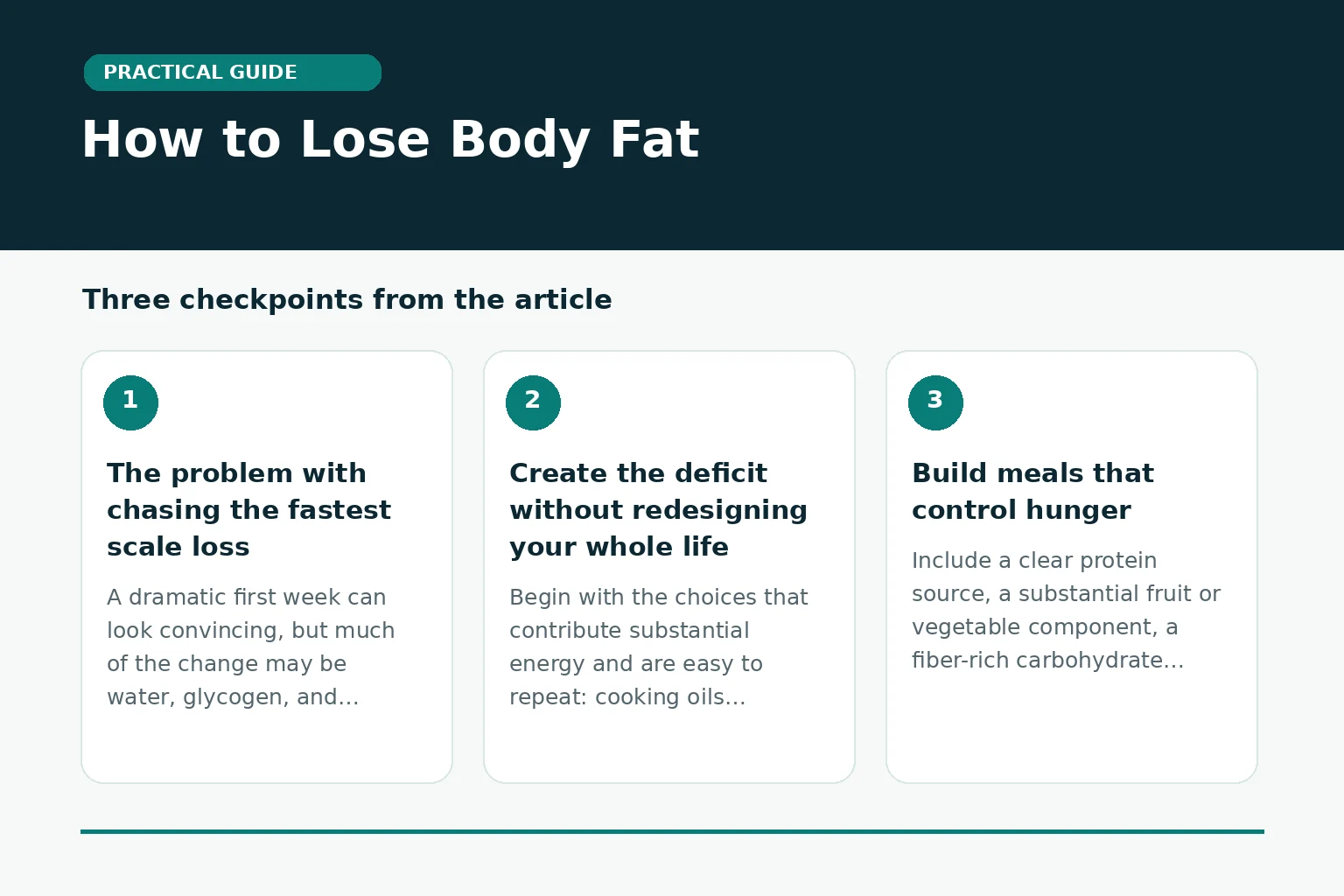
Create the deficit without redesigning your whole life
Begin with the choices that contribute substantial energy and are easy to repeat: cooking oils, sweetened drinks, alcohol, restaurant frequency, large snack portions, or automatic second servings. Keep satisfying meals rather than replacing everything with tiny “diet” products.
Some people prefer calorie tracking; others do better with a plate structure, repeated breakfasts, meal preparation, or portion cues. The correct method is the one that produces a reliable trend without worsening anxiety or disordered eating. Use our calorie-deficit guide to calibrate the estimate.
Build meals that control hunger
Include a clear protein source, a substantial fruit or vegetable component, a fiber-rich carbohydrate when appropriate, and measured fats. Protein and fiber do not cancel calories, but they can make the planned intake more satisfying and nutritionally complete.
Do not remove entire food groups without a medical or practical reason. Carbohydrates can support training; dietary fats provide essential fatty acids and help with nutrient absorption. The weekly pattern matters more than labelling one nutrient as the cause of all fat gain.
Train to preserve function, not to punish eating
Resistance training two or more times per week can be scaled to experience and ability. Use major movement patterns, progressive loads or repetitions, and enough recovery. Cardio improves fitness and adds expenditure, while walking is often easier to accumulate consistently.
Exercise calories are easy to overestimate. Avoid automatically eating back every number shown by a watch. More important, do not use exercise as compensation for a meal; that relationship can make both eating and training less stable.
Use a four-signal progress dashboard
A flat scale with a smaller waist and stable strength is different from a flat scale with unchanged waist and inconsistent execution. Agreement among several signals is more useful than any smart-scale body-fat percentage.
A practical week without a perfect meal plan
A useful fat-loss week can be simple. Choose two repeatable breakfasts, two portable lunches, and three dinners that share ingredients. Keep a protein-rich snack available for the longest gap. Schedule two resistance sessions and define a walking range rather than a rigid daily number. Decide before the weekend which restaurant meal or dessert matters most, so flexibility is planned rather than treated as cheating.
At the end of the week, do not grade individual foods as good or bad. Review the pattern: Were meals satisfying? Where did extreme hunger appear? Did the plan survive the busiest day? Did movement fall after hard training? Did alcohol or a late meal change the next day? These observations reveal the first point that needs redesign.
For the following week, preserve everything that worked and change one bottleneck. That might mean preparing lunch the night before, measuring cooking oil, moving a workout, adding carbohydrate around training, or choosing an earlier bedtime. The change should be specific enough to verify and small enough to repeat. This process produces individual evidence without pretending that one menu is ideal for everyone.
What to do when progress slows
- Confirm that the plateau lasts several weeks, not several days.
- Check sodium, cycle phase, constipation, travel, illness, and hard training.
- Audit portions, drinks, cooking fats, weekends, and restaurant meals.
- Compare current movement with the previous baseline.
- Choose one modest change and hold it long enough to evaluate.
If the plan is already very restrictive or symptoms are developing, do not cut further without qualified guidance.
When to involve a healthcare professional
Professional help is appropriate for unexplained weight change, severe fatigue, fainting, swelling, shortness of breath, menstrual disruption, recurrent binge eating, significant depression or anxiety, or symptoms after a medication change. People with diabetes, cardiovascular, kidney, liver, endocrine, or eating-disorder concerns need individualized decisions.
Prescription obesity treatment may be appropriate for some adults after clinical assessment. This is different from choosing an over-the-counter fat burner and should not be replaced by an affiliate recommendation.
A registered dietitian can also help when the plan must fit diabetes care, kidney or liver disease, food allergies, cultural patterns, shift work, limited cooking, or a history of restrictive dieting. Good support does not merely provide a lower calorie number; it identifies which changes are safe, nutritionally adequate, and realistic in the person’s actual environment.
Where Fat Burn Active fits
A supplement is an optional tool after the plan is established. Fat Burn Active contains ingredients marketed around stimulation and thermogenesis, but ingredient-level evidence is not finished-product evidence. If exact amounts or total caffeine are unavailable, effectiveness and personal risk cannot be judged precisely.
Read the full review, verify the current label and checkout terms, and discuss stimulant exposure with a clinician or pharmacist when medicines or health conditions are involved.
Set a stopping rule before any purchase: decide which missing label details, side effects, price changes, or interaction concerns would make the product unsuitable. A defined rule protects the decision from urgency, discounts, and the temptation to interpret stimulation as proof of fat loss.
Frequently asked questions
Can I target belly fat?
You can strengthen abdominal muscles, but you cannot direct nearby fat cells to supply all the energy. Overall fat loss and individual distribution determine the change.
How fast should fat loss be?
There is no universal rate. Starting size, health, deficit, training, and preference matter. Faster is not automatically better.
Do I need cardio?
No single exercise is mandatory. Combine resistance work, daily movement, and cardiovascular activity in a way that fits ability and recovery.
A supplement is not required to benefit from How to Lose Body Fat. If your foundations are already in place, use the independent Fat Burn Active review to judge whether the formula has a useful optional role. If it fits your expectations and stimulant tolerance, check current product details and ordering terms. We may receive a commission.
Sources
- NIDDK: Treatment for Overweight and Obesity
- CDC: Steps for Losing Weight
- Preserving healthy muscle during weight loss
- Physical Activity Guidelines for Americans
Sources reviewed September 8, 2026. This article is general educational information, not medical advice, diagnosis, or treatment.