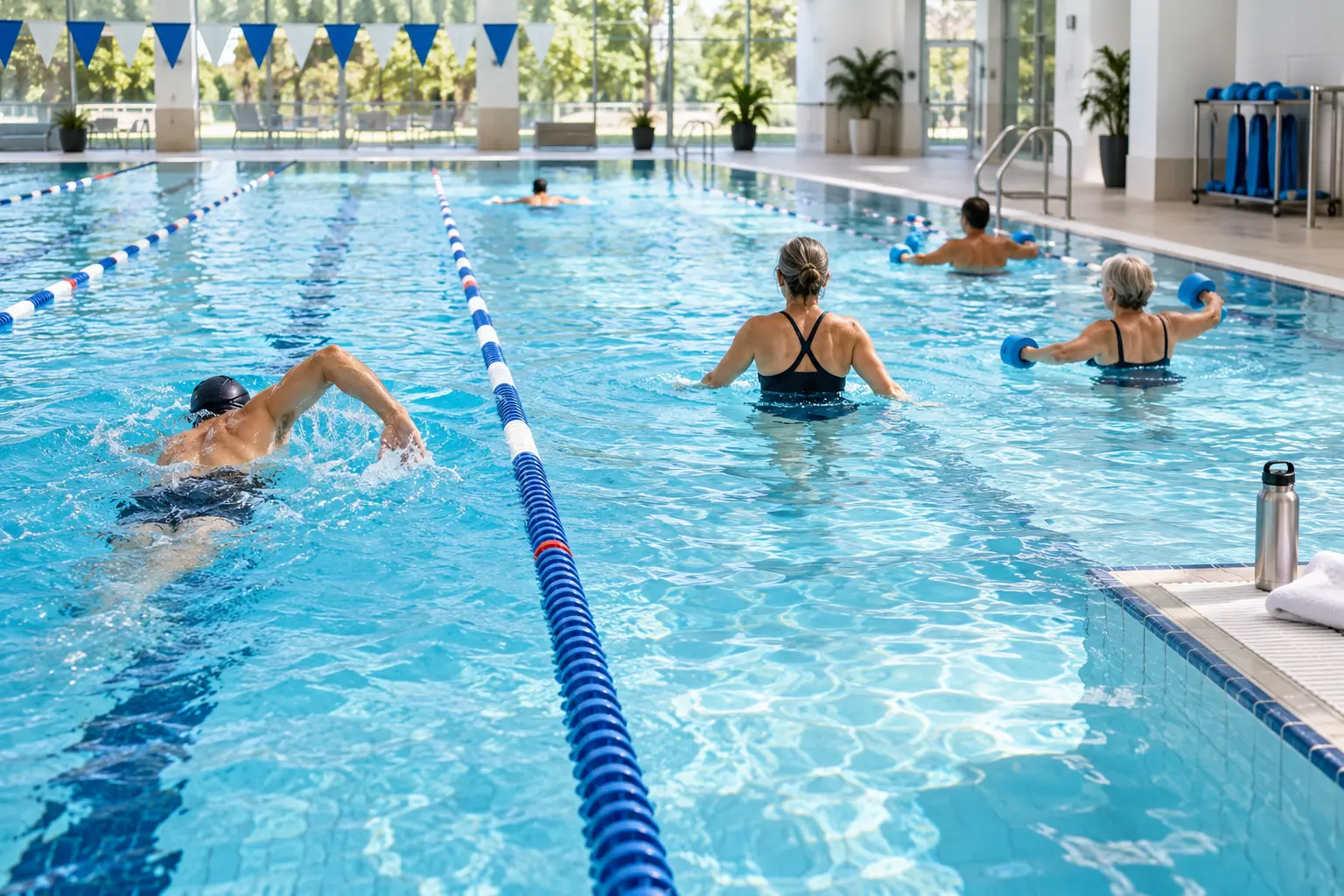
Lower impact does not mean zero joint load
Buoyancy reduces loading through the feet, knees, hips, and spine compared with many land activities. Water also provides resistance in multiple directions. This can make swimming or water walking useful when weight-bearing exercise is uncomfortable.
Shoulders still repeat large ranges, breaststroke can irritate some knees, wall turns require force, and pool decks create fall risk. Choose stroke, range, and equipment from symptoms and skill—not from the claim that swimming is universally joint friendly.
Why swimming research does not promise special loss
Swimming expends energy, but the amount varies enormously with stroke, technique, speed, rests, water temperature, and body size. Older small comparisons should not be treated as a verdict against swimming, and laboratory expenditure is not the same as net fat loss.
Some people become hungry after swimming or reward the session with larger meals. Others adhere better because they enjoy water and recover comfortably. The energy balance across weeks determines the weight outcome.

A beginner-friendly pool structure
- Confirm water confidence and pool safety rules.
- Warm up with five easy minutes of water walking or gentle lengths.
- Alternate one easy length with a planned rest.
- Stop the set before stroke quality collapses.
- Cool down and record shoulder, knee, breathing, and fatigue responses.
- Add a few minutes the next week only when recovery is predictable.
Water aerobics, deep-water running, and water walking are valid alternatives when continuous lap swimming is not suitable.
Solve access and appetite before buying equipment
Account for travel, admission cost, changing time, lane availability, skin or hair care, and supervision. A theoretically excellent workout that consumes two hours of logistics may lose to a thirty-minute walk completed consistently.
Plan the post-swim meal before entering the pool: include protein, produce, a suitable carbohydrate, and fluid. This prevents intense hunger from turning into an unplanned energy-dense purchase. Hydration still matters even when sweat is less visible.
A final choice check
Swimming skill strongly affects effort: inefficient technique can feel exhausting without allowing useful duration. Lessons may improve comfort, confidence, and training quality more than extra laps performed poorly or anxiously.
Interpret results beyond the workout screen
Separate immediate physiology from the outcome you actually want. A session can use more calories per minute, produce a higher heart rate, or use a larger proportion of fat as fuel without causing more body-fat loss over months. The body balances fuel use across time, while eating, recovery, and later movement can change after training.
Use at least two outcome layers. The first is execution: completed sessions, minutes, distance, intensity, and progression. The second is response: weight and waist trends, fitness, pain, sleep, hunger, and total daily movement. A plan that improves fitness without large scale change still has value; a falling scale accompanied by worsening function deserves review.
Compare like with like. Keep the observation period, food pattern, and other training reasonably stable. Avoid comparing a short hard session on a rested weekend with a long easy session after a demanding workday. Weather, terrain, equipment, and sleep belong in the record because they change performance.
Choose a review date before starting. Four weeks often reveals adherence and early fitness direction, although it cannot establish long-term superiority. If the option repeatedly causes pain, missed sleep, dread, or compensatory inactivity, adjust the dose or choose another mode. Consistency is not blind repetition; it includes responding intelligently to feedback.
Use a four-week exercise decision system
- Record baseline. For seven ordinary days, note activity minutes, steps or distance, session effort, symptoms, sleep, hunger, and next-day movement.
- Choose one variable. Change timing, pace, incline, or exercise mode—not all four together.
- Set a minimum dose. Pick a duration and frequency you can complete during a busy week rather than designing an ideal week.
- Progress gradually. Add time before making every session harder, unless shorter intensity intervals are the specific test.
- Review the whole response. Compare completion, fitness, pain, fatigue, appetite, sleep, and ordinary activity.
- Keep the repeatable option. The best session is the one that creates useful weekly work without repeatedly disrupting recovery.
Use the same device or route for comparisons, but treat calorie displays as estimates. A wearable can help compare your own sessions under similar conditions; it cannot measure an exact food allowance.
Exercise calories are not a guaranteed deficit
Body mass, speed, grade, technique, fitness, environment, equipment, and session length all influence energy expenditure. After exercise, appetite may rise and spontaneous movement may fall. These compensations vary, so a machine's reported 400 calories do not guarantee that total daily expenditure rose by 400 calories.
Track completed minutes, distance, pace or resistance, and recovery as controllable inputs. For weight loss, compare multiweek weight and waist trends while keeping food reasonably consistent. Avoid automatically eating back every exercise calorie. If the trend is flat, examine the full weekly pattern before turning every workout into punishment.
Progression and stop rules
Begin below your maximum, especially after a long break. Warm up gradually, use appropriate footwear or equipment setup, and change only one workload variable at a time. Pain that changes movement, persistent swelling, unusual breathlessness, dizziness, faintness, chest pressure, or a rapid irregular heartbeat requires stopping and appropriate assessment.
Pregnancy, recent surgery, significant heart or lung disease, diabetes medicines, balance problems, neurological conditions, and active joint disease can change the safest mode and dose. A clinician, physiotherapist, or qualified exercise professional can help adapt the plan. Weight-loss urgency never makes warning symptoms safe.
Where Fat Burn Active fits
Fat Burn Active is optional. It cannot reproduce cardiovascular fitness, strengthen the muscles used in movement, improve technique, or make an unsuitable session safe. Stimulation, warmth, sweating, or a higher heart rate is not proof of extra body-fat loss, and evidence for one ingredient does not prove the finished formula's effect.
Do not use Fat Burn Active to push through symptoms related to Swimming for Weight Loss and Joint-Friendly Fitness. Review its product-specific safety considerations and discuss relevant conditions or medicines with a qualified professional before considering purchase.
Frequently asked questions
Which exercise burns the most fat?
No single mode guarantees the most fat loss. Total recoverable weekly work, food intake, adherence, and compensation matter more than the fuel mix during one session.
Should I trust treadmill, bike, or watch calories?
Use them as rough comparisons under similar conditions, not exact measurements or automatic calories to eat back.
Must every session be hard?
No. Easy sessions build volume and recovery capacity; harder work can be added selectively when appropriate.
What if the scale rises after starting?
New exercise can temporarily increase water retention and glycogen. Judge several weeks, waist, performance, and adherence rather than one weigh-in.
Sources
- US Physical Activity Guidelines
- WHO Physical Activity Guidelines
- Compendium of Physical Activities
- CDC: Swimming and Recreational Water Safety
Sources reviewed September 15, 2026. This article is general educational information, not medical advice, diagnosis, or treatment.