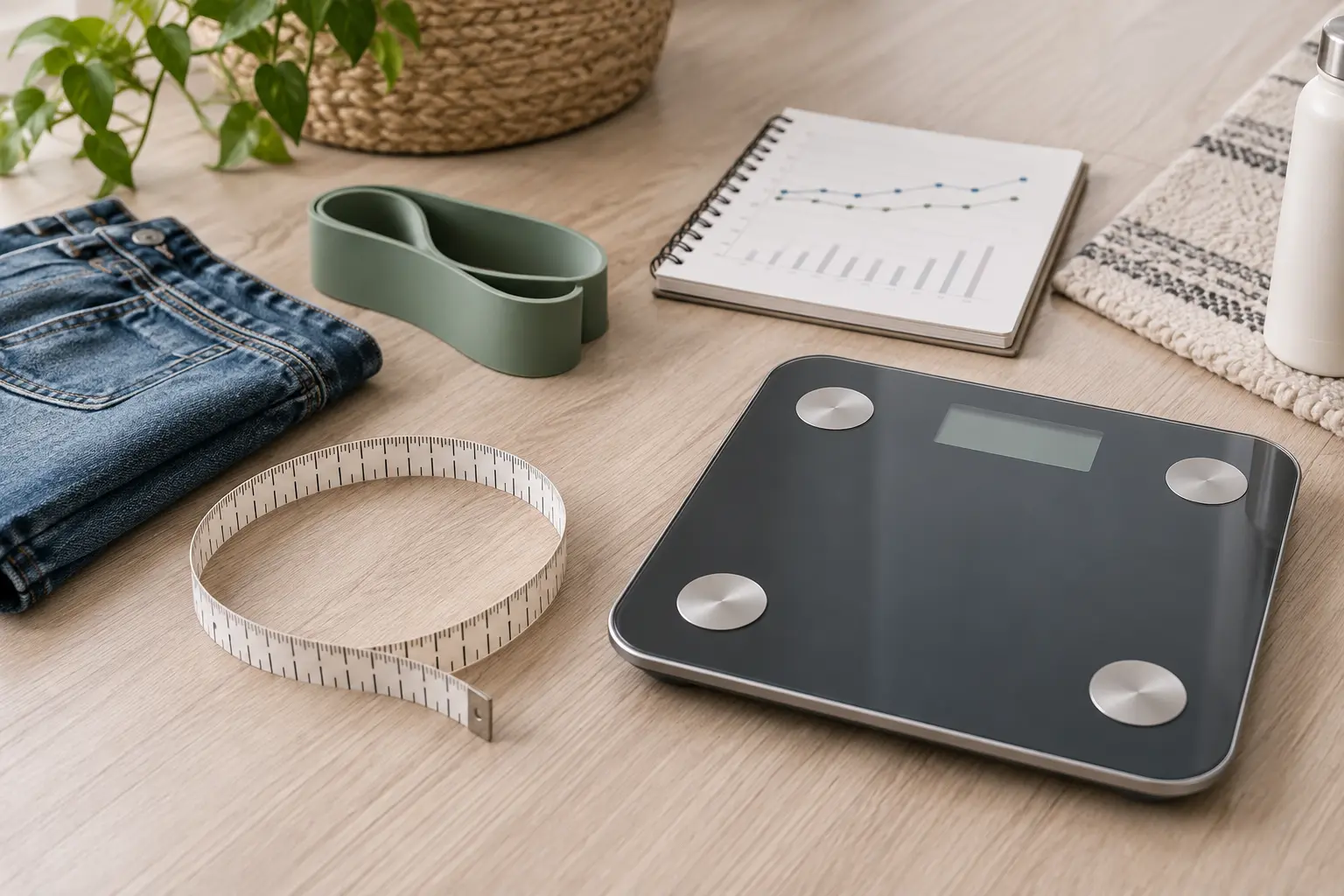
Two signals with different strengths
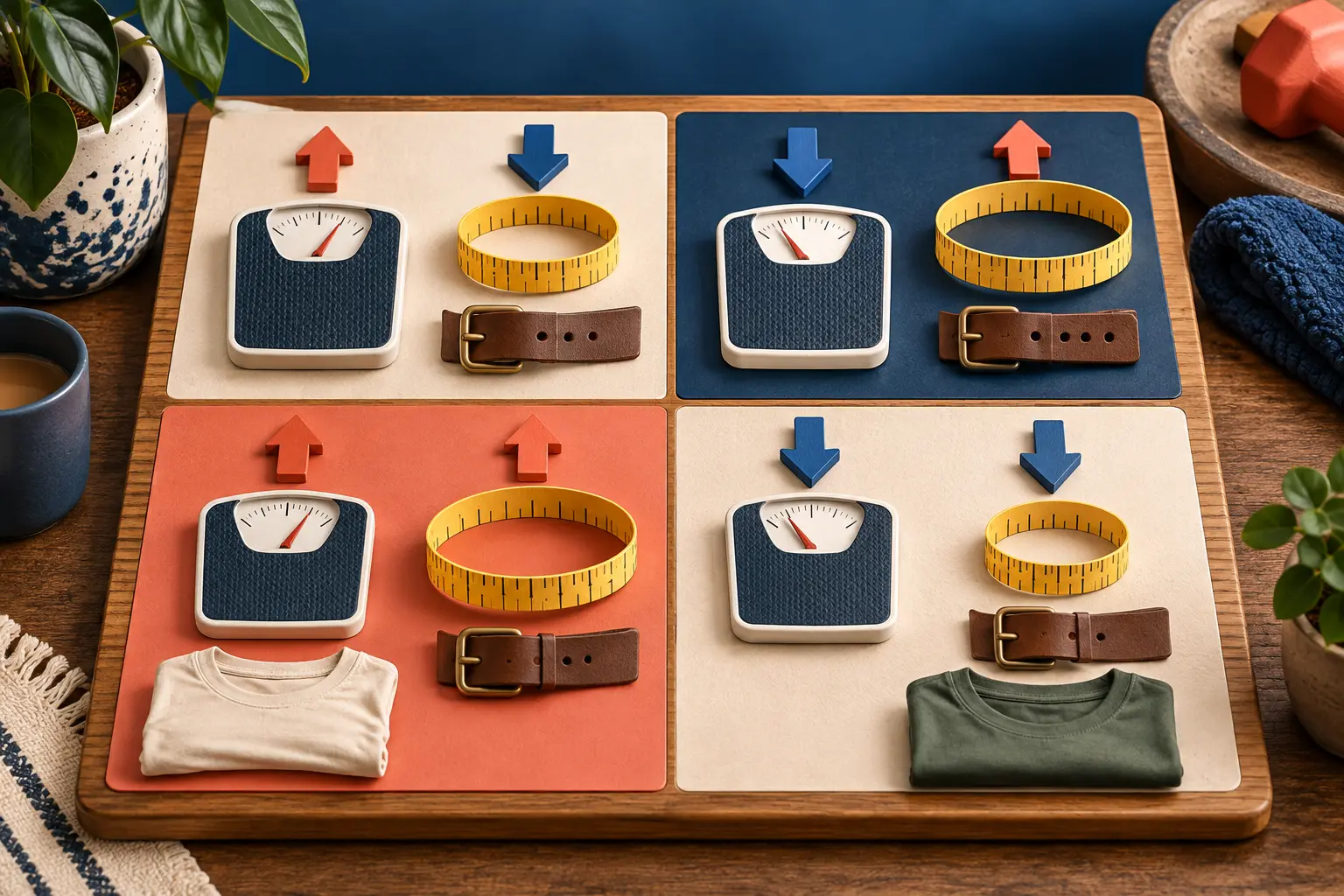
Interpret four common combinations
Weight down and waist down: the signals agree with a reduction in overall and abdominal size, though they do not quantify pure fat loss. Weight flat and waist down: water, glycogen, digestive mass, or increased lean tissue may be masking scale change; also verify tape technique. Weight down and waist flat: loss may be occurring elsewhere, early scale change may include water, or waist measurement may be too noisy. Both flat: confirm enough time and consistent execution before adjusting the plan.
No combination diagnoses health or body composition by itself. Use the pattern to choose the next question.
Match the time scale to the tool
Daily weight can be averaged because it is fast and objective once conditions are standardized. Measuring waist daily usually creates more noise than insight. Use the same day and conditions every one to four weeks, depending on the expected pace of change and how calmly you can use the data.
Compare a current average with several previous averages, not the lightest day. Compare waist with prior measurements made by the same person using the same protocol. Small differences near the limits of technique should be treated cautiously.
Example: the scale stalls while jeans loosen
A beginner starts resistance training. Over three weeks, weekly average weight changes little, but a consistently measured waist is smaller and the same jeans fit more comfortably. Training performance improves. The evidence does not permit an exact muscle-gained-versus-fat-lost calculation, but it argues against reacting to the scale alone.
The person keeps the plan stable for another review period. If waist rebounds after salty meals or constipation, they use the scheduled measurement rather than the tightest evening reading. Progress is judged from the bundle of signals.
Build a small progress dashboard
Choose at most four indicators: seven-day average weight, scheduled waist, one clothing-fit reference, and one performance or health measure. Define how often each is recorded and what magnitude or duration would justify action. More metrics are not automatically better. A small dashboard reduces cherry-picking—the habit of selecting whichever number supports today's emotion.
Write the review in one sentence: what changed, what stayed stable, and which action follows. If the signals disagree, extend observation or check technique instead of choosing the most comforting or alarming number. Preserve the raw entries so later comparisons use the same baseline.
Separate observation from interpretation
Record what happened before explaining why. “The seven-day average increased, waist was unchanged, and three readings followed restaurant meals” is an observation. “I gained fat because of sodium” is an interpretation that the measurements alone cannot prove. This distinction prevents a plausible mechanism from becoming a diagnosis.
Before acting, list at least two explanations and the next observation that could separate them. Temporary fluid or digestive mass may settle after ordinary routines resume; a tissue trend is more likely to persist across comparable weeks. Measurement error becomes more plausible when technique, device placement, clothing, timing, or the person taking the measurement changed. Keep uncertainty visible instead of forcing a precise story from limited data.
Set an action threshold in advance. For example, continue unchanged when only one daily reading differs; check technique when duplicate measurements conflict; review the plan when several comparable weekly averages and waist measurements move in an unwanted direction; seek care when concerning symptoms appear. The threshold should reflect the goal and medical context. This approach turns tracking into a decision aid rather than a daily judgment, and it protects useful habits from being rewritten whenever body water, digestion, or a consumer algorithm changes the display.
Use a two-week measurement system
Write the question before collecting more data. Use morning body weight after using the bathroom and before eating or drinking when daily weighing is appropriate. Keep the scale on the same hard surface, calculate a seven-day average, and measure waist no more than weekly at the same landmark. Record only context that can change the interpretation: unusual sodium or carbohydrate intake, bowel pattern, menstrual-cycle phase, travel, alcohol, hard training, illness, medicines, and major schedule changes.
Do not react to each entry. Set a review date fourteen days ahead and keep food, movement, and training reasonably stable unless safety requires a change. At review, compare average weight, waist, clothing fit, adherence, and symptoms. Decide whether the signal is temporary mass, measurement noise, a plausible tissue trend, or something that needs professional assessment. One controlled observation answers more than several simultaneous diet changes.
Where Fat Burn Active fits—and where it does not
A supplement should not be credited from a favorable waist or scale reading without a stable measurement system. Fat Burn Active cannot resolve disagreement between the two metrics.
Fat Burn Active is optional and is not required for fat loss. It cannot identify water retention, clear constipation, validate a tape measurement, or turn a body-fat estimate into a direct measurement. A short-term change after taking any product does not establish that body fat changed.
A supplement is not required to benefit from Waist Measurement vs Scale Weight. If your foundations are already in place, use the independent Fat Burn Active review to judge whether the formula has a useful optional role. If it fits your expectations and stimulant tolerance, check current product details and ordering terms. We may receive a commission.
Know when the number needs medical context
Seek prompt medical advice for rapid unexplained weight change accompanied by swelling, shortness of breath, chest pain, fainting, severe weakness, persistent vomiting, marked thirst or urination, blood in stool, severe abdominal pain, fever, or inability to pass stool or gas. New symptoms matter more than an attempt to complete a tracking experiment.
Fluid balance and bowel function can be affected by heart, kidney, liver, endocrine, gastrointestinal, and neurological conditions as well as medicines. Pregnancy, an eating-disorder history, diabetes medication, diuretics, obesity medication, and major changes in bowel habits require individualized guidance. Do not use dehydration, laxatives, extreme sodium restriction, or extra exercise to force a lower reading.
Frequently asked questions
Which is better, waist or weight?
Neither is universally better. They measure different outcomes and are most useful together.
Can my waist shrink without weight loss?
Yes. Body composition, water, digestion, posture, and measurement technique can all contribute.
How often should I measure waist?
Every one to four weeks under the same conditions is usually more interpretable than daily measurement.
Sources
- WHO: Waist Circumference and Waist–Hip Ratio report
- NHLBI: Assessing Your Weight and Health Risk
- CDC: About Adult BMI
- NIDDK Body Weight Planner
Sources reviewed September 13, 2026. This article is general educational information, not medical advice, diagnosis, or treatment.