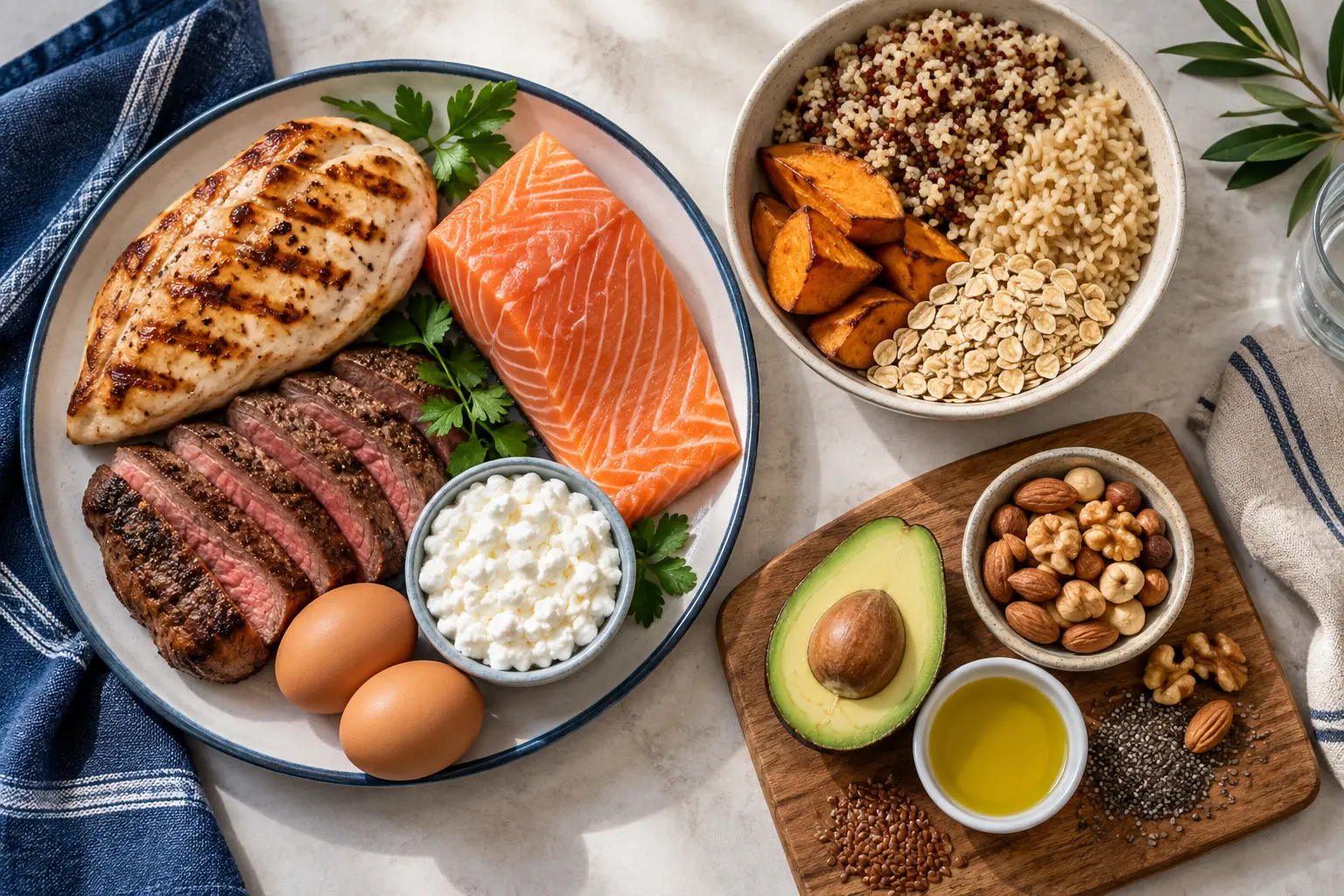
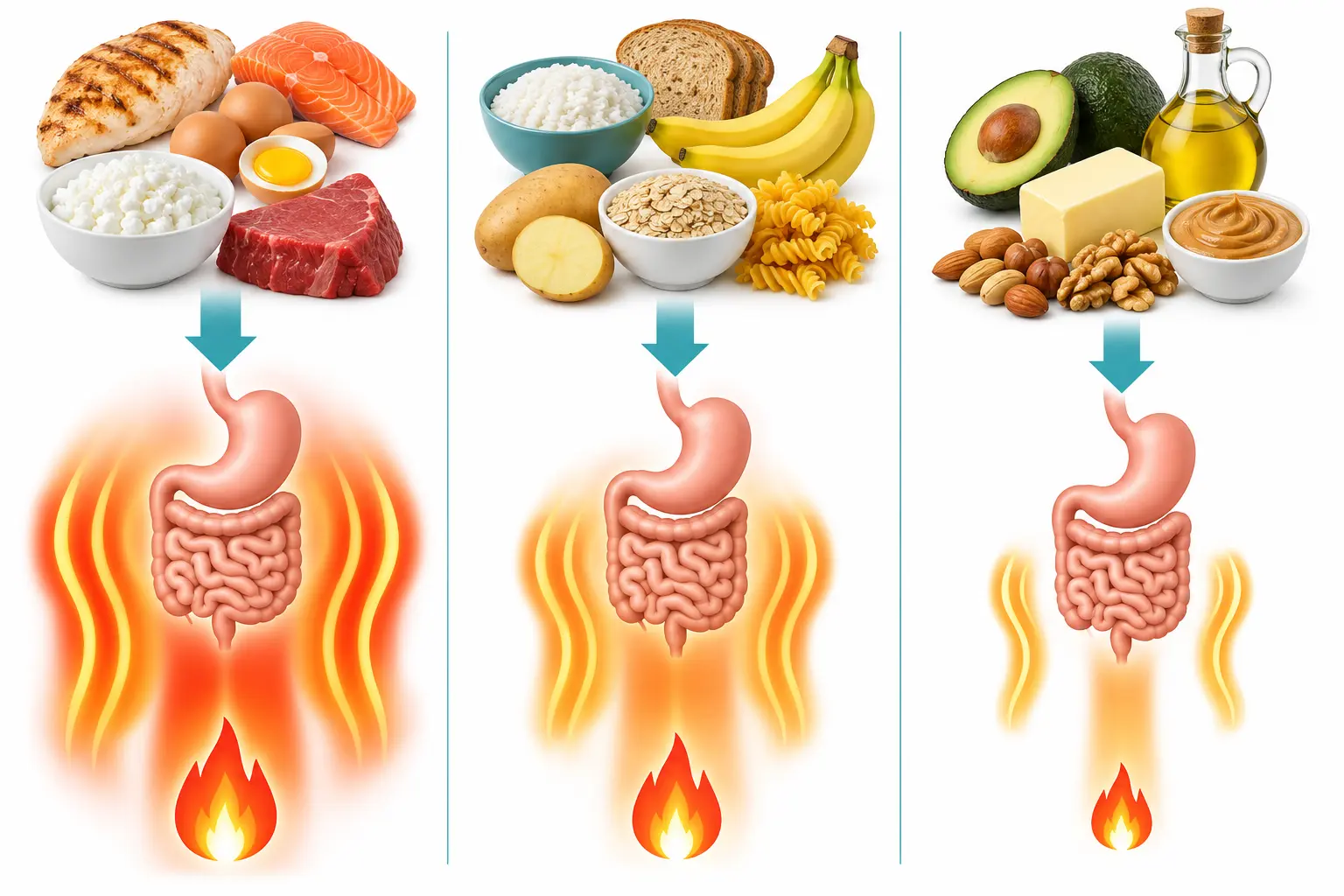
The macronutrient ranking
The ranges are not a personal calculator. Mixed foods contain more than one macronutrient, and processing pathways change with the meal and current physiological needs.
Why protein costs more to process
Protein must be broken into amino acids, absorbed, and used for protein synthesis, other nitrogen-containing compounds, oxidation, or conversion. The body has no dedicated storage depot for excess amino acids comparable with fat tissue, and handling nitrogen adds metabolic work.
Protein also supports lean tissue and often improves satiety, which may be more practically important than the thermic difference. Neither effect guarantees a deficit if portions and total intake rise.
Use the math without creating fake precision
Suppose a meal contains 40 grams of protein, 60 grams of carbohydrate, and 20 grams of fat. Before TEF, that is about 580 calories using standard conversion factors. Applying midpoint percentages might produce an illustrative processing estimate, but it cannot measure the person's actual response.
Do not deduct that estimate from the meal. Maintenance equations already incorporate typical food processing, and the percentages come from controlled research rather than a specific plate.
Build the plate around function
Choose protein to meet personal nutrition and training needs, then distribute it across meals in portions that are enjoyable and digestible. Add vegetables, fruit, legumes, whole grains, or other fiber-rich carbohydrate according to preference and tolerance. Include enough dietary fat for essential fatty acids, nutrient absorption, flavor, and satisfaction.
Kidney disease, pregnancy, older age, athletic training, allergies, culture, budget, and total calorie needs can change the decision. The highest-TEF pattern is not automatically the healthiest.
Do not turn the ranking into an elimination diet
Carbohydrate can support training and supply fiber-rich foods; fat supplies essential fatty acids and helps absorb fat-soluble vitamins. Protein also has a useful range rather than an unlimited target. Replacing olive oil with lean protein changes calories, texture, fatty acids, vitamins, fullness, and meal size. The result cannot be credited to TEF alone.
Start with an adequate protein anchor, then allocate the remaining foods around health, activity, preference, and the calorie target.
Example: a useful breakfast change
A breakfast of a pastry and sweet drink leaves Dana hungry. She replaces part of it with Greek yogurt, berries, and oats while keeping a smaller pastry she enjoys. Protein and fiber rise, the meal remains satisfying, and its thermic response may be higher.
The useful outcome is that lunch portions and hunger become easier to manage. If she merely adds the new foods on top, higher TEF may not offset the additional intake.
Turn the mechanism into a useful decision
Use a three-column meal audit rather than chasing percentages. In the first column, list the protein source and whether the portion meets the meal's practical goal. In the second, list fiber-rich carbohydrate and produce. In the third, list measured fats that provide flavor and essential nutrition. Then record fullness, digestion, training quality, and later snacking. This shows whether a higher-protein choice improves the whole day. It also prevents a common mistake: adding extra protein to an unchanged meal and expecting its processing cost to erase the added calories. If the change worsens affordability, variety, digestion, or a medical condition, the theoretical advantage is not the priority.
Use an evidence ladder before believing a calorie claim
Separate four questions before turning a laboratory effect into a weight-loss strategy. Does the mechanism exist? Can researchers measure it? How large and durable is the change? Does it improve body weight, waist, fat mass, health, or adherence in real life? A statistically detectable rise in expenditure may still be too small, brief, or variable to matter on the scale.
Put controlled human outcome trials above acute metabolic measurements, and acute measurements above animal or cell mechanisms. Check the actual food, compound, temperature, dose, exposure time, participants, and comparator. Do not annualize an effect recorded for a few hours as though it repeats unchanged every day. Appetite, movement, tolerance, environment, and behavior can compensate.
Protect the large levers first: a sustainable intake pattern, adequate protein and fiber, daily movement, resistance training, sleep, and medical care when needed. A thermogenic effect can exist inside that system, but it cannot make an unmeasured calorie deficit reliable or turn discomfort into evidence of fat loss.
Run a practical two-week reality check
- Define the claim. Write the exact outcome: fullness, meal quality, warmth, beverage substitution, daily intake, or weight trend. “Faster metabolism” is too vague.
- Record the baseline. Use comparable morning weights, a weekly waist measure, ordinary activity, sleep, hunger, and relevant symptoms.
- Change one variable. Keep the rest of the eating and activity plan as stable as practical.
- Measure execution first. A strategy cannot be judged if it happened only on two unusually good days.
- Compare averages. Interpret at least two weekly averages, not the highest or lowest reading.
- Keep only useful changes. Continue when the tactic improves nutrition, comfort, or consistency; stop when it adds risk, obsession, or inconvenience without a meaningful benefit.
Two weeks cannot prove fat loss from a tiny thermogenic mechanism. It can show whether the behavior is tolerable and whether it changes the part of the routine that matters. Longer trends are required for body-composition conclusions.
Where Fat Burn Active fits
Fat Burn Active is marketed through thermogenic ingredients, but a food, cold, or water mechanism does not prove that the finished supplement produces meaningful fat loss. Ingredient studies use specific preparations and doses; their effects cannot be added together or transferred automatically to a multi-ingredient formula. Feeling warm, stimulated, or less hungry is not a body-fat measurement.
Once the practical steps in Which Macronutrient Has the Highest Thermic Effect? are working, decide whether an optional supplement adds enough value. Start with the Fat Burn Active review; if the formula and limitations are acceptable, see current availability and official ordering details. We may receive a commission.
Frequently asked questions
Does a higher metabolic rate automatically mean fat loss?
No. The size and duration of the change, total intake, total expenditure, compensation, and time determine whether body fat changes.
Can several small thermogenic tactics be added together?
You cannot assume separate study effects are additive. Combining tactics may change appetite, sleep, comfort, hydration, or safety.
Does sweating show that extra calories are being burned?
No. Sweating mainly regulates temperature and changes body water; it does not measure fat loss.
Should a calorie target change because of one thermogenic food or exposure?
Usually not. Treat the effect as uncertain and calibrate the complete plan from multi-week trends.
Sources
- National Academies: Energy Expenditure Components
- Thermic Effect and Sympathetic Nervous System
- Meal Composition and Thermic Effect Review
- High-Protein Diets, Thermogenesis and Satiety
Sources reviewed September 14, 2026. This article is general educational information, not medical advice, diagnosis, or treatment.