Why one protein number can mislead
Online calculators often multiply current body weight by a high target and present the result as exact. For someone with a larger body size, that can produce an impractical number that crowds out vegetables, grains, fruit, and dietary fat. At the other extreme, using only the minimum adult allowance may not reflect the demands of a calorie deficit and resistance training.
Protein recommendations answer different questions. The adult Recommended Dietary Allowance is designed to cover the needs of nearly all healthy adults under ordinary conditions; sports and weight-loss guidance may aim to support training adaptation, satiety, or lean-tissue retention. A number suitable for a lean athlete cannot be copied automatically to every person with obesity, kidney disease, or limited food access.
Treat the first target as a testable range, not a biological password. The plan must still be nutritionally complete, affordable, enjoyable, and sustainable.
When shopping to meet that goal, compare lower-cost protein foods by usable serving and meal value.
The seven-day high-protein meal plan shows food anchors across a week without prescribing a universal calorie total.
A practical starting range
These categories overlap and are not prescriptions. More protein is not automatically better once needs, training support, and meal quality are covered.
Choose the right weight for the calculation
Using current body weight is straightforward when body composition is within a range where the result remains practical. With a high body-fat level, multiplying total weight by an athletic target may overstate needs. Clinicians may use an adjusted weight, goal-weight range, estimated lean mass, or absolute daily target depending on the purpose and available data.
Avoid pretending a home body-fat scale gives an exact lean-mass number. Hydration and device algorithms create error. If a calculation produces a target that consumes an unreasonable share of calories or requires constant supplements, pause and review the reference weight and purpose.
Worked example without false precision
A healthy 80 kg adult using 1.2–1.6 g/kg would obtain a working range of 96–128 g/day. That range is a starting point for meal planning, not proof that 95 g is inadequate or 129 g is superior. Training, age, total calories, food sources, and health still matter.
Distribute protein across meals
Putting nearly all protein at dinner leaves breakfast and lunch unable to support fullness or provide repeated amino-acid exposure. Many people find it practical to place a substantial source at two or three main meals, with a snack only when it serves the schedule.
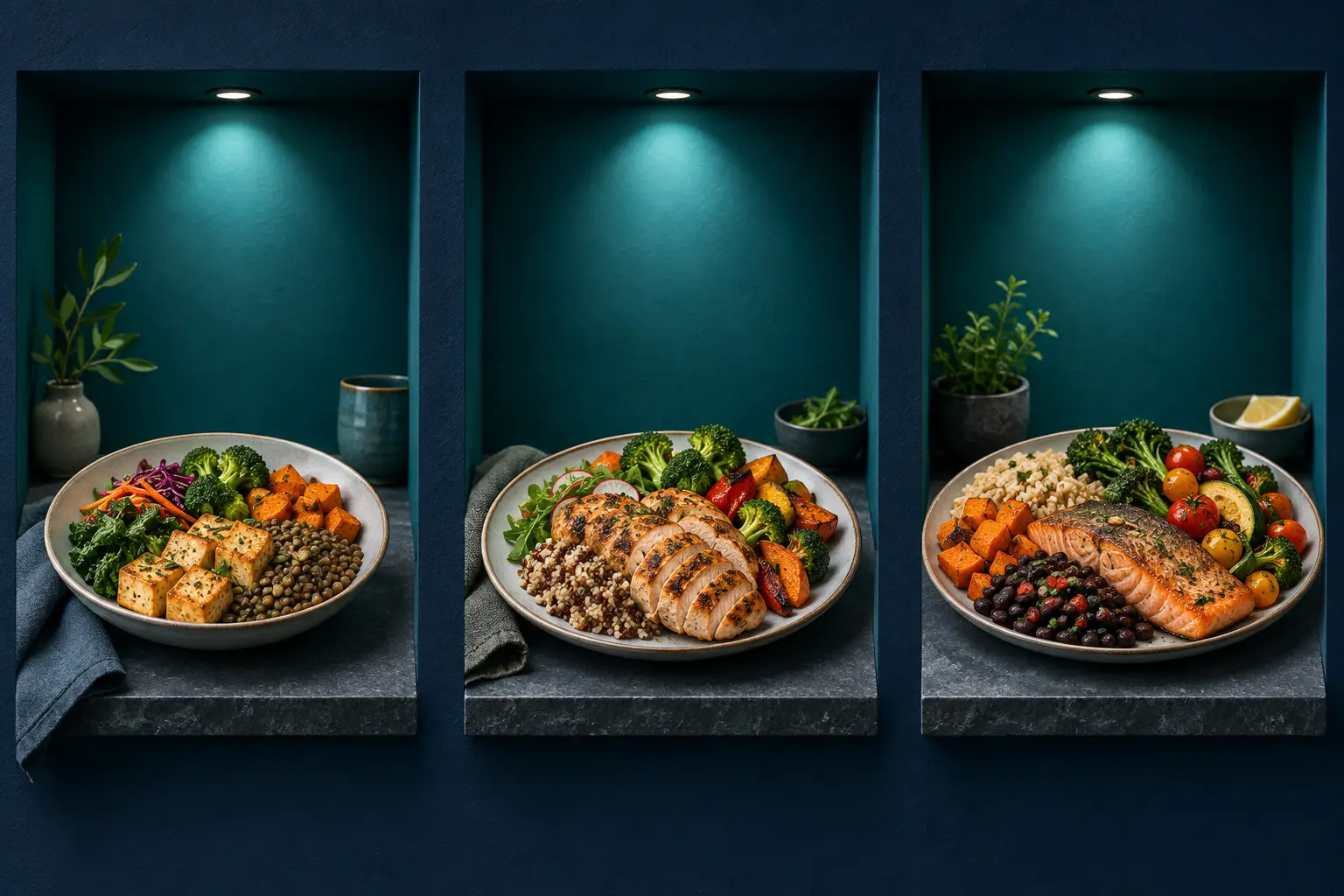
A daily target of 100 g might be approached through three meals containing roughly 25–35 g plus smaller contributions from grains, vegetables, or a snack. The exact split does not need to be identical. Older adults and people training may benefit from avoiding extremely uneven distribution, but the day still matters more than perfection at one meal.
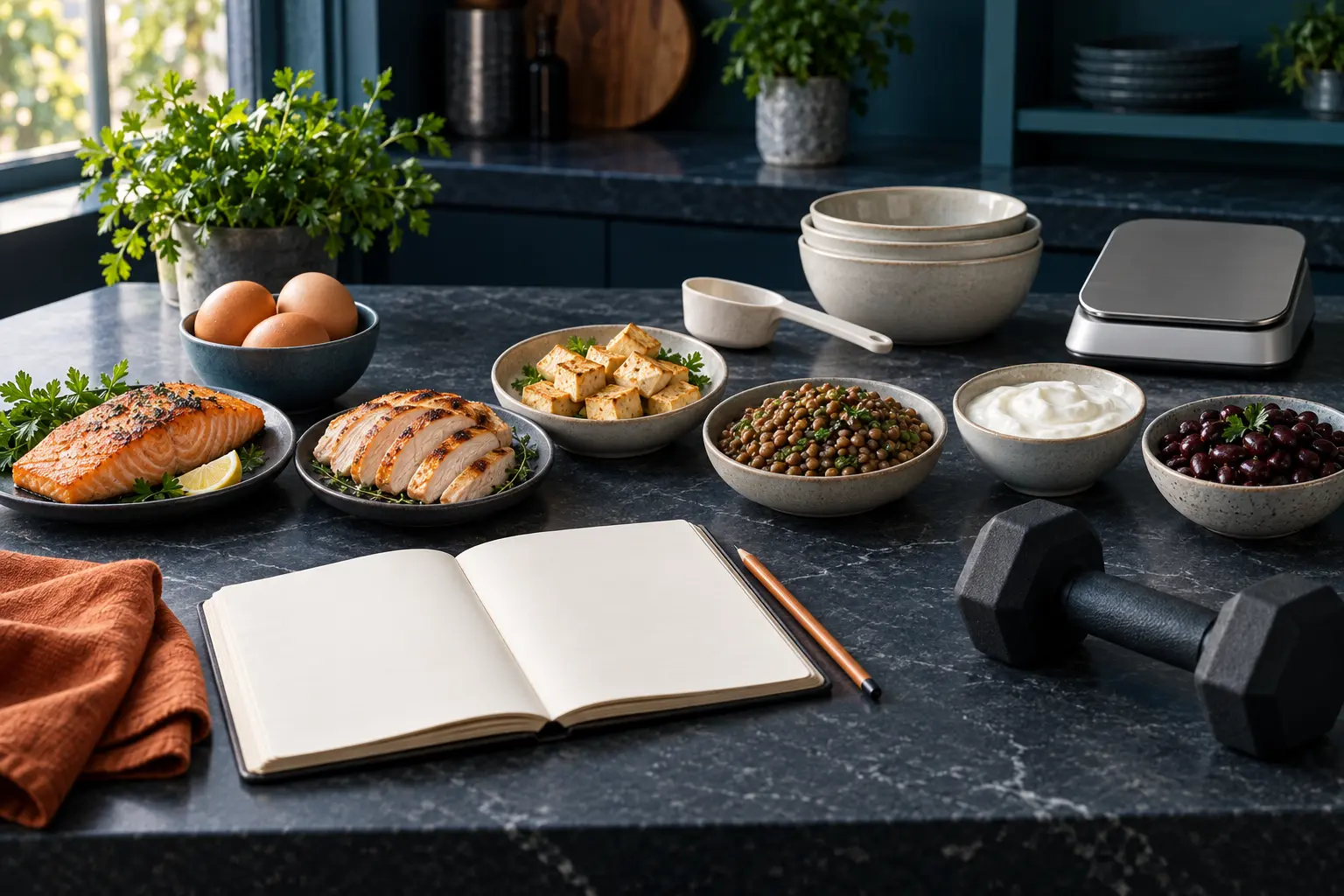
Use recognizable food anchors: eggs or yogurt, tofu or tempeh, fish, poultry, lean meat, lentils, beans, peas, cottage cheese, or culturally appropriate combinations. Plant proteins count; variety helps cover amino acids and other nutrients.
Build the target with food before powders
List the protein already present in three ordinary days. Then identify the weakest meal and replace or add one useful food. Pair it with vegetables, fruit, legumes, or whole grains so protein does not crowd out fiber. Keep sauces, oils, cheese, nuts, and other energy-dense additions visible.
A powder can solve a convenience gap, limited appetite, travel problem, or post-training schedule. It is not required for fat loss and may be less satisfying than a mixed solid meal. Check serving size, added sugar, allergens, cost, and third-party certification relevant to identity or contamination—not as proof of effectiveness.
Repeated whole-food meals also reveal whether the target is realistic. If meeting it requires foods you dislike at every meal, select a lower practical point in the range and improve the overall plan.
Run a two-week adequacy test
- Choose a conservative starting target appropriate to your context.
- Map it across two or three meals using foods you already eat.
- Keep total calories and fiber-rich foods visible.
- Record hunger, strength, recovery, digestion, cost, and adherence.
- Compare weekly average weight and waist under consistent conditions.
- Adjust only after reviewing the full pattern, not one hungry day.
If strength falls, recovery deteriorates, hunger stays extreme, or loss is rapid, the issue may be insufficient total energy rather than protein alone. If weight does not change, extra protein calories may have been added without replacing another food.
When a higher target becomes counterproductive
A very-high-protein plan can displace fiber, unsaturated fats, and carbohydrate needed for preferred training. Depending on food choices, it can raise saturated fat, sodium, cost, or gastrointestinal burden. It may also reinforce rigid tracking or fear of ordinary meals.
Protein supports lean tissue, but resistance training supplies the mechanical stimulus. Neither can fully protect muscle during severe under-eating. Use a moderate deficit, progressive training when appropriate, and adequate recovery rather than treating grams as insurance against an extreme diet.
Where Fat Burn Active fits
A thermogenic supplement does not supply dietary protein or replace the training and nutrition needed to retain lean tissue. Fat Burn Active is optional and cannot replace an appropriate energy intake, adequate protein and fiber, dietary variety, activity, sleep, or medical care. A short-term change in alertness, appetite, warmth, heart rate, or sweating does not prove meaningful fat loss.
A supplement is not required to benefit from Protein for Fat Loss: How Much Do You Need?. If your foundations are already in place, use the independent Fat Burn Active review to judge whether the formula has a useful optional role. If it fits your expectations and stimulant tolerance, check current product details and ordering terms. We may receive a commission.
Safety and individual context
Do not adopt a high-protein target from a calculator when you have kidney disease, significant liver disease, a clinician-directed protein restriction, pregnancy, a metabolic disorder, or unexplained symptoms. A clinician or registered dietitian can choose a suitable reference weight and range.
Pregnancy or breastfeeding, adolescence, frailty, eating-disorder recovery, diabetes medicines, and significant kidney, liver, cardiovascular, gastrointestinal, or endocrine disease require individualized nutrition advice. Seek assessment for rapid unintended weight change, fainting, persistent vomiting or diarrhea, marked weakness, excessive thirst or urination, severe abdominal symptoms, or a sudden appetite change. Do not alter prescribed treatment or use a supplement as a diagnostic test.
Frequently asked questions
Is 0.8 g/kg enough during fat loss?
It is the adult RDA for general adequacy, not a specialized dieting target. Activity, age, deficit, and health can justify a different working range.
Should protein use current or goal weight?
It depends on body composition and purpose. Current weight can overstate needs at higher body-fat levels; qualified guidance can select a better reference.
Do you need protein powder?
No. It is a convenience food, not a requirement. Whole foods can meet targets while supplying broader nutrition.
Sources
- ISSN position stand on protein and exercise
- Systematic review of protein intake and lean mass
- Dietary Reference Intakes for protein
- Dietary Guidelines for Americans
Sources reviewed September 8, 2026. This article is general educational information, not medical advice, diagnosis, or treatment.