
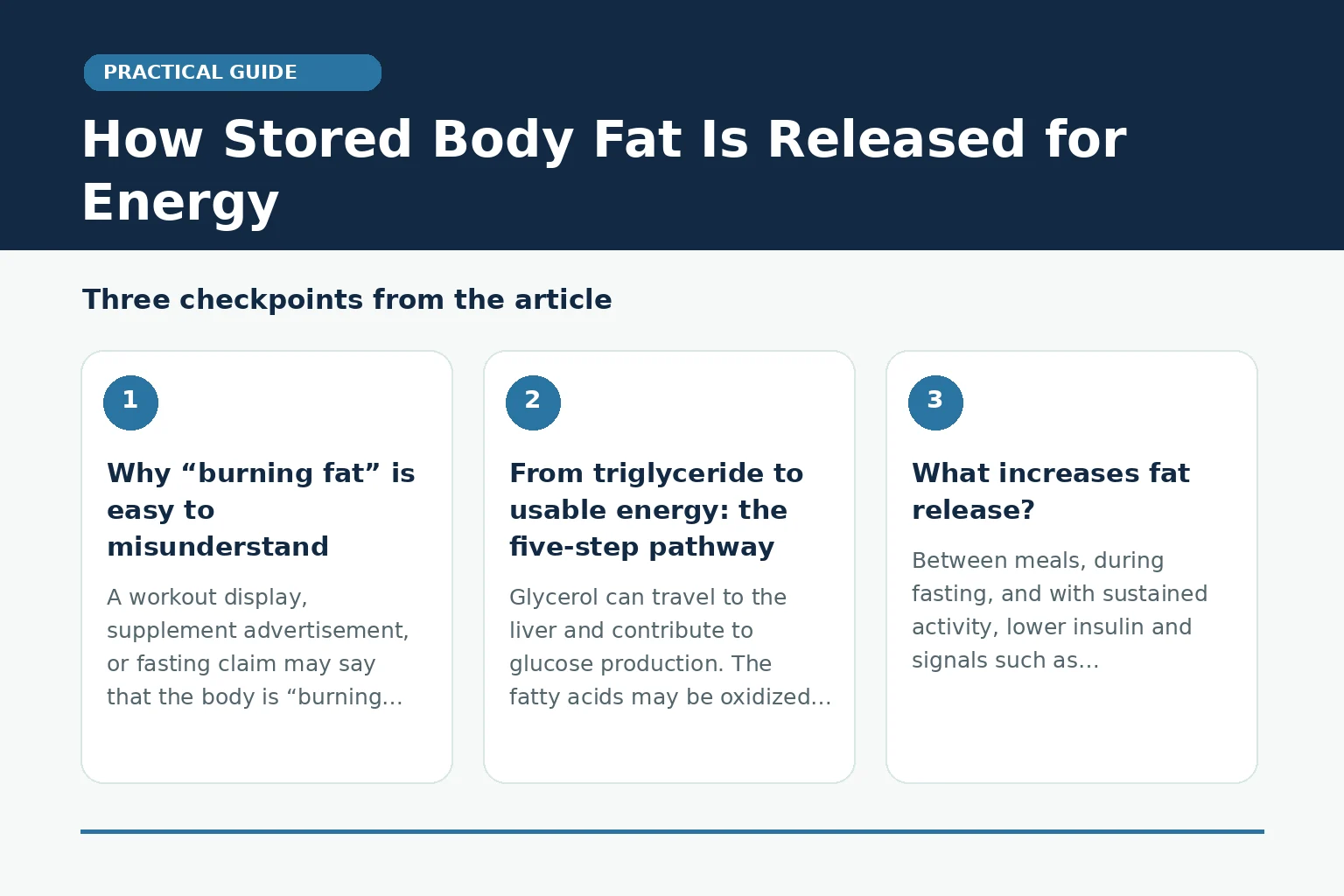
Why “burning fat” is easy to misunderstand
A workout display, supplement advertisement, or fasting claim may say that the body is “burning fat.” The phrase sounds like stored fat is disappearing permanently. In reality, fuel use is dynamic. The body continuously shifts between carbohydrate and fat, while fat storage and release can occur within the same day.
This creates a costly mistake: people chase the highest possible fat oxidation during one workout while ignoring total intake, recovery, activity, and adherence. A low-intensity session can use a higher percentage of fat while a harder session may expend more total energy. Neither guarantees fat loss if energy intake later replaces what was used.
From triglyceride to usable energy: the five-step pathway
Glycerol can travel to the liver and contribute to glucose production. The fatty acids may be oxidized, re-esterified, or redirected depending on tissue demand and the wider metabolic state. Mobilization is therefore an opportunity to use stored energy—not proof that the energy has permanently left the body.
What increases fat release?
Between meals, during fasting, and with sustained activity, lower insulin and signals such as catecholamines generally favor greater lipolysis. During and after eating, insulin tends to suppress adipose-tissue lipolysis and supports storage. These are normal transitions, not “good” and “bad” metabolic states.
Exercise raises energy demand and can increase fatty-acid availability and use, but intensity, duration, training status, recent food intake, glycogen availability, and individual biology all affect the mixture of fuels used.
The release–oxidation–loss gap
Can you choose where stored fat is released?
Working a nearby muscle does not selectively empty the fat cells above it in a predictable, meaningful way. Genetics, sex hormones, age, blood flow, receptor patterns, and total fat loss influence which areas change first or last. Abdominal exercises can strengthen the trunk, but they are not a local fat-removal tool.
Can fat burners accelerate this pathway?
Some ingredients may temporarily affect stimulation, energy expenditure, appetite, or markers of fat oxidation. That is not the same as showing clinically meaningful loss of stored body fat from the finished product. Ingredient form, dose, duration, population, total stimulant exposure, and product-level trials all matter.
Before considering a supplement, read how fat-burner mechanisms are evaluated. Our Fat Burn Active review applies that framework while clearly identifying information that is not publicly verified.
How to encourage net use of stored energy
- Create a moderate, sustainable energy deficit. Use food choices and portions that can be maintained rather than repeated crash dieting.
- Preserve muscle. Include resistance training and sufficient dietary protein within individual medical and nutritional needs.
- Move consistently. Combine daily movement with suitable aerobic and strength activity.
- Protect sleep and recovery. Poor sleep can make hunger, training, and adherence harder to manage.
- Track trends. Compare multi-week weight averages, waist measurements, performance, and adherence.
- Adjust with evidence. If the trend stalls, reassess intake and activity before adding stronger claims or products.
Frequently asked questions
When does the body start burning stored fat?
There is no universal minute when fat use suddenly begins. Fat and carbohydrate contribute in changing proportions throughout the day.
Does fasting burn more fat?
Fasting can increase fat oxidation during the fasting period, but long-term fat loss depends on the overall energy balance and whether the pattern is safe and sustainable.
Where does lost fat go?
Oxidized fat is ultimately converted mainly into carbon dioxide, which is exhaled, and water, which leaves through breath, urine, sweat, and other routes.
Treat Fat Burn Active as an optional addition, not a substitute for How Stored Body Fat Is Released for Energy. Review its listed ingredients and limitations in our product analysis. If the evidence, warnings, and cost fit your decision, verify the current formula and purchase options. We may earn a commission.
Sources
- Lipolysis and fatty-acid utilization
- Adipose-tissue lipid metabolism and lipolysis
- NCBI Bookshelf: Lipolysis
- Fatty-acid oxidation and metabolic variation
Evidence reviewed September 7, 2026. Educational information only; not medical advice.
From release to actual loss
Lipolysis only releases fatty acids from storage; it does not guarantee that they remain gone. Fatty acids can be oxidized for energy or re-esterified and stored again. Net fat loss requires oxidation to exceed storage over time. Hormones, exercise intensity, food intake, energy demand, and training status shift these flows continuously. Marketing that proves a compound increases lipolysis in a cell or acutely raises fat oxidation has not yet proved meaningful long-term fat loss in people.
A four-week review process
- Week 1 — establish the baseline. Keep normal routines, collect the measures above, and note unusual travel, illness, restaurant meals, hard training, poor sleep, or other events that can distort the result.
- Week 2 — choose one controlled change. Define a behavior you can actually measure, such as a meal structure, a walking range, or a training target. Avoid changing food, exercise, supplements, and sleep at the same time.
- Week 3 — check execution before outcome. Ask whether the planned behavior happened often enough. A plan cannot be judged fairly from perfect weekdays followed by unrecorded weekends or from data collected under changing conditions.
- Week 4 — compare averages and context. Review direction, size, consistency, hunger, recovery, and practical cost. Continue when the trend and experience are acceptable; simplify or adjust one variable when they are not.
How to avoid a false conclusion
Association is not always cause. A lower scale reading after a new food, supplement, or workout may reflect water, meal timing, or random variation. A higher reading does not prove fat gain. Look for a repeatable pattern, a plausible mechanism, and agreement between several measures. Consumer wearables and home body-composition devices are useful for trends but are not laboratory instruments.
What a useful decision looks like
A useful conclusion is specific and reversible: keep the current approach for another review period, reduce the size of the change, improve measurement consistency, or ask a qualified professional about an individual concern. It is not “this one tactic always works” or “nothing works.” Record why you made the decision and what result would cause you to reconsider it. That simple rule reduces hindsight bias and helps separate a genuine response from ordinary fluctuation.
When to adjust
Keep the method stable long enough to see a trend. Change one major variable at a time, document the change, and reassess the result rather than reacting to a single day. Stop and seek qualified medical guidance when symptoms, medicines, a diagnosed condition, pregnancy, disordered-eating concerns, or an unusually rapid unexplained change make self-directed experimentation inappropriate.